Tala player
Play the basic stroke pattern, or theka, of a tala on the tabla. Add the tanpura beneath it.
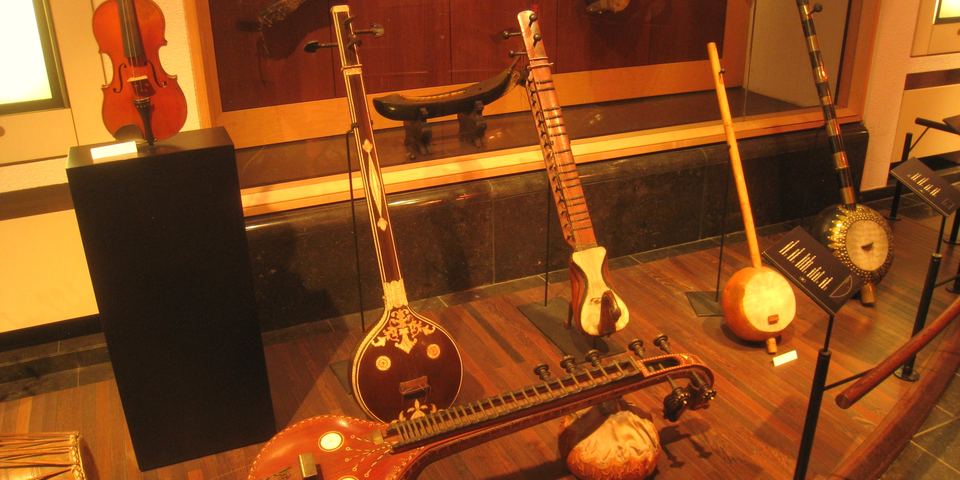
Indian music has two classical traditions. Hindustani music belongs to the north, and Carnatic music belongs to the south. Both build melody on the raga and rhythm on the tala. A drone on Sa, the tonic, sounds beneath them. India also has many folk traditions, devotional songs and the songs of its films.
A sitar plays a raga melody over the tabla. Listen to the two drums of the tabla. The small drum rings high, and the strokes of the large drum are deep and can slide in pitch.
Music: Envato (India_Happy)
A raga is a melodic framework. It sets the swaras, the notes of Indian music, and the ways they rise and fall. Its phrases make it recognizable. Singers and players improvise within it.
The seven swaras are Sa, Re, Ga, Ma, Pa, Dha and Ni. Sa is the tonic, and the musician chooses its pitch.
A tala is a cycle of beats that repeats through a piece. The tabla keeps the tala in Hindustani music. The mridangam keeps it in Carnatic music.
Play the basic stroke pattern, or theka, of a tala on the tabla. Add the tanpura beneath it.
Hindustani music is the classical music of northern, eastern and central India. It is also the classical music of Pakistan and Bangladesh. It took in ideas from Persian music, and the Mughal courts supported its musicians.
Dhrupad is its older vocal form, and khyal is the main modern form. Tarana, a song at a medium or fast tempo, often comes near the end of a concert. Thumri is a lighter classical song.
Its instruments include the sitar, the sarod, the bansuri, the santoor, the sarangi and the shehnai. The tabla and the pakhavaj are its drums. Schools of style called gharanas pass the music from teacher to student.
Carnatic music is the classical music of South India. It belongs to Tamil Nadu, Kerala, Karnataka, Andhra Pradesh and Telangana. It is learned and performed mainly through composed songs. The kriti is the chief form among them. Instruments, too, play in a singing style.
Tyagaraja, Muthuswami Dikshitar and Syama Sastri are honored as the Trinity of Carnatic composers. Carnatic theory groups its ragas under seventy-two parent scales called melakartas.
A typical group has a singer, a violin, a mridangam and a tambura for the drone. The veena, the venu flute, the ghatam and the kanjira are also heard. A concert often opens with a varnam.
A drone holds Sa, and usually Pa, beneath the music. Singers tune all their notes against it. The tanpura plays the drone with plucked strings. The shruti box plays it with reeds that sound without a break.
The regions of India have their own folk music. Punjab has bhangra and giddha. Assam has the songs of Bihu, and Gujarat has garba and dandiya raas. Maharashtra has lavani, which is sung to the dholaki drum.
In Rajasthan, the Manganiyar and Langa communities perform the folk music of the region. The kamayacha and the sarangi are two of its bowed string instruments.
The Bauls are mystic minstrels of rural Bangladesh and West Bengal. They sing to the one-string ektara and to the dotara lute. UNESCO lists Baul songs as intangible heritage.
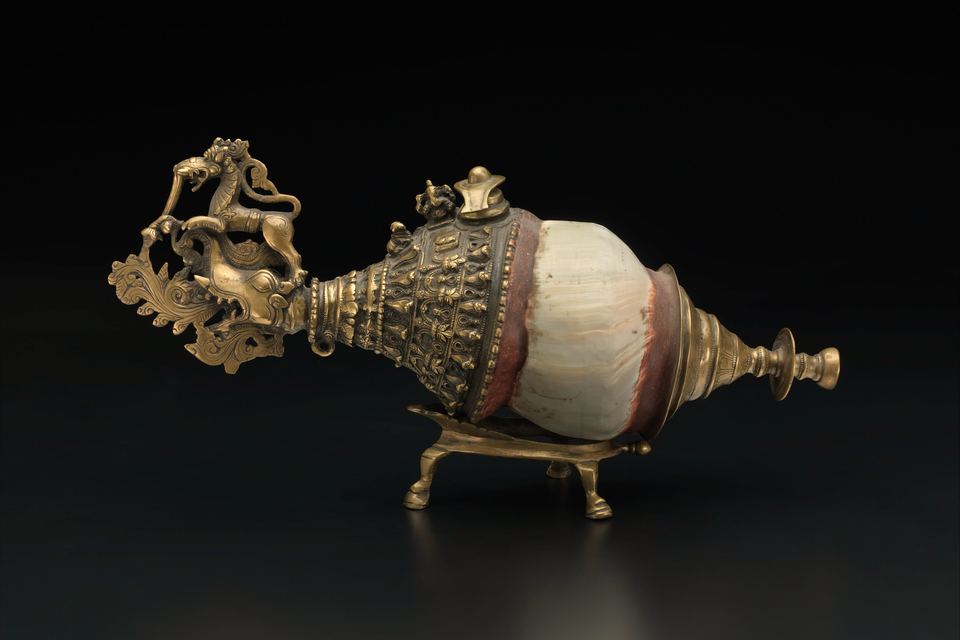
The shankh, written शङ्ख in Sanskrit, is a conch shell blown as a horn. It is the shell of a large sea snail of the Indian Ocean. The maker cuts a hole at the pointed end of the spiral to turn the shell into a horn. The player buzzes the lips against the hole, as on a trumpet. The air travels through the coils of the shell and comes out as a loud, piercing call.
In Hindu temples and homes the shankh sounds during worship. It is heard above all in the aarti, when lamps are waved before the deity. It is an emblem of Vishnu, whose own conch is called Panchajanya. In the past the shankh gave the signal for battle. The Bhagavad Gita is a sacred Hindu poem. In it the warriors blow their conches before the fighting begins. Buddhists count the conch among their eight auspicious symbols.
The hymns of the Samaveda, one of the four Vedas, were sung. Priests still pass on the chanting of the Vedas by ear. They keep its exact accents and pronunciation. UNESCO lists the tradition of Vedic chanting as intangible heritage.
Songs from Indian films make up most of the music sold in India. Playback singers record the songs, and the actors mime them on screen.
Choose one answer per question.
Which tradition is the classical music of South India?
Carnatic music belongs mainly to South India. Hindustani music belongs to the north.
What does a tala organize?
A tala is a cycle of beats. The raga organizes the melody.
Which instrument usually plays the drone in a classical concert?
The tanpura sounds Sa and Pa again and again beneath the music.
Hindustani music comes from North India, Pakistan and Bangladesh. Carnatic music comes from South India.
Both use raga and tala. Carnatic music centers on composed songs and the voice. Their instruments differ: Hindustani music uses the sitar and the tabla, and Carnatic music uses the veena and the mridangam.
The sitar, sarod, bansuri, santoor and tabla are central to Hindustani music. The veena, violin, mridangam and ghatam are central to Carnatic music. The tanpura plays the drone in both.
Its oldest roots lie in the sung hymns of the Samaveda. Hindustani music later took in Persian ideas. Carnatic music took its teaching system from Purandara Dasa and many of its best-known songs from the Trinity.
The notes are Sa, Re, Ga, Ma, Pa, Dha and Ni. Re, Ga, Dha and Ni also have a lower form, and Ma has a higher form.
It is the music of the regions and communities of India. Examples include bhangra in Punjab, Bihu songs in Assam, lavani in Maharashtra and the Baul songs of Bengal.