Tanpura drone
The tanpura sounds Sa and Pa beneath your singing. You choose its key.
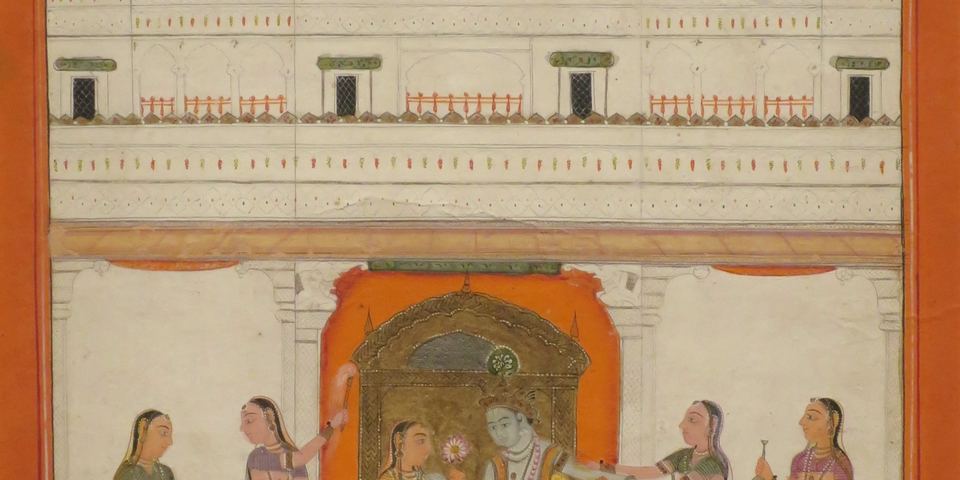
Raag Bhairav is a raga of the early morning, and Bhairav thaat takes its name from it. It uses all seven swaras. Re and Dha are komal, or lowered. Ga, Ma and Ni are shuddha, or natural. With Sa on C, the notes are C, D♭, E, F, G, A♭ and B. Its most important notes are Dha and Re.
The aroh is the way up, and the avroh is the way down. Bhairav uses all seven swaras in both directions. Komal means a half step lower than the usual pitch. Shuddha means natural.
In the sargam below, a lowercase name marks a komal swara: re and dha. A dot over Sa marks the upper Sa. The notes are given with Sa on C.
| Phrase | Sargam | Notes | Listen |
|---|---|---|---|
| Aroh | Sa re Ga Ma Pa dha Ni Ṡa | C D♭ E F G A♭ B C | |
| Avroh | Ṡa Ni dha Pa Ma Ga re Sa | C B A♭ G F E D♭ C | |
| Pakad | Ga Ma dha dha Pa, Ga Ma re re Sa | E F A♭ A♭ G, E F D♭ D♭ C |
The pakad is the short phrase that makes a raga recognizable. A common pakad of Bhairav rises from Ga through Ma to dha. It rests on dha and falls to Pa. Its second phrase moves from Ga and Ma down to re, rests on re and closes on Sa.
Sing it slowly over a drone. Give dha and re a little extra length.
The tanpura sounds Sa and Pa beneath your singing. You choose its key.
Andolan is a slow, gentle swing of the pitch around a swara. In Bhairav, singers swing komal re and komal dha.
The piano plays fixed pitches, so it gives only the outline of the phrases. A singer or a flute player adds the swing.
In this recording, a flute plays a melody in another raga, so its notes differ from the scale of Bhairav. Listen for the bends in its pitch. Bends of this kind give komal re and komal dha their slow swing in Bhairav.
Music: Envato (KabbalisticVillage)
The vadi, the most important swara of Bhairav, is komal Dha. The samvadi, the second most important swara, is komal Re. With Sa on C, they are A♭ and D♭.
Bhairav belongs to dawn, which is the first part of the day. Morning concerts traditionally open with it.
Carnatic music has the same scale in Mayamalavagowla, which is the fifteenth melakarta. A melakarta is a parent scale of Carnatic music. Students of Carnatic music sing their first exercises in Mayamalavagowla.
In Western music, the same notes form the double harmonic scale. It has two steps of three half steps apiece. With Sa on C, they lie from D♭ to E and from A♭ to B.
Bhairavi is a different raga. It makes Re, Ga, Dha and Ni komal. Bhairav lowers only Re and Dha, and it keeps Ga and Ni shuddha.
Choose one answer per question.
Which swaras of Bhairav are komal?
Re and Dha are komal. Ga, Ma and Ni are shuddha, and Sa and Pa never change.
Which swara is the vadi of Bhairav?
Komal Dha is the vadi. Komal Re is the samvadi.
When is Bhairav traditionally sung?
Bhairav belongs to the hours around sunrise.
Bhairav uses Sa, komal Re, shuddha Ga, shuddha Ma, Pa, komal Dha and shuddha Ni. With Sa on C, they are C, D♭, E, F, G, A♭ and B.
A common pakad is Ga Ma dha dha Pa, Ga Ma re re Sa. Teachers also use other short phrases.
It belongs to Bhairav thaat. The thaat has the same seven swaras and takes its name from this raga.
Most sources give komal Dha as the vadi and komal Re as the samvadi.
The two ragas share one scale. The traditions give it their own phrases and ornaments.
Hindustani tradition links the ragas to times of day, and it places Bhairav near sunrise.