Tala player
Choose Keherwa and a medium tempo, and press play. Keherwa is a cycle of eight beats in two groups of four. Clap on the first beat, and wave your open hand on the fifth.
Qawwali is the devotional song of the Sufis of South Asia. A lead singer and a chorus sing poems of love for God, the Prophet Muhammad and the Sufi saints. A harmonium carries the melody. The tabla, the dholak and the handclaps of the chorus keep the rhythm. Qawwali is sung at Sufi shrines in Pakistan, India and Bangladesh.
Kali Jan of Delhi sings a qawwali in an early recording of the Gramophone Company. Its words praise Muinuddin Chishti. He is the Sufi saint whose shrine stands at Ajmer. The old disc carries some hiss.
Sufism is the mystical tradition of Islam. Its followers seek nearness to God through love and devotion. Sama means listening. A gathering of sama is a gathering for listening to sacred song.
Qawwali is sung at such gatherings. Its purpose is the remembrance of God. This remembrance is called dhikr. Some listeners reach a state of rapture called wajd. A shrine, or dargah, is the tomb of a Sufi saint. Qawwals sing there above all on the urs. The urs is the yearly anniversary of the saint’s death.
Tradition credits qawwali to Amir Khusrau. He was a poet and musician of Delhi in the Middle Ages and a disciple of Nizamuddin Auliya. Nizamuddin Auliya was a saint of the Chishti order of Sufis. Khusrau joined Persian poetry with the ragas of India.
Khusrau wrote devotional poems in Persian and in Hindavi. Hindavi is an early form of Hindi and Urdu. Qawwals sang them at the gatherings for listening held in the lodge of Nizamuddin Auliya in Delhi. Man Kunto Maula is among the oldest songs linked to Khusrau. It is a qaul, which is a song that sets a saying of the Prophet. The saying is about Ali, who was the cousin and son-in-law of the Prophet. In the early gatherings the Chishti masters allowed no instruments. The harmonium, the tabla and the dholak entered qawwali much later.
The word qawwali comes from the Arabic qawl, which means a saying. A qawwal is a singer of qawwali. Many qawwals belong to families that have sung at the same shrine for generations.
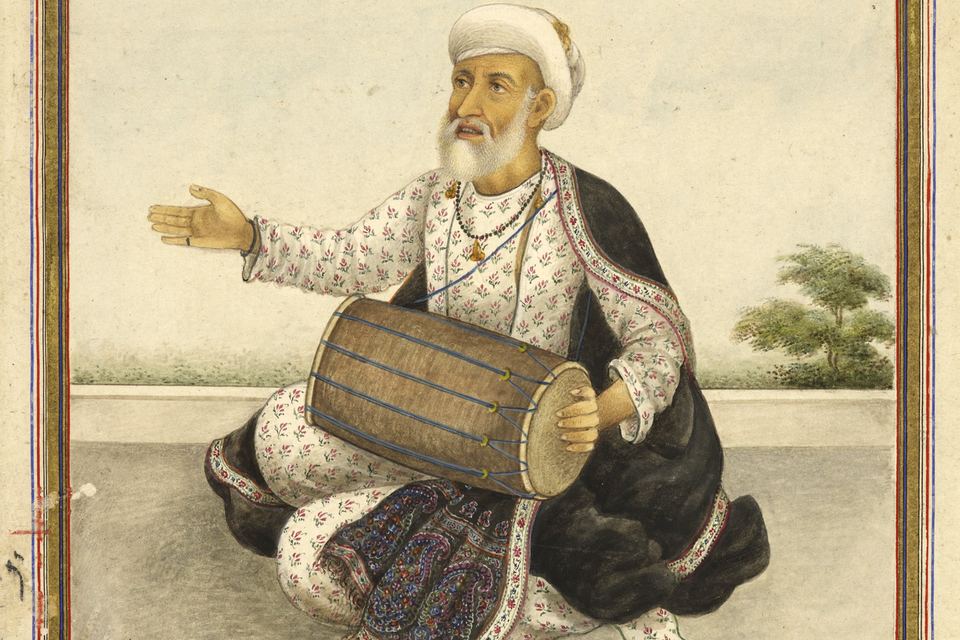
A group of qawwali musicians is called a party. It usually has eight or nine men. A lead singer is joined by one or two side singers. The party has one or two harmoniums for the melody, and the lead singer often plays one. A tabla and a dholak, a barrel drum with two heads, play the rhythm. A chorus of four or five men repeats the main lines and claps the beat.
The musicians sit cross-legged on the ground in two rows. The singers and the harmoniums sit in front. The chorus and the drummers sit behind them. In earlier times a bowed string instrument called the sarangi played the melody. The harmonium needs no retuning between songs, so it took the place of the sarangi.
The two recordings below are not qawwali. They let you hear two instruments of the party on their own: a harmonium from India holding a chord, and a tabla.
Almost all qawwalis rest on a raga. A raga is a melodic framework of Hindustani music. A performance opens with a prelude on the harmonium, and the tabla often joins it. Next comes an alap. The alap is a slow, free opening on long notes of the raga.
The lead singer then sings verses without a beat. Only the harmonium follows him. A side singer repeats the verses in his own way. These verses lead into the main song.
With the main song, the tabla, the dholak and the clapping begin. The whole party sings the refrain. The song grows faster and more intense, and it often ends suddenly.
Qawwals sing loudly and with great force. The chest voice is the full, low register that people use in speech, and the head voice is the lighter, higher register. Qawwals carry the chest voice much higher than Western singers usually do. They make no break between the chest voice and the head voice. When a word begins with m, the singer often holds the humming m before the vowel opens. The words of the main verses are never improvised. The singers improvise the melody around them within the raga. At the height of a song, some lead singers add fast passages of sargam. Sargam is the system of Indian note names.
Qawwalis are sung mainly in Persian, Urdu and Hindi. Some are in Punjabi, Saraiki or Braj Bhasha. A qaul sets a saying of the Prophet, and it often opens or closes a gathering. A hamd praises God, and a naat praises the Prophet. A manqabat praises Imam Ali or a Sufi saint.
The ghazal is a poem of separate couplets about love and longing. Images of wine and of a lover far away stand for the soul that longs for God. A kafi is a Sufi poem in Punjabi, Saraiki or Sindhi.
The Gramophone Company recorded singers in India from the first years of the gramophone. Its engineers recorded on single-sided discs in Calcutta and other Indian cities. A side held about three minutes of music. A qawwali at a shrine can last far longer. A commercially released qawwali by Aziz Mian lasts nearly two hours. Singers in the recording room therefore sang a short form of their songs.
Kali Jan of Delhi made this recording in those first years. The copy heard here is a later pressing on the company’s His Master’s Voice label. The paper label on the disc calls the song a qawwali in Urdu script. The other side carries a bhajan, which is a Hindu devotional song.
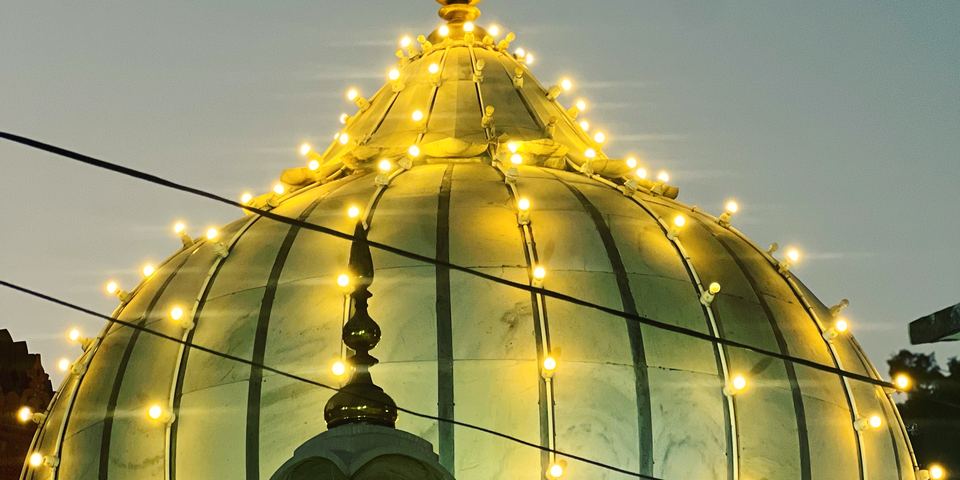
The shrine of Nizamuddin Auliya in Delhi is a center of Sufi life in India. A white dome rises over the tomb of the saint. Beside the shrine stands the Urs Mahal, a hall that serves as a stage for qawwali. On the urs of the saint, thousands of visitors gather, and the tombs are lit with lamps. The tomb of Amir Khusrau lies within the same complex.
At Ajmer in Rajasthan stands the shrine of Muinuddin Chishti. He spread the Chishti order across India. Hundreds of thousands of pilgrims attend its urs. Qawwals who serve such shrines learn the music in a brotherhood of performers. Their families hand the songs of the shrine from one generation to the next.
In the twentieth century qawwali reached concert halls and recordings. Nusrat Fateh Ali Khan of Pakistan and the Sabri Brothers took qawwali to Europe and America. Both sang at world music festivals. Indian and Pakistani films also adopted the form in film qawwali.
Most qawwals are still men, and families of qawwals still serve the shrines. Some women now sing qawwali as well.
Listen first for the verses without a beat. Notice how the side singer answers the lead singer. When the drums enter, clap softly with the chorus on the beat.
Follow one line of the refrain whenever it returns. Notice how the singers vary it as the song grows faster. On the early disc, listen for the words that come back again and again. Qawwals repeat a phrase as a form of dhikr. Dhikr is the remembrance of God.
Choose Keherwa and a medium tempo, and press play. Keherwa is a cycle of eight beats in two groups of four. Clap on the first beat, and wave your open hand on the fifth.
Choose one answer per question. The explanation appears below the correct answer.
Where is qawwali traditionally sung?
Qawwali is sung at gatherings for listening at Sufi shrines. These shrines are called dargahs.
Which instrument carries the melody in a qawwali party?
The harmonium carries the melody. The tabla, the dholak and the handclaps keep the rhythm.
What happens when the main song begins?
The opening verses are sung without a beat. With the main song, the tabla, the dholak and the clapping begin.
It is a form of Sufi devotional song from South Asia. A party of singers and drummers performs it, most often at the shrines of Sufi saints.
Tradition credits Amir Khusrau. He was a poet of Delhi and a follower of the Chishti saint Nizamuddin Auliya.
Qawwali uses the harmonium, the tabla and the dholak. The chorus adds handclaps.
Most qawwalis are in Urdu, Persian or Hindi. Others use Punjabi, Saraiki and the dialects of northern India.
A ghazal is a form of poem. Qawwals sing many ghazals, but qawwali is the devotional performance as a whole.
The music builds toward a state of rapture in the singers and the listeners. Its speed and intensity rise toward the end.
A qawwali at a shrine often lasts a long time, and some recordings run for more than an hour. The earliest discs held only about three minutes on a side.
World MusicIndian musicTablaTeentaalLevel 2
