The harmonium (हारमोनियम)
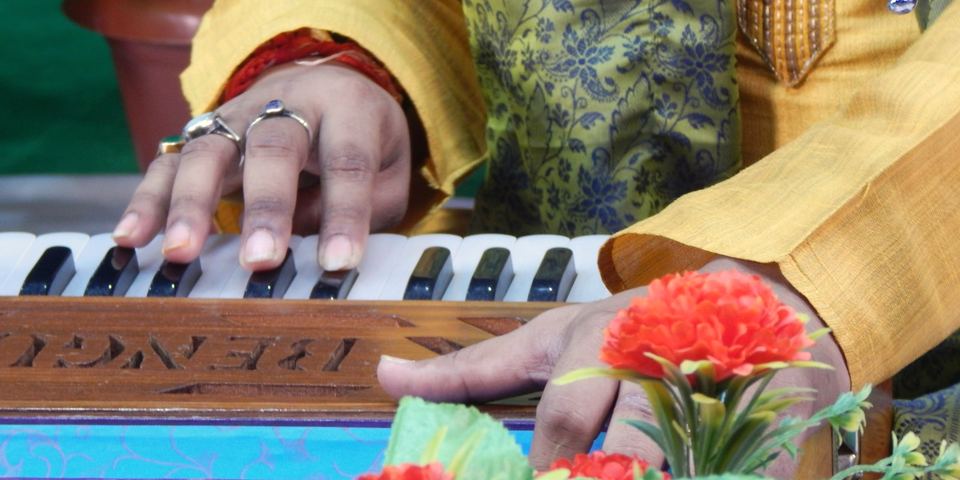
The harmonium is a small keyboard with metal reeds and hand bellows. In South Asia it accompanies classical song and the sung love poem called the ghazal. It also accompanies bhajan and kirtan, which are hymns of Hindus and Sikhs. Muslim singers of qawwali use it too. The player pumps the bellows with one hand and plays with the other.
Bhai Sainditta plays a theatrical tune on the harmonium. The Gramophone Company recorded it in India in the early years of the gramophone. The tune fills both sides of the disc, and the hiss of the old record can be heard.
The sound of the harmonium
The recording at the top of the page is a harmonium solo on an early disc of the Gramophone Company. It is a theatrical tune, which means a song melody from the stage of its time. The harmonium plays it with no singer. Listen for the steady tone of the notes. The bellows keep the air flowing, so a held note does not fade as a piano note does. The first side ends after about three minutes, and the second side carries the tune on.
The first button below plays the early disc again. The second button plays a drone on a modern harmonium made in India. A drone is one note held under the music. The other buttons play single keys of another harmonium. Those keys play the sargam with Sa on C. They rise from Sa to the upper Sa. Sargam is the set of Indian note names: Sa, Re, Ga, Ma, Pa, Dha and Ni.
Names of the harmonium
The name harmonium comes from France, where a maker of reed organs chose it for his patent. In Hindi the instrument is हारमोनियम (harmonium). Players also call it the peti, which means box, or the vaja. A harmonium with strings added for resonance is called the samvadini.
Harmonium players have their own names for the keys. A white key is safed, and a black key is kali. Both sets are counted upward from C, so C is Safed 1 and C♯ is Kali 1.
History of the harmonium
The harmonium grew from the free reed of the Chinese sheng. A free reed is a thin metal strip that sounds when air flows past it. The sheng is a mouth organ, and it reached Europe in the eighteenth century. French makers built keyboard instruments with free reeds early in the nineteenth century. Alexandre Debain of Paris then patented his design under the name harmonium. European harmoniums were large. The player sat on a chair and pumped the bellows with pedals. They became common in small churches and homes, where a pipe organ cost too much.
Reed organs reached India in the middle of the nineteenth century, probably with missionaries or traders. Indian musicians play seated on the floor, and a melody needs only one hand. Indian craftsmen therefore made the harmonium small enough to rest on the floor. They moved the bellows to the back, where the left hand works them. They added drone stops, because a drone lies beneath most Indian music. Dwarkanath Ghose founded the firm of Dwarkin in Kolkata, which was then called Calcutta. He is often counted among the first makers of this hand harmonium.
The new instrument was light and reliable, and it spread quickly. It accompanied the songs of the theater and of professional women singers. It can be heard on the early Indian discs of the Gramophone Company. The music schools of the early twentieth century used it to teach ragas to large classes. Critics objected that a harmonium cannot glide between notes. All India Radio kept it off the air for about three decades. Singers went on using it all the same, and it became the usual companion of North Indian classical song. Today it is played across India, Pakistan and Bangladesh.
The role of the harmonium in music
The harmonium supports singers. The player follows the melody of the song and fills the spaces between its phrases.
It is central to Sufi qawwali. Sikhs, Hindus and Muslims also use it in devotional singing. It is easy to learn and suits group singing. For these reasons it also became the usual companion of khyal. Khyal is the main form of North Indian classical song. Some musicians play the harmonium as a solo instrument too, as on the early disc above.
Music for the harmonium
A key of the harmonium sounds one fixed pitch. It cannot make a meend or a gamak. A meend is a glide between notes, and a gamak is a shake on a note. Many expert listeners still prefer the sarangi beside a voice, because its bowed strings can glide.
Harmonium players answer with ornaments of their own. They play quick grace notes, fast turns and rapid repeated notes. Solo players also borrow the strokes and fast passages of string playing. A modern design adds a set of strings that ring with the reeds. Another design adds a second, slightly higher reed to some keys. The player can then choose the pitch that a raga needs.
How the harmonium is made
The sound comes from free reeds made of brass. A reed swings through a close-fitting slot when air flows past it. A key opens the way to its own reed. The reeds sit on a wooden reed board inside the case.
The bellows at the back pump air into a small reservoir inside the harmonium. The reservoir evens out the strokes of the hand, so the reeds sound without a break. Most Indian harmoniums have thirty-nine or forty-two keys. That range is a little over three octaves. Knobs on the front, called stops, open whole sets of reeds. Smaller drone stops let a single reed sound without a key. It sounds for as long as the bellows move.
A coupler sounds a note together with the note an octave away. Many harmoniums have two sets of reeds. Players call the lower set bass and the higher set male. The male set sounds an octave above the bass set. Some makers add a scale changer. It slides the keyboard over the reeds, so a singer can move a song to another key with the same fingering.
How the harmonium is played
The player sits on the floor with the harmonium in front. The left hand opens and closes the bellows at the back, and the right hand plays the keys.
Even strokes of the bellows keep the tone steady. Gentle pumping gives a soft tone, and stronger pumping gives a louder one. A drone stop set on Sa holds that note under the melody. Good players change the force of the bellows within a phrase, so the music swells and falls like a voice.
What makes a fine harmonium
Players judge a harmonium first by its reeds. They are brass, and they must be tuned and set at the right height in their slots. A well-made reed speaks at once and holds its pitch at a soft or a strong pressure. Brass reeds made in Germany for Indian harmoniums are the most prized. They are known for their tone and their steady tuning. The factory in Germany that made them stopped production long ago, so players seek them in older instruments.
The number of reed sets shapes the sound too. A harmonium may have one, two or three sets of reeds. Added sets make the tone fuller, and the stops let the player choose among them.
The bellows must be airtight and smooth. A good bellows opens and closes evenly. No air should hiss from it. The keys must spring back at once, and no key should let a reed sound faintly when it is up. The size of the case matters as well. A small harmonium has a smaller sound box, so its tone is thinner and fades sooner.
Choosing a harmonium
Count the keys and the reed sets first. Forty-two keys give more range than thirty-nine, and two reed sets give a fuller tone than one.
For a first instrument, a harmonium with drone stops is enough. A coupler doubles the notes at the octave, so the sound is fuller. A scale changer helps singers who often change key, but it adds weight and cost. Play the keys in turn with the bellows pumped evenly, and listen for any reed that is out of tune or slow to speak.
Who keeps these instruments
Workshops in Kolkata built the first Indian hand harmoniums. Dwarkin, founded there by Dwarkanath Ghose, began as a firm that tuned and repaired pianos and then made hand harmoniums. Workshops in Delhi and Lahore later built harmoniums as well.
Amgueddfa Cymru, the National Museum of Wales, holds a portable harmonium with handles that Welsh missionaries used in the Khasi Hills of India. The London Museum holds a harmonium given by an Indian community association in London. Recordings keep the sound of the early players. Collectors have restored many Gramophone Company discs, and the Internet Archive offers them freely. The harmonium solo above is one of them.
How to learn the harmonium
Harmonium classes begin with posture and the bellows. Sit on the floor with the harmonium square in front of you. Pump with the left hand in long, even strokes, so that the tone does not waver.
Next, find Sa. This page uses Sa on C, which harmonium players call Safed 1. Play the sargam from Sa to the upper Sa with the right hand, and sing the swaras as you press their keys. A swara is a note of Indian music.
Then learn the alankars. An alankar is a short pattern of swaras that climbs and falls through the scale. The pattern Sa Re Ga, Re Ga Ma, Ga Ma Pa is an example. After that, learn the aroh and the avroh of a raga. The aroh is the rising order of its notes, and the avroh is the falling order.
A teacher shows you how to follow a singer and when to play between the phrases. In our curriculum, the Hindustani path begins in the Level 3 course. Practice daily over the drone of a shruti box or a tanpura, so that you learn to hear Sa.
| Swara | Note | Harmonium name |
|---|---|---|
| Sa | C | Safed 1 |
| Re | D | Safed 2 |
| Ga | E | Safed 3 |
| Ma | F | Safed 4 |
| Pa | G | Safed 5 |
| Dha | A | Safed 6 |
| Ni | B | Safed 7 |
| Upper Sa | C | Safed 1 |
A short check
Choose one answer per question. The explanation appears below the correct answer.
What makes the sound of a harmonium?
Air from the bellows passes a free reed, and the reed swings through its slot.
Which key is Safed 1 on the harmonium?
Safed means white. The white keys are counted from C, so C is Safed 1.
Why can a harmonium not play a meend?
A meend glides through the pitches between two notes. A key of the harmonium sounds one fixed pitch.
Why did Indian makers move the bellows to the back of the harmonium?
Indian musicians play seated on the floor. A melody needs only one hand, so the other hand can pump the bellows.
Sources
- Wikipedia: Pump organ (harmonium)
- Wikipedia: Indian harmonium
- Wikipedia: Dwarkin
- Wikipedia: German Jubilate harmonium reeds
- Open magazine: the rise and the sudden fall of the harmonium
- Amgueddfa Cymru, Museum Wales: harmonium used in Khasia
- London Museum: harmonium
- Internet Archive: Theatrical Tune (on Harmonium)
- Internet Archive: Imman Kalyani (Gramophone Company)
Common questions
Is the harmonium hard to learn?
In the first lessons a student learns to pump evenly and to play the sargam from Sa to the upper Sa. Following a singer through a raga takes years of practice.
Can I learn the harmonium online?
You can learn the sargam, the alankars and the aroh of a raga from recordings and practice tools. A teacher who watches you play, in person or by video, corrects posture and timing.
What is the difference between a harmonium and a piano?
A piano strikes strings with hammers, and its notes fade. A harmonium sounds reeds with air, so a note lasts while the key is down and the bellows move.
How many keys does a harmonium have?
Indian harmoniums usually have thirty-nine or forty-two keys. Both sizes cover a little over three octaves.
What is a scale changer?
It is a mechanism that slides the keyboard over the reeds. The player can then move a song to a new key and keep the same fingering.
Is the harmonium used in Hindustani classical music?
Yes. It accompanies khyal and the lighter classical forms. Some musicians prefer the sarangi, which can glide between notes.
Why was the harmonium banned on All India Radio?
Critics held that its fixed pitches could not show the glides and fine shades of a raga. The national broadcaster kept it off the air for about three decades.
What are German reeds in a harmonium?
They are brass reeds that a German factory once made for Indian harmoniums. Players prize them for their tone and steady tuning.
World MusicShruti boxSargamSarangiLevel 3 course