Tanpura drone
Set the tanpura to your own Sa. Its Sa and Pa ring under the aroh as you sing.
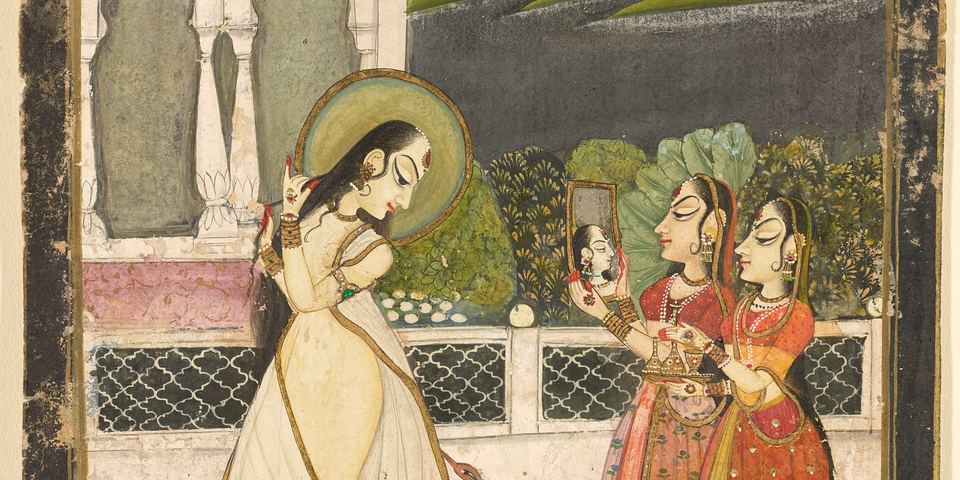
Raag Bilawal is a morning raga that uses all seven swaras in their shuddha, or natural, form. Its aroh is Sa Re Ga Ma Pa Dha Ni Ṡa. Its avroh comes back down through the same swaras. With Sa on C, these are the white keys from C to C. Its most important notes are Dha and Ga.
Aroh means the rising line of a raga, and avroh means the falling line. Bilawal is the raga that gives Bilawal thaat its name. This thaat is the parent scale whose swaras are all shuddha.
A dot over Sa marks the upper Sa. Bilawal has no komal swaras, so all the names in its sargam begin with a capital letter. The note names in the third column take C as Sa.
| Phrase | Sargam | Notes | Listen |
|---|---|---|---|
| Aroh | Sa Re Ga Ma Pa Dha Ni Ṡa | C D E F G A B C | |
| Avroh | Ṡa Ni Dha Pa Ma Ga Re Sa | C B A G F E D C | |
| Pakad | Ga Re Ga Pa, Ni Dha Ni Ṡa | E D E G, B A B C |
The pakad is a short phrase by which listeners recognize a raga. A common pakad of Bilawal turns from Ga to Re and back, and it leaps up to Pa. Its second phrase climbs to the upper Sa through a turn on Ni and Dha.
Bilawal often rests on Sa, Ga and Pa. With Sa on C, these are C, E and G. They are the notes of the C major chord.
Set the tanpura to your own Sa. Its Sa and Pa ring under the aroh as you sing.
The vadi is the most important swara of a raga, and the samvadi is the second. In Bilawal the vadi is Dha and the samvadi is Ga. With Sa on C, they are A and E.
Bilawal belongs to the morning. Some books place it at dawn, and others place it later in the morning.
Alhaiya Bilawal is a close relative of Bilawal. It leaves out Ma in the aroh. In the avroh, it adds komal ni in a short turn between two Dhas. Komal ni lies a half step below Ni.
Its aroh is Sa Re Ga Pa Dha Ni Ṡa. Its avroh is Ṡa Ni Dha ni Dha Pa Ma Ga Re Sa.
Bilawal has the same notes as the major scale of Western music. With Sa on C, it is the C major scale. In Carnatic music, the same scale is Dheerasankarabharanam, which is the twenty-ninth melakarta. It is often called Shankarabharanam for short.
Set a drone on Sa. Sing the aroh slowly, one swara to a beat, and hold the upper Sa. Sing the avroh at the same speed. When all the swaras sound in tune against the drone, sing the pakad.
Choose one answer per question.
How many komal swaras does Raag Bilawal use?
Bilawal uses all seven swaras in their shuddha form, so it has no komal swaras.
Which swara is the vadi of Bilawal?
Dha is the vadi, and Ga is the samvadi.
Which swara does Alhaiya Bilawal leave out of the aroh?
Alhaiya Bilawal rises Sa Re Ga Pa Dha Ni Ṡa. It leaves out Ma on the way up.
The aroh is Sa Re Ga Ma Pa Dha Ni Ṡa. With Sa on C, it climbs C, D, E, F, G, A, B and C.
The avroh is Ṡa Ni Dha Pa Ma Ga Re Sa. With Sa on C, it falls from the upper C through the white keys to the lower C.
A common pakad is Ga Re Ga Pa, Ni Dha Ni Ṡa. Books give several other short phrases as well.
Alhaiya Bilawal skips Ma on the way up and adds a touch of komal ni on the way down. Bilawal uses only shuddha swaras.
Its notes match the major scale. The raga adds its own phrases, its resting notes and its time of day.
It is a morning raga.