Metronome
A cycle of dhamar lasts fourteen clicks. Start near sixty clicks a minute.
Dhamar taal is a Hindustani tala of fourteen matras, or beats. The cycle has four sections, called vibhags, of five, two, three and four matras. Players clap on matras one, six and eleven. They wave on matra eight. That matra is called khali, which means empty. Dhamar belongs to the dhrupad tradition.
Miss Hira sings a dhrupad in Raag Kedar on this early record. Dhamar songs are lighter in mood than dhrupad. Compare this dhrupad with the dhamar recording in the section on songs.
The theka is the set pattern of drum syllables, or bols, for one cycle. In dhamar, a dash marks a matra on which the drum rests. The sound of the stroke before it rings on.
Books spell some bols in more than one way. Ta is also written Te, and Ga is also written Gi. The claps and the wave stay the same.
| Vibhag | Matras | Bols | Hand |
|---|---|---|---|
| First | 1 to 5 | Ka Dhi Ta Dhi Ta | Clap on sam, marked X |
| Second | 6 to 7 | Dha – | Clap, marked 2 |
| Third | 8 to 10 | Ga Ti Ta | Wave on khali, marked 0 |
| Fourth | 11 to 14 | Ti Ta Ta – | Clap, marked 3 |
The vibhags of dhamar have different lengths. Count them as one to five, one to two, one to three and one to four. The long first vibhag makes the cycle feel uneven.
Jhumra is another tala of fourteen matras. It groups them three, four, three and four. The places of the claps tell the two talas apart.
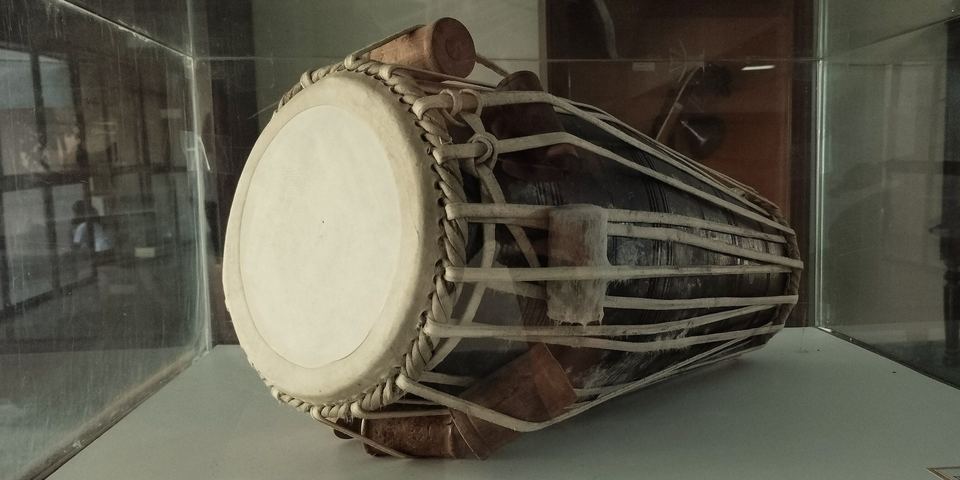
The pakhawaj is a barrel-shaped drum with a skin at both ends. The player sits cross-legged and lays it flat in front of the body. The larger skin gives a deep bass. Players put fresh wheat dough on it to deepen the sound.
Dhrupad is the oldest surviving form of Hindustani classical song, and the pakhawaj is its drum. Its deep strokes give dhrupad its weight. Tabla players also play dhamar, and they borrow the strokes of the pakhawaj.
A song in the dhrupad style set to this tala is also called a dhamar. Its words tell of Krishna teasing the milkmaids at Holi. Holi is the spring festival of colors. For this reason such songs are also called hori.
The recording comes from an early gramophone disc made in India. A singer of Bengal performs a dhamar. The old disc is noisy, and the drum cannot be heard on it.
Laya means tempo. Dhamar is sung at slow and medium tempos. Jhaptal and rupak are common in faster pieces.
Set the metronome to a slow tempo, and let one click stand for one matra. Count one to five, and clap on one. Count one and two, and clap on the first. Count one to three, and wave on the first. Count one to four, and clap on the first.
When the count is steady, speak the theka in place of the numbers. Hold a dash for one full matra.
A cycle of dhamar lasts fourteen clicks. Start near sixty clicks a minute.
Choose one answer per question. The explanation appears below the correct answer.
How are the fourteen matras of dhamar divided?
Dhamar groups its matras five, two, three and four. Jhumra has the same length, but it groups them three, four, three and four.
On which matra do you wave in dhamar?
The khali vibhag begins on matra eight. Claps fall on matras one, six and eleven.
Which drum traditionally plays dhamar?
Dhamar belongs to the dhrupad tradition, and its drum is the pakhawaj. Tabla players also play it.
Dhamar has fourteen matras. They fall into vibhags of five, two, three and four.
The first vibhag is Ka Dhi Ta Dhi Ta. The second is Dha with a rest. The third is Ga Ti Ta, and the fourth is Ti Ta Ta with a rest.
Claps fall on matras one, six and eleven. Matra eight takes a wave.
Both have fourteen matras. Dhamar is grouped five, two, three and four, and jhumra three, four, three and four.
It is a song about Holi. In the dhrupad tradition a hori is sung in dhamar taal, and it is also called a dhamar.
Yes. Its main drum is the pakhawaj, but tabla players also accompany dhamar. They often play in the heavier pakhawaj style.