Ragas
This page explains what a raga is and how it differs from a scale.
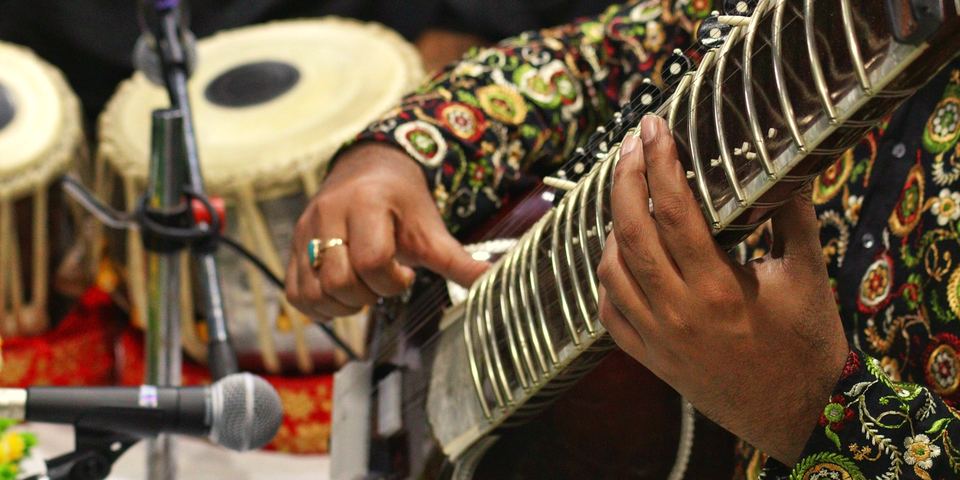
Hindustani music is the classical music of northern India. Pakistan and Bangladesh share it as their classical music. Its melody is built on the raga, and its rhythm on the tala. A drone on Sa sounds beneath the music. Singers perform it, and so do players of the sitar, the sarod and the bansuri.
A sitar plays a raga at a slow tempo. Listen for meend. The player pulls a string sideways across its fret. The pitch then glides to the next note, or swara, without a break.
Music: Envato (KabbalisticVillage)
The notes of Hindustani music are called swaras. There are seven swaras in an octave: Sa, Re, Ga, Ma, Pa, Dha and Ni. Singers call the set of swaras sargam. The word comes from the first four swaras: Sa, Re, Ga and Ma.
Sa and Pa never change. Re, Ga, Dha and Ni also have a lower form, which is called komal. Ma has a higher form, which is called tivra. With these forms there are twelve swaras in the octave. Musicians choose the pitch of Sa.
A raga is the framework of a melody. A raga has its own set of swaras and its own way of rising and falling. Its characteristic phrases let a listener recognize it. Many ragas also belong to a time of day or a season.
The pages below teach one raga apiece. The pages give the swaras in sargam and on the staff, the catch phrase called the pakad and the most important swaras.
This page explains what a raga is and how it differs from a scale.
This evening raga uses tivra Ma. Its thaat, or parent scale, is Kalyan.
This raga of the early night leaves out Ma and Ni.
This raga of dawn uses komal Re and komal Dha.
This morning raga uses four komal swaras.
This morning raga uses the seven natural swaras, which are called shuddha.
This grave raga belongs to the late night.
A tala is a fixed cycle of beats, and it repeats for the whole of a piece. A beat is a matra, and sam is the first matra of the cycle. Claps and waves of the hand mark the sections of the cycle.
The tabla keeps the tala in most performances. The pakhawaj keeps it in dhrupad.
The most common tala has sixteen matras.
This uneven cycle of fourteen matras comes from dhrupad.
The player sounds the theka of six talas on the tabla. A theka is the basic drum pattern of a tala.
Dhrupad is the oldest surviving form of Hindustani song. It is grave and strict, and it opens with a long alap. The alap is a slow opening without a beat. Khyal is the main classical form today. It gives the singer more freedom to improvise.
Tarana is a lively song at a medium or fast tempo. It is sung on syllables such as ta, na and dim. Thumri, dadra and the ghazal are lighter songs. Musicians call them light classical music. Qawwali is the devotional song of the Sufi shrines.
Plucked strings play the melody on the sitar and the sarod. The sarangi is bowed, and it follows the voice closely. The bansuri is a bamboo flute, and the santoor is struck with light hammers. The harmonium often accompanies light classical songs. The sitar recording here is a short improvisation.
Its curved frets carry the melody, and sympathetic strings ring beside them.
This fretless lute has a metal fingerboard.
Its bowed strings follow the singer closely.
This bamboo flute is blown from the side.
Light hammers strike the strings of this dulcimer from Kashmir.
The strokes of this pair of drums have spoken bols.
The player pumps the bellows with one hand and plays the keys with the other.
A drone sounds Sa without a break, and usually Pa as well. Singers and players tune the swaras against it. The tanpura plays the drone on four plucked strings. The shruti box plays it on reeds.
The drone plays in any of the twelve keys.
Its reeds can sound Sa, Pa, Ma or Ni.
The Gandharva Mahavidyalaya and the Prayag Sangeet Samiti hold graded exams in Hindustani music. Their syllabuses take a student from the first ragas and talas to advanced performance. Our exam pages give free practice questions.
Free questions prepare you for the theory paper of this level.
This page describes its levels in voice and instruments.
Start a drone on a comfortable Sa. Sing Sa and hold it until it matches the drone. Next, sing the seven swaras slowly up and down, one swara per beat.
When the swaras feel steady, learn the aroh and avroh of Raag Yaman or Raag Bhupali. The aroh is the rising order of a raga's swaras, and the avroh is the falling order. Clap teentaal while you sing.
Pick a comfortable Sa and start the drone. Sing Sa first and Pa next. Listen for the moment a note matches the drone.
South India has its own classical music. It is called Carnatic music. It also builds on raga and tala, but it centers on composed songs. Hindustani music gives more time to slow improvisation on a raga. The two traditions use different names for many ragas.
Choose one answer per question. The explanation appears below the correct answer.
What is a raga?
A raga sets the swaras of a melody and the phrases that move between them. The tala organizes the rhythm.
Which swaras never change in a raga?
Sa and Pa are fixed. Re, Ga, Dha and Ni can be komal, and Ma can be tivra.
Which instrument usually sounds the drone beneath a classical performance?
The tanpura sounds Sa and, on most instruments, Pa beneath the music. The tabla keeps the tala.
It is the classical music of North India, Pakistan and Bangladesh. Its melodies follow ragas, and its rhythms follow talas.
Both use raga and tala. Carnatic music, from South India, rests on composed songs. Hindustani music, from the north, gives long sections to improvisation.
Dhrupad and khyal are the classical forms. Thumri, dadra and the ghazal belong to light classical music.
The sitar, sarod, sarangi, bansuri and santoor play melody. The tabla and the pakhawaj are its drums, and the tanpura sounds the drone.
Begin with sargam over a drone. Learn one simple raga such as Yaman or Bhupali, and clap teentaal as you sing it.
A gharana is a school of style passed from teacher to student. A gharana has its own way of singing or playing.