Shruti box drone
The shruti box holds Sa and Pa without a break. You choose its key.
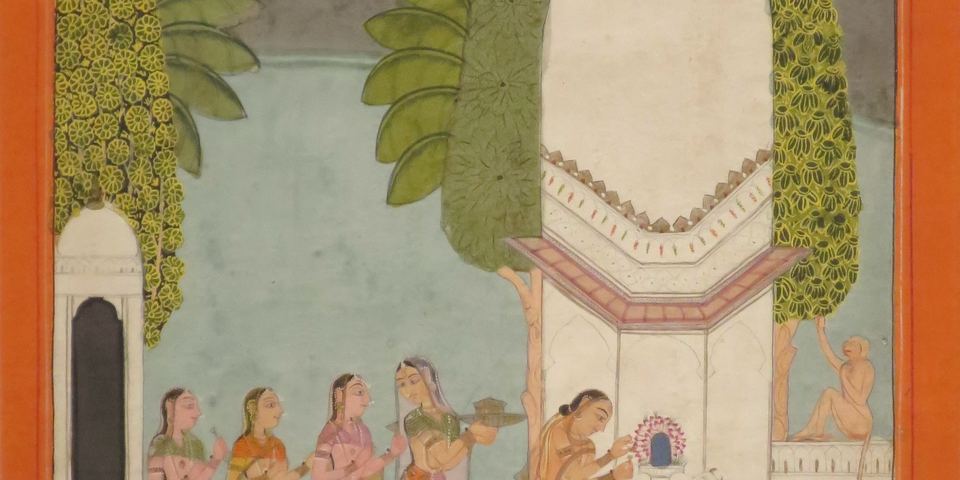
Raag Bhairavi is a morning raga of Bhairavi thaat. It uses all seven swaras. Re, Ga, Dha and Ni are komal, or lowered. Ma is shuddha, or natural. With Sa on C, the notes are C, D♭, E♭, F, G, A♭ and B♭. Its most important notes are Ma and Sa. Many concerts end with a piece in Bhairavi.
Achhan Bai sings a ghazal in Raag Bhairavi on this early record. A ghazal is a sung poem in couplets. Listen for the four komal swaras re, ga, dha and ni, which give Bhairavi its color.
The aroh is the ascent, and the avroh is the descent. Bhairavi uses all seven swaras in both. Komal means lowered by a half step. Shuddha means natural, at the swara's usual pitch.
In the sargam below, a lowercase name marks a komal swara: re, ga, dha and ni. A dot under a swara marks the lower octave, and a dot over it marks the upper octave. The notes are given with Sa on C.
| Phrase | Sargam | Notes | Listen |
|---|---|---|---|
| Aroh | Sa re ga Ma Pa dha ni Ṡa | C D♭ E♭ F G A♭ B♭ C | |
| Avroh | Ṡa ni dha Pa Ma ga re Sa | C B♭ A♭ G F E♭ D♭ C | |
| Pakad | Ma ga, Sa re Sa, ḍha ṇi Sa | F E♭, C D♭ C, A♭ B♭ C |
The pakad is a short phrase that identifies a raga. A common pakad of Bhairavi falls from Ma to ga. Next it touches re between two Sas. It closes with a rise from the lower dha and ni to Sa. Teachers give several pakads for this raga.
Sing the phrase slowly over a drone on Sa. Let Ma ring longer than the swaras around it.
The shruti box holds Sa and Pa without a break. You choose its key.
The vadi, the most important note of Bhairavi, is Ma. The samvadi, the second most important note, is Sa. With Sa on C, they are F and C. Some musicians make Dha the vadi and Ga the samvadi.
The chalan is the way a raga moves through its swaras. On the way up, Bhairavi often leaves out re, as in the phrase Sa ga Ma Pa. On the way down, it often returns through Ma ga re Sa.
Bhairavi belongs to the early morning. Concerts also close with Bhairavi, so it is heard at the end of an evening too. Some musicians sing it at any hour.
Bhairavi is a favorite raga for light classical forms. Singers use it in thumri, ghazal, tappa and the devotional songs called bhajans. A thumri is a light classical song. The recording is an early record of Abdul Karim Khan singing a thumri in Bhairavi.
Bhairavi is also the name of a thaat, which is a parent scale of seven swaras. Its swaras match those of Raag Bhairavi. Malkauns belongs to the same thaat. With Sa on E, Bhairavi thaat uses only the white keys of the piano. This scale is the Phrygian mode of Western music.
Carnatic music has its own raga Bhairavi. Its scale is different. Its Re lies a whole step above Sa. Its ascent uses the higher Dha. With Sa on C, it rises C, D, E♭, F, G, A, B♭ and C.
Its descent uses the lower Dha. With Sa on C, it falls C, B♭, A♭, G, F, E♭, D and C. The raga belongs to Natabhairavi, which is the twentieth melakarta.
The veena recordings below come from a varnam in Carnatic Bhairavi.
Choose one answer per question.
Which swara of Bhairavi is shuddha?
Ma is shuddha. Re, Ga, Dha and Ni are komal, and Sa and Pa never change.
With Sa on C, which note is komal Ga?
Komal Ga lies a half step below Ga. With Sa on C, Ga is E, so komal Ga is E♭.
When is Bhairavi traditionally sung?
Bhairavi is a morning raga. It also closes many concerts.
Bhairavi uses Sa, komal Re, komal Ga, shuddha Ma, Pa, komal Dha and komal Ni. With Sa on C, the notes are C, D♭, E♭, F, G, A♭ and B♭.
Bhairavi belongs to Bhairavi thaat. The thaat and the raga share their seven swaras.
Most sources give Ma as the vadi and Sa as the samvadi. Some musicians use Dha and Ga.
Tradition makes Bhairavi the closing raga of a formal performance. Its mood is devotional.
They are different ragas. Bhairav uses komal Re and komal Dha with shuddha Ga and Ni. Bhairavi makes all four of those swaras komal.
No. In Carnatic Bhairavi, Re lies a whole step above Sa, and Dha takes two forms. In Carnatic music, the scale of Hindustani Bhairavi is called Hanumatodi.