Metronome
Play the exercises with hands separately before you play them with hands together.
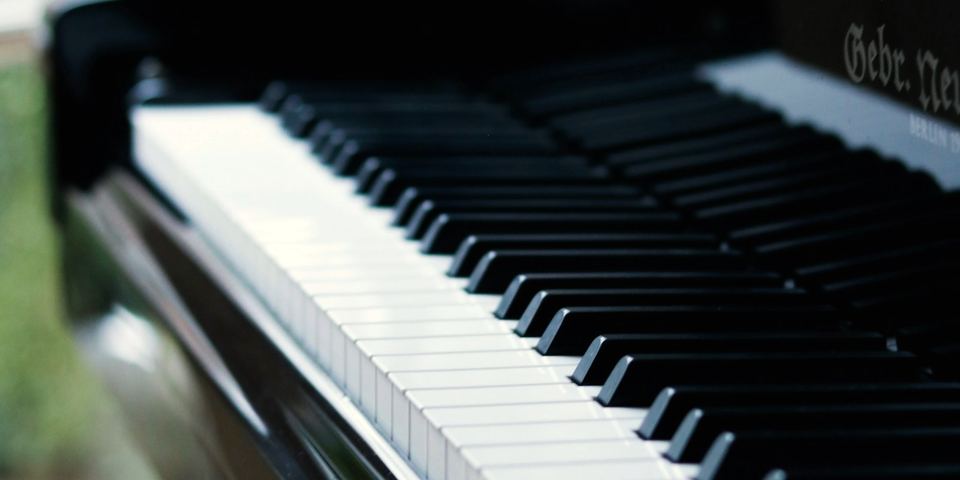
A major scale is a set of seven notes in order of pitch. It runs from the tonic to the tonic an octave higher. Its steps follow one pattern: whole, whole, half, whole, whole, whole, half. A half step goes from one piano key to the next. A whole step is two half steps.
Mozart wrote this Allegro as the first movement of his Piano Sonata in D major, K. 576. Listen for its many fast scale runs.
Music: Envato (StanNau)
A major scale takes its name from its tonic. The half steps fall between the third and fourth notes and between the seventh and eighth. All the other steps are whole steps.
The scale divides into two equal halves. Both halves are groups of four notes called tetrachords. Its steps are whole, whole, half. A whole step joins the two halves. In C major the halves are C D E F and G A B C.
The pattern fixes the sharps or flats of any key. A major scale on G needs F♯ as its seventh note, which lies a half step below G. A major scale on F needs B♭ as its fourth note, which lies a half step above A.
The upper half of C major is also the lower half of G major. G major keeps six notes of C major and raises F to F♯. On the sharp side of the circle of fifths, the keys change one note at a time in the same way.
The notes of the scale have numbers and names. The tonic is the point of rest. The dominant lies a fifth above it, and its chord leads most strongly back to the tonic chord.
The leading tone lies a half step below the tonic and rises to it. Singers also learn the degrees as syllables. Solfège uses do, re and mi, and Hindustani sargam uses Sa, Re and Ga.
| Degree | In C major | Solfège | Sargam |
|---|---|---|---|
| 1Tonic | C | do | Sa |
| 2Supertonic | D | re | Re |
| 3Mediant | E | mi | Ga |
| 4Subdominant | F | fa | Ma |
| 5Dominant | G | so | Pa |
| 6Submediant | A | la | Dha |
| 7Leading tone | B | ti | Ni |
A triad is a chord of three notes. Build triads on all the degrees from the notes of the scale. The key then has seven chords. Capital numerals mark major chords, small numerals mark minor chords, and the sign ° marks a diminished chord. Chords I, IV and V are major. Chords ii, iii and vi are minor, and chord vii° is diminished. The same pattern holds in all major keys.
Many songs in a major key use only these chords. The progressions I–IV–V–I and I–V–vi–IV both come from this set. Press “Hear it” beside a chord to play it in C major.
| Chord | Roman numeral | Notes | Listen |
|---|---|---|---|
| C | I | C E G | |
| Dm | ii | D F A | |
| Em | iii | E G B | |
| F | IV | F A C | |
| G | V | G B D | |
| Am | vi | A C E | |
| Bdim | vii° | B D F |
The table gives the major scale in all the keys. The keys follow the circle of fifths. Clockwise from C, the keys add one sharp at a time. Counterclockwise from C, the keys add one flat at a time. The table lists the flat keys from five flats down to one.
F♯ major and G♭ major sound the same but are written in two ways. The table gives F♯ major, which has six sharps. G♭ major has six flats.
| Scale | Notes | Key signature | Listen |
|---|---|---|---|
| C major | C D E F G A B | no sharps or flats | |
| G major | G A B C D E F♯ | one sharp | |
| D major | D E F♯ G A B C♯ | two sharps | |
| A major | A B C♯ D E F♯ G♯ | three sharps | |
| E major | E F♯ G♯ A B C♯ D♯ | four sharps | |
| B major | B C♯ D♯ E F♯ G♯ A♯ | five sharps | |
| F♯ major | F♯ G♯ A♯ B C♯ D♯ E♯ | six sharps | |
| D♭ major | D♭ E♭ F G♭ A♭ B♭ C | five flats | |
| A♭ major | A♭ B♭ C D♭ E♭ F G | four flats | |
| E♭ major | E♭ F G A♭ B♭ C D | three flats | |
| B♭ major | B♭ C D E♭ F G A | two flats | |
| F major | F G A B♭ C D E | one flat |
Scale fingering keeps the hand moving without gaps. In the right hand the thumb passes under finger 3 or finger 4. In the left hand finger 3 or finger 4 crosses over the thumb. The thumb stays off the black keys.
C, G, D, A and E major share one fingering. F major uses a different right hand, and B major uses a different left hand. Scales that begin on a black key start with a finger other than the thumb.
On the guitar, one octave of C major fits within the first three frets. The tonic C lies on the A string at the third fret.
| Scale | Right hand | Left hand |
|---|---|---|
| C major | 1 2 3 1 2 3 4 5 | 5 4 3 2 1 3 2 1 |
| G major | 1 2 3 1 2 3 4 5 | 5 4 3 2 1 3 2 1 |
| D major | 1 2 3 1 2 3 4 5 | 5 4 3 2 1 3 2 1 |
| A major | 1 2 3 1 2 3 4 5 | 5 4 3 2 1 3 2 1 |
| E major | 1 2 3 1 2 3 4 5 | 5 4 3 2 1 3 2 1 |
| B major | 1 2 3 1 2 3 4 5 | 4 3 2 1 4 3 2 1 |
| F major | 1 2 3 4 1 2 3 4 | 5 4 3 2 1 3 2 1 |
| B♭ major | 2 1 2 3 1 2 3 4 | 3 2 1 4 3 2 1 3 |
| E♭ major | 3 1 2 3 4 1 2 3 | 3 2 1 4 3 2 1 3 |
Begin with one octave, hands separately, at a slow tempo. Play one note per click of the metronome. Use the same fingering whenever you play, and raise the tempo only when all the notes sound even.
Next, play the scale in thirds by skipping the note in between: C to E, D to F, E to G and so on. Thirds train the hand to skip a note and the ear to hear the chords of the key. Add the arpeggio of the tonic chord, which climbs through the root, the third and the fifth.
Last, take the scales around the circle of fifths: C major, G major, D major and A major. A new key adds one sharp, so you meet one new black key at a time.
| Exercise | Listen |
|---|---|
| C major in thirds | |
| The C major arpeggio | |
| Keys around the circle of fifths |
Play the exercises with hands separately before you play them with hands together.
Any minor key shares its key signature with the major key a minor third above it. That major key is its relative major. A minor uses the notes of C major and runs from A to A.
D♯ minor and E♭ minor are one scale written in two ways. The table gives D♯ minor, which is the relative minor of F♯ major. E♭ minor has six flats and a page of its own.
| Scale | Notes | Key signature | Listen |
|---|---|---|---|
| A minor | A B C D E F G | no sharps or flats | |
| E minor | E F♯ G A B C D | one sharp | |
| B minor | B C♯ D E F♯ G A | two sharps | |
| F♯ minor | F♯ G♯ A B C♯ D E | three sharps | |
| C♯ minor | C♯ D♯ E F♯ G♯ A B | four sharps | |
| G♯ minor | G♯ A♯ B C♯ D♯ E F♯ | five sharps | |
| D♯ minor | D♯ E♯ F♯ G♯ A♯ B C♯ | six sharps | |
| B♭ minor | B♭ C D♭ E♭ F G♭ A♭ | five flats | |
| F minor | F G A♭ B♭ C D♭ E♭ | four flats | |
| C minor | C D E♭ F G A♭ B♭ | three flats | |
| G minor | G A B♭ C D E♭ F | two flats | |
| D minor | D E F G A B♭ C | one flat |
In Hindustani music, a thaat is a parent scale of seven swaras. Bilawal thaat has the steps of the major scale, and Asavari thaat has the steps of the natural minor.
A mode uses the notes of a scale but starts on another note. The major scale is the Ionian mode, and the natural minor is the Aeolian mode. The notes of C major played from D form the Dorian mode. Played from G, they form the Mixolydian mode.
Do re mi and sa re ga appear on one circle, so you can sing the same scale in both systems.
The spellings, key signatures and fingerings on this page follow these references.
A scale is a set of notes in order of pitch. It runs from the tonic to the tonic an octave higher. Melodies and chords in a key are built from the notes of its scale.
Any of the twelve notes of the octave can be the tonic of a major scale. On three of those notes the scale can be written in two ways. F♯ major and G♭ major are one such pair. Key signatures therefore cover fifteen major keys.
The third note of a minor scale is a half step lower than in the major scale. The natural minor also lowers the sixth and seventh notes.
Learn C major first on the piano, because it uses only the white keys. Add G major and F major next. G major has one sharp, and F major has one flat.
No scale is best for singing. What matters is the key. Choose a key that suits your range. In Hindustani music this choice sets Sa. The tanpura page can find a Sa that suits your voice from a hummed note.
A pentatonic scale has five notes per octave. The major pentatonic leaves out the fourth and seventh notes of the major scale.