The Saraswati veena
The Saraswati veena is a plucked string instrument of South India. It belongs to Carnatic music, which is the classical music of the south. It has a large wooden resonator and a neck with twenty-four brass frets set in wax. It has four playing strings and three drone strings. It bears the name of the goddess Saraswati.
A Saraswati veena plays this kriti at a live concert. A kriti is a song form of Carnatic music. This one is Shri Nilotpala Nayike by Muthuswami Dikshitar, and its raga is Nariritigaula. Listen for the gamakas. The player pushes a string sideways on its fret, and the note bends upward.
The sound of the veena
Both recordings come from one performance of a varnam on the veena. A varnam is a Carnatic composition that sets out the main features of its raga. A raga is a melodic framework with its own notes and phrases. This varnam is in raga Bhairavi.
Names of the veena
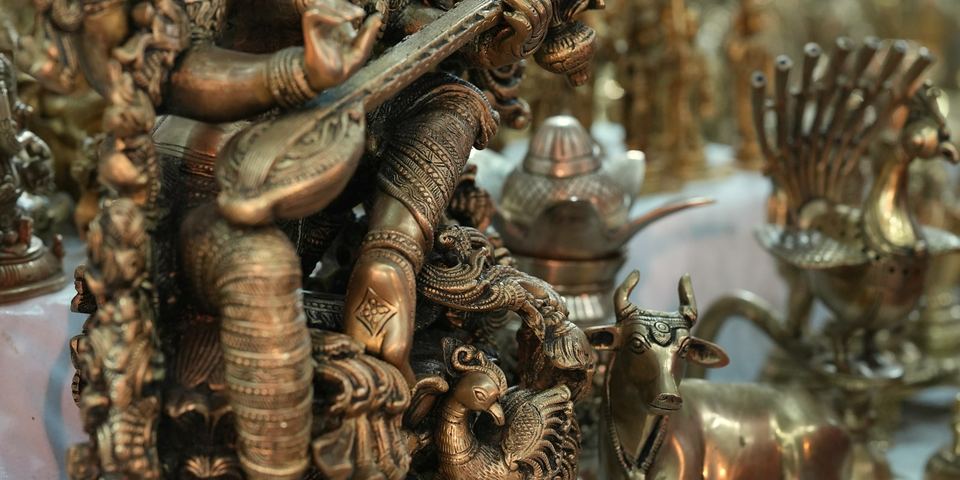
Its full name is Saraswati veena. It is also called the raghunatha veena. A veena player is called a vainika. The goddess Saraswati is often shown playing it, and Shiva appears as Vinadhara. That name means the bearer of the veena.
The Saraswati veena is one of four major veenas played today. The others are the chitra veena, the vichitra veena and the rudra veena.
Where the veena is played
The Saraswati veena belongs to South India. Its form with twenty-four frets grew up in Thanjavur, a city of Tamil Nadu, whose makers have the highest reputation. Pithapuram and Bobbili, in Andhra Pradesh, are also known for their veena makers.
The role of the veena in music
In Carnatic music, the veena plays the melody of a composition with all its ornaments. These ornaments are called gamaka. The player pushes a string sideways on a fret to raise its pitch, and slides between notes. The three side strings add a drone.
Music for the veena
A Carnatic concert often opens with a varnam. Students also practice varnams to build control of pitch and rhythm.
How the veena is made
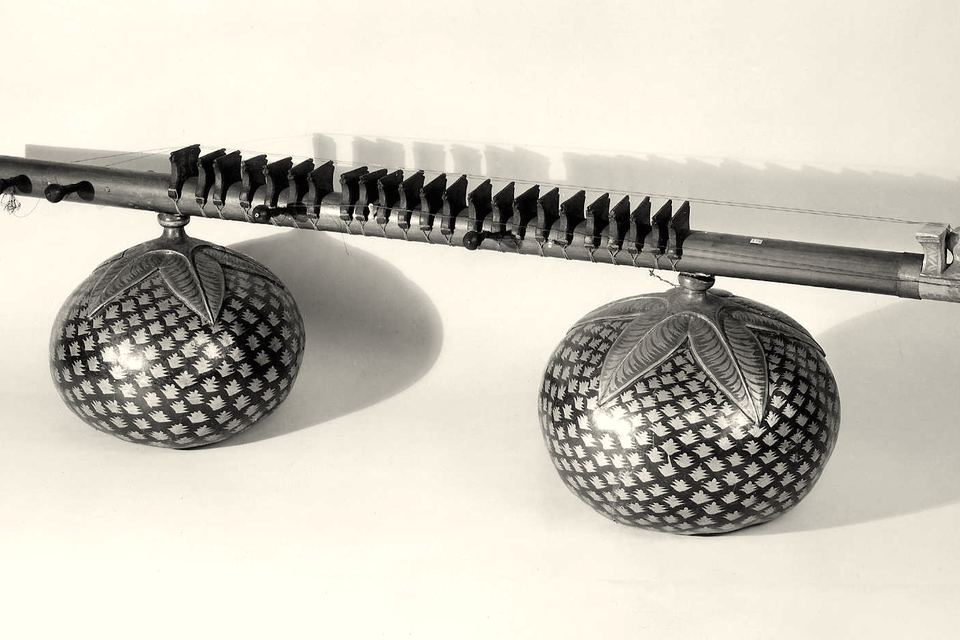
The veena is about one hundred twenty centimeters long. Its resonator, the kudam, is usually carved from the wood of the jackfruit tree. The neck, or dandi, carries twenty-four frets of brass or bell metal set in scalloped black wax. A carved dragon head, the yali, ends the tuning box. All seven strings are made of steel.
The four main strings are tuned Sa, Pa, Sa and Pa across two octaves. The three side strings sound Sa, Pa and the upper Sa. The player chooses the pitch of Sa.
How the veena is played
The player sits cross-legged and holds the veena tilted away from the body. A second, smaller gourd under the neck rests on the left thigh. The fingers of the left hand stop the strings on the frets. The right hand plucks with the index and middle fingers, and the little finger plays the drone strings.
How the veena has changed
The form with twenty-four frets took shape in Thanjavur under its Nayak rulers. In recent times makers have added sound holes, machine heads for tuning and pickups for amplification. Electric and digital veenas have also been built.
Choosing a veena
Check that the frets are set firmly in the wax and give a clear note on all the strings. Ask whether the maker can reset the frets, because the frets need care about once a year. The acoustic veena is easily damaged in travel, so buy a strong case with it.
Sources
Common questions
What is a veena?
Veena is the name of several Indian string instruments. The best known are the Saraswati veena, the chitra veena, the vichitra veena and the rudra veena.
How many strings does the Saraswati veena have?
The Saraswati veena has seven steel strings. The four main strings run over the frets and carry the melody. The three side strings serve as drone strings.
How is the veena tuned?
The four main strings sound Sa, Pa, Sa and Pa across two octaves. The side strings sound Sa, Pa and the upper Sa. The player sets Sa at a comfortable pitch.
What is the veena made of?
The resonator is usually carved from jackfruit wood. The frets are brass or bell metal set in black wax. The strings are steel.
Why is it called the Saraswati veena?
It bears the name of Saraswati. She is the Hindu goddess of learning and music. In Hindu art she is often shown holding a veena.
What is a varnam?
A varnam is a Carnatic composition that shows the main features of its raga. It often opens a concert, and students practice varnams to build control of pitch and rhythm.
World MusicIndian musicTunerTanpuraBansuri