Timing in milliseconds
Clap with the beat. The clap timer measures how early or late a clap comes. It shows the gap in thousandths of a second.
This free metronome plays a soft wooden tick at any tempo from 30 to 240 beats per minute. The first beat of the bar sounds higher. It can divide the beat into two, three or four clicks. To match a song, press “Tap the tempo” in time with its beat.
72 beats per minute
Press “Start the metronome.” The dots light with the beats, and the first dot marks the first beat of the bar. Move the slider to change the tempo. “Slower” and “Faster” change it by one beat per minute. Choose the beats in a bar to match the time signature of the music.
The menus below the slider shape the bar. “Clicks in a beat” divides the beat into two, three or four softer clicks. “Accent” moves the stronger click from the first beat to beats two and four, or removes it. “Silent bars” leaves bars without a sound, so that you keep the tempo on your own.
BPM stands for beats per minute. At 60 BPM a beat lasts one second. At 120 BPM a beat lasts half a second.
The beat is usually the quarter note. In 6/8 time, players often count two beats in a bar. The beat is a dotted quarter note, which divides into three eighth notes. For this meter, choose two beats in a bar and three clicks in a beat. Set three beats for 9/8 and four beats for 12/8 in the same way. The first click of a group marks the beat.
A subdivision splits the beat into equal parts. With two clicks in a beat, you hear eighth notes. With three you hear triplets, and with four you hear sixteenth notes. Practice with subdivisions when a passage has many short notes. The softer clicks show whether a short note falls in its place or arrives early.
Practice at a slow tempo first. Play a scale in eighth notes with two clicks in a beat. When it is even, change to three clicks and play triplets. Then change to four clicks and play sixteenth notes. Keep the beat in the same place while the notes inside it grow faster.
Composers often give the tempo as an Italian word. The ranges are rough guides, and they overlap. When you choose a tempo in the last column, the metronome above starts at that tempo.
Start a new passage at a tempo where you can play all the notes on the beat. When the passage feels secure, raise the tempo by a few beats per minute. Stop raising it when the passage starts to feel tense. The next day, begin at a slightly slower tempo and raise it again.
For swing and backbeat styles, put the accent on beats two and four. Snap your fingers or play a chord with the stronger clicks. This places the beat where a drummer plays the snare drum.
To test your own sense of tempo, choose one silent bar in two. Keep playing through the silent bar. When the clicks return, listen for any gap between your playing and the clicks. Move to two silent bars in four when one bar feels easy.
Clap with the beat. The clap timer measures how early or late a clap comes. It shows the gap in thousandths of a second.
Musicians kept time with pendulums long before the metronome. Galileo studied the steady swing of the pendulum in the late sixteenth century. A century later, the French musician Étienne Loulié built the chronomètre, a pendulum device that showed the tempo of a piece.
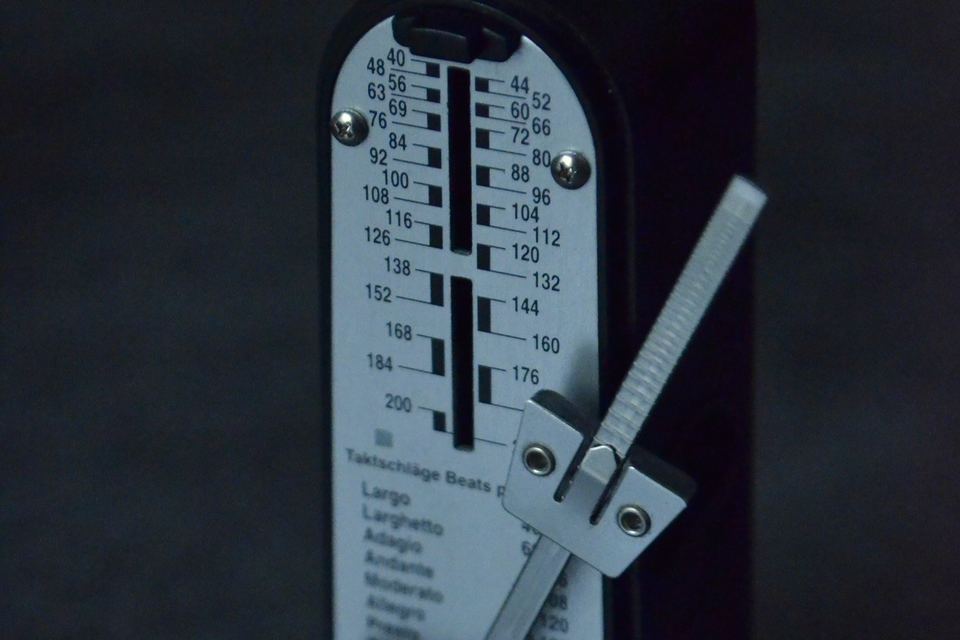
The metronome as we know it came from Amsterdam. There, Dietrich Nikolaus Winkel built a compact spring-driven pendulum with two weights. Johann Maelzel added a scale of numbers, patented the design and made it in large numbers under his own name. Scores still mark tempos with M.M., which stands for Maelzel’s Metronome. Beethoven was the first major composer to give metronome marks in his music.
A mechanical metronome usually runs from 40 to 208 beats per minute. Its scale rises in uneven steps. Between 60 and 72, for example, the marks are 60, 63, 66, 69 and 72. Electric metronomes with a flashing lamp appeared in the twentieth century. Electronic metronomes with a quartz crystal came later, and software metronomes followed them. Electronic and software metronomes keep time more exactly than mechanical ones. They can also set any tempo between the marks of a mechanical scale.
Not all musicians welcomed the metronome. Composers such as Mendelssohn and Wagner criticized published metronome marks. They argued that one fixed speed could not suit all halls and all performances. In the nineteenth century, many musicians used the metronome only to find the tempo before they played.
At 60 BPM the metronome ticks once per second. Many slow pieces marked Largo or Adagio are near this tempo.
A metronome mark gives the tempo in beats per minute. A mark of 120 for the quarter note means that the music has 120 quarter-note beats per minute.
Press “Tap the tempo” in time with the beat of the song. After three taps the metronome sets the tempo to the average of your recent taps.
The first beat of the bar sounds higher than the other beats. Change the beats in a bar to match the time signature of the music.
The metronome can divide the beat into two, three or four clicks. Choose the number in the “Clicks in a beat” menu. The extra clicks sound softer than the beat itself, so the beat stays clear.
Set two beats in a bar and three clicks in a beat. The metronome then plays six eighth notes per bar in two groups of three. Use three beats for 9/8 and four for 12/8.
In a score, M.M. stands for Maelzel’s Metronome. The number after it gives the beats per minute.
The metronome runs from 30 to 240 beats per minute. The “Slower” and “Faster” buttons change the tempo by one beat per minute. Tap tempo works across the same range.