The tabla
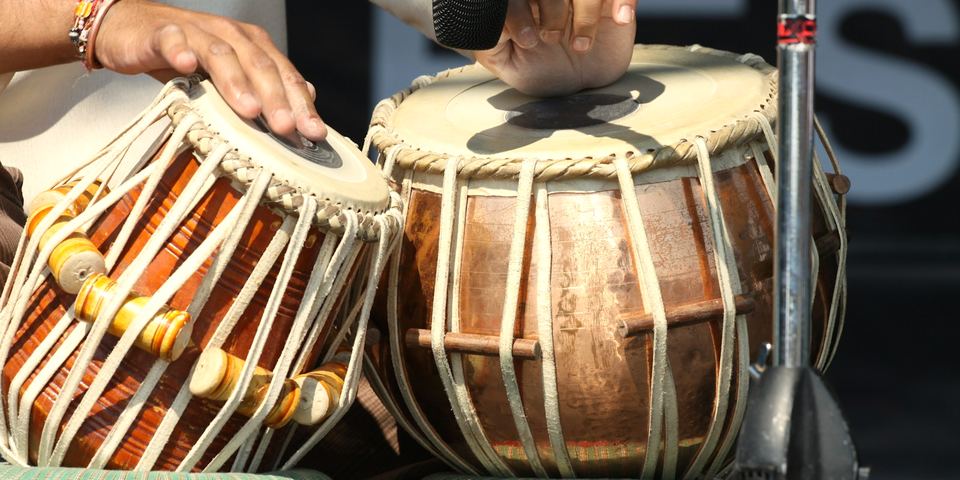
The tabla is a pair of hand drums from the Indian subcontinent and the main percussion instrument of Hindustani classical music. The smaller drum is the dayan, which is tuned to a note of the raga. The larger drum is the bayan, which gives the bass. Tabla strokes have spoken syllables called bols.
The tabla and other drums play this piece under a sitar. Listen for the deep strokes of the bayan. The player can make the pitch of these strokes glide upward by pressing the heel of the hand into the drum skin.
Music: Envato (Valharmony)
The sound of the tabla
A passage of tabla playing opens the recordings. Single strokes on the dayan follow it.
For Na, the index finger strikes the rim of the dayan while the last two fingers rest lightly on the black patch. The stroke rings. Te strikes the center of the patch, so its sound is short and dry.
Names of the tabla
The word tabla probably comes from tabl, which is the Arabic word for a drum. The right-hand drum is the dayan, which means right. It is also called the tabla itself.
The left-hand drum is the bayan, which means left. It is also called the dagga or the duggi.
Where the tabla is played
The tabla is played across South Asia in classical, popular and folk music. It accompanies the devotional singing of bhajan and kirtan. Sufi musicians use it in qawwali. It also accompanies kathak dance.
The role of the tabla in music
In Hindustani music the tabla keeps the tala. A tala is a repeating cycle of beats. The tabla marks the cycle with its theka. The theka is a fixed pattern of bols. Around the theka the player adds variations. The tabla also plays solo concerts.
Music for the tabla
Tabla players learn in gharanas, which are lineages that pass on compositions and styles. The Delhi gharana is thought to be the oldest. Others include the Lucknow, Ajrada, Farukhabad, Benares and Punjab gharanas.
A kayda is a tabla composition built from a short theme. The player develops the theme using only the bols that it contains.
How the tabla is made
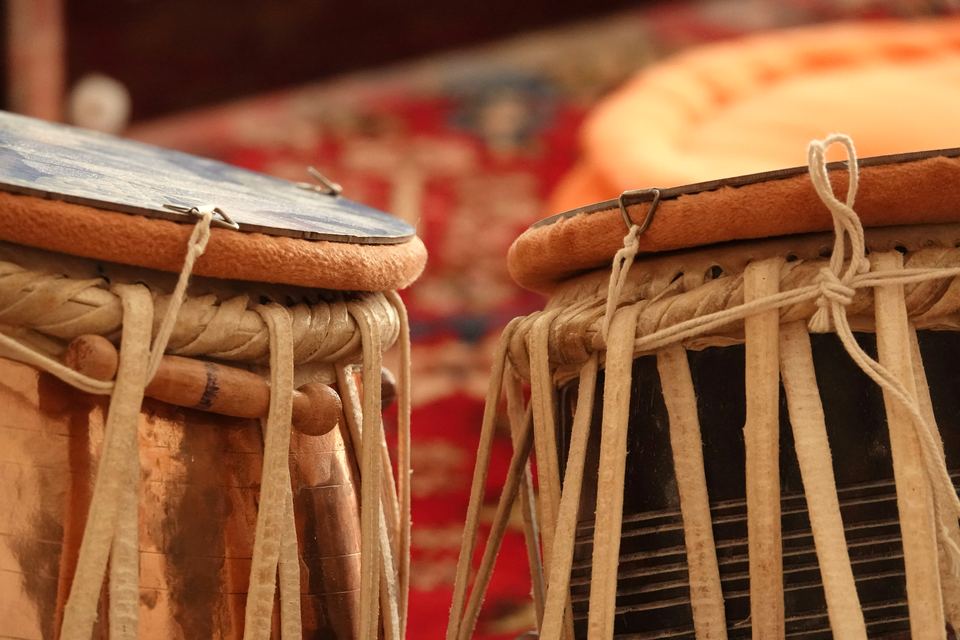
The dayan is carved from a block of wood. Teak and rosewood are the usual woods. It is about fifteen centimeters across. Straps run down its sides over small wooden blocks, and moving the blocks changes the pitch.
The bayan is wider and shaped like a kettledrum. Most bayans are brass, and copper is thought to be the best metal. Steel, aluminum, clay and wood are also used.
Both heads have a black patch called the syahi. It is built from layers of a paste of starch and a black powder. The syahi gives the drum its clear, bell-like pitch.
How the tabla is played
The player sits cross-legged on the floor. The drums rest on cloth rings. The right hand plays the dayan, and the left hand plays the bayan. The heel of the hand presses on a head to change its pitch and tone.
The player tunes the dayan to Sa, Pa or Ma of the soloist. A small hammer taps the braided edge of the head for fine tuning.
How the tabla has changed
The origins of the tabla are debated. Some scholars trace it to older drums of the subcontinent. Others link it to drums brought by the Mughals. Clear pictures of the tabla appear from the eighteenth century, and since that century it has led the percussion of Hindustani music.
Choosing a tabla
A dayan is made in a size that suits a range of pitches. Choose one that tunes to the Sa you use most.
Brass bayans are common. Copper bayans are more expensive and are often thought the best. Steel and aluminum appear in cheaper sets.
The syahi is the main mark of quality. Play Na and Tin on the dayan, and listen for a clear and ringing pitch.
How to learn the tabla
Tabla is taught by ear and by speech. The teacher says the bols, and the student speaks them before playing them. Compositions pass from teacher to student in person, as in the guru and shishya tradition.
Start with single strokes: Na, Tin and Te on the dayan, and Ge and Ka on the bayan. Then join them into Dha and Dhin. Next learn the theka of Teentaal. Speak it and clap it along with the tala player linked below. Then play it.
Teentaal is a tala of sixteen beats. The beats are called matras. The beats fall into four sections of four. These sections are called vibhags. Sam is the first beat of the cycle. A tali section is marked by a clap, and the khali section by a wave of the hand.
A teacher watches your hands and corrects your strokes. Our courses add a Hindustani path at Level 3.
| Vibhag | Mark | Bols |
|---|---|---|
| First | Sam (X) | Dha Dhin Dhin Dha |
| Second | Tali (2) | Dha Dhin Dhin Dha |
| Third | Khali (0) | Dha Tin Tin Ta |
| Fourth | Tali (3) | Ta Dhin Dhin Dha |
A short check
Choose one answer per question.
Which hand plays the dayan for most players?
The dayan is played with the stronger hand, which is the right hand for most players. Dayan means right.
How many matras are in one cycle of Teentaal?
Teentaal has sixteen matras in four vibhags of four.
Which bol joins Na on the dayan with Ge on the bayan?
Dha is Na and Ge played together. Dhin joins Tin with Ge in the same way.
Sources
Common questions
What are the two drums of the tabla called?
The smaller drum is the dayan, which the right hand plays. The larger drum is the bayan, which the left hand plays.
What is the black circle on a tabla?
It is the syahi, a patch of paste made from starch and a black powder. It shapes the overtones and gives both drums a clear pitch.
How is the tabla tuned?
The player moves the wooden blocks under the straps of the dayan. Fine tuning comes from light taps of a small hammer on the braided edge.
What is a bol in tabla?
A bol is the spoken syllable for a stroke or a group of strokes. Players speak bols to learn and to remember compositions.
What is a theka?
A theka is the fixed pattern of bols that marks a tala. Teentaal, for example, starts with Dha Dhin Dhin Dha.
Do tabla players read music?
Tabla was traditionally taught by ear. Written systems for bols came into use in the twentieth century, but teaching still relies mainly on speech.
World MusicTala playerRagasSitarLevel 3 course