Pitch practice for singers
Sing a note and see in cents how far it sits from true pitch.
This free tuner listens through your microphone and shows the nearest note. It also shows in cents how far the note is from true pitch. A cent is one hundredth of a semitone, and a semitone is the smallest step on a piano. Play one string at a time and let it ring.
Play a note.
Hold the note steadily.
Press “Start the tuner.” Your browser asks before the microphone turns on. Play one open string and let it ring. The tuner shows the nearest note and a reading in cents. Turn the tuning peg until the needle points to the center. When the needle turns gold, the string is within five cents of true pitch.
For a guitar in an alternate tuning, choose the tuning in the Tuning menu above the Start button. The tuner then reads a string against the nearest string of that tuning. When a string is more than half a semitone away, the tuner tells you to tighten or loosen it. The number after a note gives its octave, and middle C is C4.
A semitone is divided into one hundred cents. A reading of minus twenty cents means that the string sounds one fifth of a semitone below the note. A plus sign means that the note is sharp, so loosen the string a little. A minus sign means that the note is flat, so tighten it.
Many listeners can hear a difference of about five or six cents between two pitches, though the limit differs from person to person. The needle turns gold within five cents for this reason. The tuner measures against A440. This is the A above middle C, which vibrates four hundred forty times a second. Most musicians tune to this pitch. An international standard called ISO 16 sets it.
Sing a note and see in cents how far it sits from true pitch.
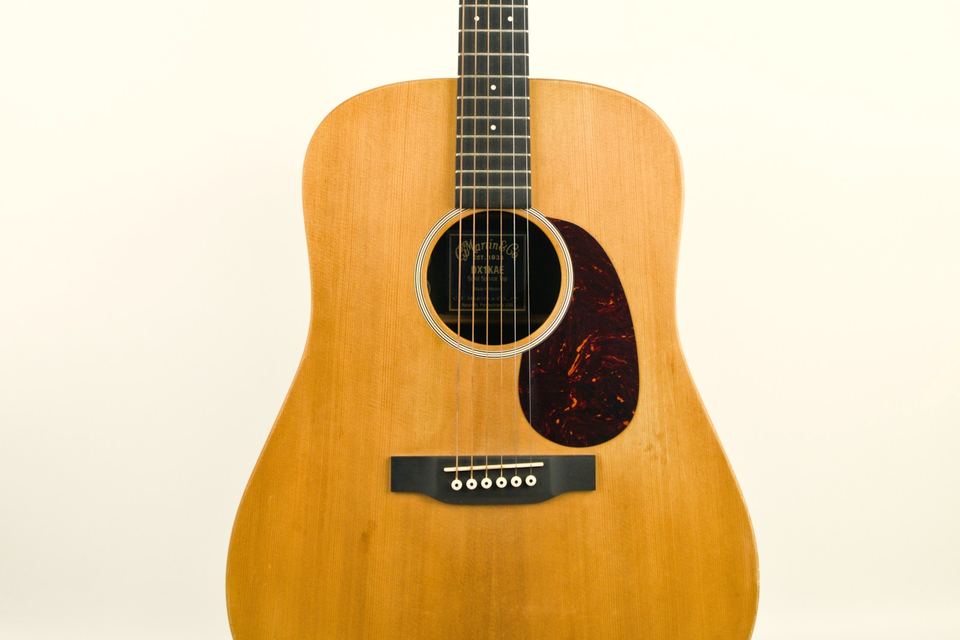
The buttons play one open string apiece. The guitar strings sound on a recorded nylon-string guitar, and the other strings sound on a recorded grand piano. Tune the lowest string first and work upward.
From the lowest string to the highest, standard guitar tuning is E, A, D, G, B and E.
From the lowest string, a four-string bass is tuned E, A, D and G.
Soprano, concert and tenor ukuleles are tuned G, C, E and A. The G string sounds higher than the C string. A baritone ukulele has the tuning of the four highest guitar strings: D, G, B and E.
The violin is tuned in fifths: G, D, A and E, low to high.
The viola is tuned C, G, D and A. Its strings sit a fifth below the strings of the violin.
The cello is tuned C, G, D and A. Its strings sound an octave below the strings of the viola.
The mandolin has four pairs of strings, and both strings of a pair sound the same note. The pairs are tuned G, D, A and E, as on the violin.
The five-string banjo is usually tuned to an open G chord: G, D, G, B and D. The fifth string is short and starts at the fifth fret. It sounds the high G.
Sitar tunings differ from one school of playing to another. In a common tuning, the main playing string sounds Ma and the next string sounds Sa. The lower strings sound Pa and Sa, and the thin chikari strings sound Sa in higher octaves.
Many players set Sa near C, C♯ or D. The sympathetic strings are tuned to the notes of the raga. The buttons sound Sa, Ma and Pa with Sa on C♯.
The four main strings of the Saraswati veena are tuned Sa, Pa, Sa and Pa across two octaves. The three side strings sound Sa, Pa and the upper Sa.
Players choose their own Sa. The buttons sound Sa, Pa and the upper Sa with Sa on C.
An alternate tuning changes the pitch of one or more open strings. Some tunings lower the whole guitar to suit a singer or to give a heavier sound. Others tune the open strings to a chord. The strings then ring together, and a slide or a single barre plays a full chord.
Choose a tuning in the Tuning menu of the tuner. To hear its six strings from low to high on a recorded guitar, press its button below. Tune down to a lower note whenever you can, and bring a raised string up to its note slowly. A string tuned far above standard pitch carries more tension and may break.
| Tuning | Strings from low to high | Listen |
|---|---|---|
| StandardMost guitar music | E A D G B E | |
| Drop DRock riffs on a low D string | D A D G B E | |
| Half step downBlues and rock | E♭ A♭ D♭ G♭ B♭ E♭ | |
| Whole step downHeavier rock | D G C F A D | |
| Drop CMetal riffs | C G C F A D | |
| DADGADCeltic and folk fingerstyle | D A D G A D | |
| Open GSlide guitar and blues | D G D G B D | |
| Open D (Vestapol)Slide guitar and fingerstyle blues | D A D F♯ A D | |
| Open ESlide guitar in E | E B E G♯ B E | |
| Open CFingerstyle pieces | C G C G C E |
A seven-string guitar adds a low B below the low E, so its strings are B, E, A, D, G, B and E. A twelve-string guitar pairs the main strings with second strings. On the four lowest pairs, the second string sounds an octave higher. The two highest pairs are tuned in unison. Tune the main string of a pair first. Set the Tuning menu to “Any note” for the octave strings. The tuner then reads them as the same letter one octave higher.
Tune the low E string to its reference note first. Press the low E string at the fifth fret and play the open A string after it. The two notes should match. If you hear a slow wobble when they sound together, the strings are slightly out of tune with one another. This wobble is called beating. Turn the peg of the A string until the beating slows and stops.
Tune the D string and the G string in the same way. They are tuned from the fifth fret of the next lower string. The B string is the exception: press the G string at the fourth fret to find its note. Tune the high E string from the fifth fret of the B string.
Harmonics give a cleaner check. Touch the low E string lightly above the fifth fret and pluck it. Then touch the A string above the seventh fret and pluck it. Both harmonics sound the E two octaves above the low string, and they ring long enough for the beating to be clear. The harmonic at the seventh fret sounds an octave and a pure fifth above the open string. This pure fifth is about two cents wider than the tempered fifth that the tuner uses. An A string tuned this way ends about two cents flat. Check the result with the tuner.
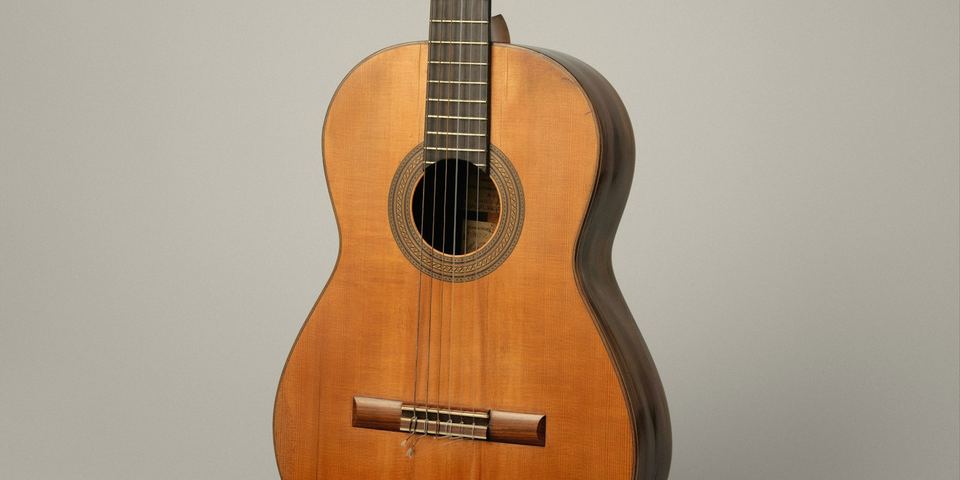
Hear the opening of a Bourrée by Bach on a classical guitar. The open strings and the chords ring clearly when all the strings are in tune.
A microphone tuner picks up all the sounds in the room. Turn off fans and music, and hold the phone or computer close to the sound hole. Pluck the strings with medium force. A hard pluck sounds sharp for an instant. Read the needle once the note has begun to ring.
An electric guitar played without an amplifier is too quiet for most microphones. Plug it into an amplifier, or use a clip-on tuner, which reads the vibration of the headstock. If the needle jumps between two notes, rest the side of your hand on the strings you are not tuning. Strings that ring together give the tuner more than one pitch.
A string that will not stay in tune is often new. New strings stretch during the first days of playing. Pull a new string gently away from the fretboard and tune it again until it holds. Tune up to a note from below, so that the gear of the peg holds the tension. Old strings, a slipping peg and a change of room temperature also move the pitch.
A clip-on tuner clamps onto the headstock and reads the vibration of the wood. For this reason it works in a noisy room, where a microphone tuner would pick up other sounds. With a clip-on tuner, play one string at a time, as you would with this tuner.
The Korg Pitchclip 2 reads any note from the lowest key of a piano to the highest. It works for guitar, ukulele, violin and other string instruments.
Press Start the tuner and play the low E string. The tuner shows the nearest note and how many cents sharp or flat it is. Tighten the string to raise the pitch, or loosen it to lower the pitch. Then tune the other strings in the same way.
From the string nearest your chin to the string nearest the floor, a standard ukulele is tuned G, C, E and A. The G string is higher than the C string beside it. Some tenor players tune the G an octave lower.
A four-string bass is tuned E, A, D and G. These notes sound an octave below the four lowest strings of a guitar.
A microphone tuner works well for the violin. Bow the open strings in turn from G up to E, and hold the note steadily. A long, even bow stroke gives the clearest reading.
A chromatic tuner reads any note of the octave, including the sharps and flats. This tuner is chromatic, so it works for any instrument and for the voice.
A440 means that the A above middle C vibrates four hundred forty times a second. Most tuners use this pitch as their reference.
The tuner reads any pitch, so it works for Indian instruments as well. The full tuner also lets you set Sa. It then shows the notes as swaras (Sa, Re, Ga and the rest) and gives their distance from true pitch in cents.