The sitar
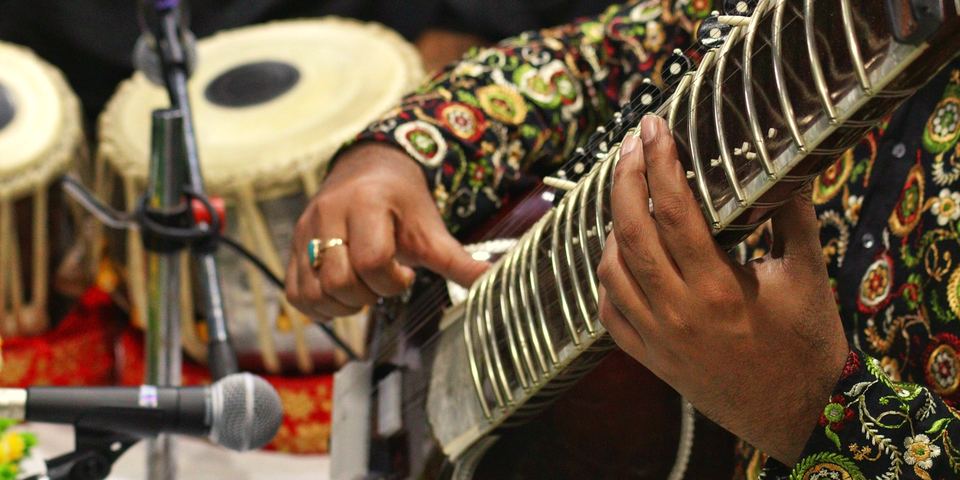
The sitar is a long-necked lute of North India and a main instrument of Hindustani music. It has a gourd body, movable curved frets and up to twenty-one strings. The player plucks six or seven of them with a metal pick called a mizraab. The others are sympathetic strings below the frets. They ring when the player sounds their notes.
In this piece the sitar plays a melody over a drone and a hip-hop beat. Listen for the bright, buzzing tone of the sitar, which comes from the jawari bridge.
Music: Envato (KabbalisticVillage)
The sound of the sitar
The first button below plays improvised music on a sitar. Listen for the bright attack of the mizraab and the long ring that follows a stroke. A faint halo of sound hangs behind the notes. It comes from the sympathetic strings, which resonate with the notes of the melody.
The second button plays a single note on the main playing string. The string is plucked once and left to ring. This string is tuned to Ma. Sa is the tonic, and Ma lies a fourth above it. On this sitar Ma is F, so Sa is C.
History of the sitar
The word sitar comes from the Persian setar, which means three strings. Many Persian lute names join the word tar, which means string, to a number. The sitar grew from such a lute at the Mughal court of Delhi. Its earliest known mention is in a book about Delhi written in the eighteenth century.
An old story credits the poet Amir Khusrau with its invention, but scholars reject it. No record from his time uses the word sitar. In the late Mughal period the neck grew wider and gained metal frets, and the body came to be made from a gourd.
Players of the eighteenth and nineteenth centuries shaped the instrument and its music. The first style of composition made for the sitar appeared in the eighteenth century. Masit Khan gave his name to the slow gat, which players still use today. Raza Khan gave his name to the fast gat. The sitar took its present form in the nineteenth century. In the twentieth century the sitar reached concert halls in Europe and America, and several rock bands used it in their songs.
The role of the sitar in music
In Hindustani classical music the sitar plays the melody of a raga. A raga is a melodic framework with its own notes, phrases and mood. The tabla accompanies the sitar, and a tanpura or the sitar's own drone strings hold Sa beneath the music.
The player bends notes by pulling the string sideways across a fret. This is called meend, and on the main string it can raise a note by up to seven half steps. With meend the sitar can glide between notes as a singer does. The style of playing called gayaki imitates the voice in this way.
A sitar performance
A full performance moves from freedom to strict rhythm. It opens with the alap. In this slow opening the player unfolds the raga with no tabla and no fixed beat. The notes of the raga enter one by one. The jor follows. It has a steady pulse but no rhythmic cycle. The jhala closes this part. In the jhala the player alternates the main string with fast strokes on the chikari, the high drone strings.
Then the tabla enters for the gat. The gat is a fixed composition set in a tala. The slow gat comes first, and a fast gat follows. Between returns of the composition, the player improvises phrases and fast runs called taans. A second jhala often ends the performance at great speed.
Sitar playing passes down through schools called gharanas. Gharanas keep their own repertoire, tuning and touch. The Imdadkhani, the Maihar and the Bishnupur gharanas are among the best known. Their sitars differ too. A common type is called the instrumental style. This sitar is fully decorated with carving and inlay and often has thirteen sympathetic strings. It usually has a second gourd and low bass strings as well.
How the sitar is made
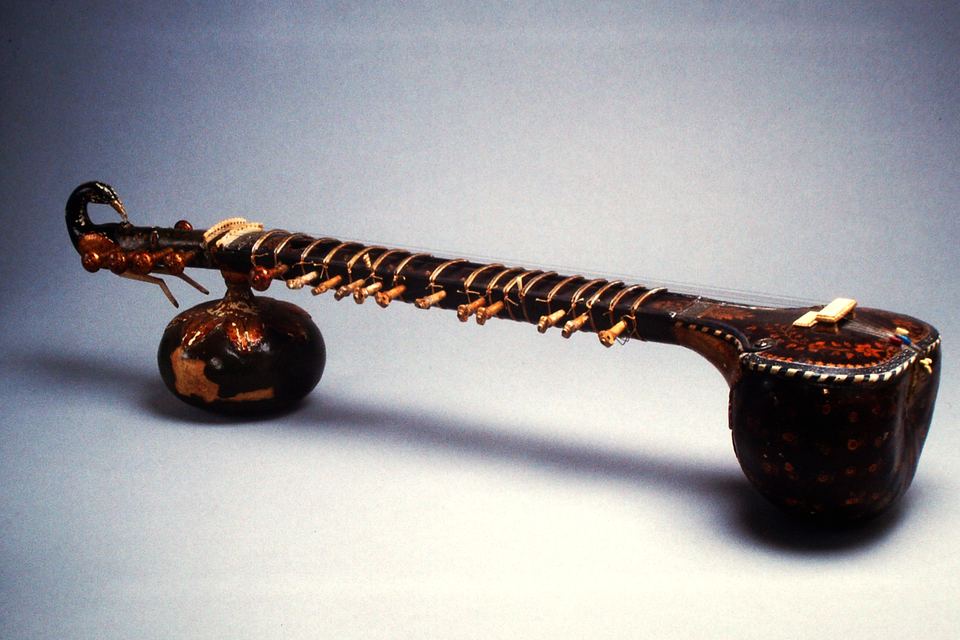
The resonating body is a calabash gourd, called the kaddu. A thin top of wood, called the tabli, closes it. The long, hollow neck is made of teak or of tun, which is a relative of mahogany. Many sitars carry a second, smaller gourd near the top of the neck.
The frets are curved metal bars tied to the neck with cord. The player can slide them to adjust their pitch. They stand high above the neck, so the sympathetic strings can run beneath them.
The sitar has eighteen to twenty-one strings. The six or seven playing strings include the main string and the second string. The main string is tuned to Ma, and the second to Sa. The chikari strings are high drones that the player strikes for rhythm. The sympathetic strings lie beneath the frets. They pass through small holes in the neck to small pegs along its side. The player tunes them to the notes of the raga.
The sitar has two bridges. The large bridge carries the playing strings, and the small bridge carries the sympathetic strings. The top of the large bridge is a wide, gently flattened curve. A vibrating string grazes this curve, and the contact adds many overtones. The shaping of this bridge is called jawari.
How the sitar is played
The player sits on the floor and balances the sitar between the left foot and the right knee. The hands carry none of its weight. The neck slants up and away to the left. The mizraab is a wire pick worn on the index finger of the right hand. The thumb of that hand rests on the edge of the fretboard above the gourd.
The left hand stops the strings with the index and middle fingers. Meend pulls the string across the fret to bend the pitch. Krintan sounds quick notes with the left hand alone. The fingers hammer onto the string and pull off it. Kan is a light grace note before a main note. Murki and zamzama are fast ornaments of several notes.
The player retunes the sitar from raga to raga. The frets move for fine tuning, and the sympathetic strings change to match the notes of the raga.
What makes a fine sitar
The gourd is the first concern of a sitar maker. The makers of Miraj in Maharashtra buy bitter, inedible gourds grown near Pandharpur. The maker chooses a gourd with even walls and dries it well before use. The gourd gives the sitar its deep tone.
The neck and the top are made of tun wood or teak. Fine sitars are often made of seasoned tun. Seasoned wood is less likely to warp under the pull of so many strings.
The jawari shapes the tone of the sitar. A maker files and polishes the top of the large bridge to a precise curve. An open jawari gives a bright, buzzing tone, and a closed jawari gives a plainer one. The strings slowly wear the bridge, and the tone turns thin. A skilled maker then reshapes it. Players call this work doing the jawari.
The sympathetic strings need a small jawari of their own and careful tuning. On a fine sitar they ring clearly when the melody touches their notes. The frets must be smooth and evenly curved, so the string glides freely through a long meend.
Choosing a sitar
Sitars are made in student, professional and master grades. A student model is the usual first instrument.
Ask which style of sitar a teacher uses before you buy, because tuning and playing differ between the schools. A student sitar in the same style lets you follow the lessons exactly.
Check that the neck is straight and the frets are firm. Ask for the jawari to be set before the sitar leaves the workshop. Many players rely on a maker to reshape the bridge when the tone changes.
Who keeps these instruments
Sitar making is a family craft in India. Workshops in Kolkata and Delhi have built sitars for generations. Collectors prize older instruments from the Rikhi Ram workshop in Delhi and the Hiren Roy workshop in Kolkata. In Miraj, a town in Maharashtra, makers have built sitars and tanpuras for well over a century. Their work now carries a geographical indication of India.
Families and schools carry the music forward. A gharana passes from teacher to student and often from parent to child. Universities and music colleges in India teach the sitar in full degree programs. The University of Delhi is one of them. Museums keep historical sitars as well. The Metropolitan Museum of Art in New York holds nineteenth-century sitars. Its collection includes a sitar with a wooden body inlaid with ivory.
First steps on the sitar
Posture comes first, because the sitar must rest steadily without the help of the hands. Then pluck the main string with slow, even strokes of the mizraab.
Play the notes of sargam on the main string while the tanpura sounds the drone. Tunings and styles differ between gharanas, the schools of playing, so a teacher sets the first tuning. Learn a short meend between two neighboring frets early. It trains the left hand to pull the string evenly.
A short check
Choose one answer per question.
What is the mizraab?
The mizraab is the metal pick that plucks the strings. The thumb of the same hand rests on the fretboard.
To which note is the main playing string usually tuned?
The main playing string is almost always tuned to Ma, which lies a perfect fourth above Sa. The second string is tuned to Sa.
What does the jawari of the bridge do?
The top of the main bridge is a wide, flat curve. The vibrating string grazes it, and the contact adds bright overtones.
Which part of a performance has no tabla and no fixed rhythm?
The alap opens the raga slowly and without a fixed beat. The tabla joins later, when the gat begins.
Sources
Common questions
How many strings does a sitar have?
A sitar has eighteen to twenty-one strings. The player plucks six or seven, and the rest are sympathetic strings that ring by themselves.
What is the sitar made of?
The body is a calabash gourd, and the neck and top are teak or tun wood. The bridges are made of deer horn, ebony, camel bone or a synthetic material.
Who invented the sitar?
No single inventor is known. It grew from a Persian lute at the Mughal court, and the earliest mention of its name dates from the eighteenth century.
What are sympathetic strings?
They are strings beneath the frets that the player does not pluck. They vibrate when the played strings sound their notes, and they add resonance to the tone.
How is a sitar tuned?
The main string is usually tuned to Ma and the second string to Sa. The other strings vary with the raga and with the school of the player.
What is meend on the sitar?
Meend is a slide made by pulling the string sideways over a fret. The pitch rises smoothly, and the player can let it fall back to the fretted note.
What is the jawari of a sitar?
Jawari is the shaping of the flat, curved top of the main bridge. It gives the sitar its buzzing, overtone-rich tone, and a maker must renew it from time to time.
What is the difference between the sitar and the sarod?
The sitar has frets and a gourd body. The sarod has no frets and a skin-covered body with a metal fingerboard, so its notes slide over smooth steel.