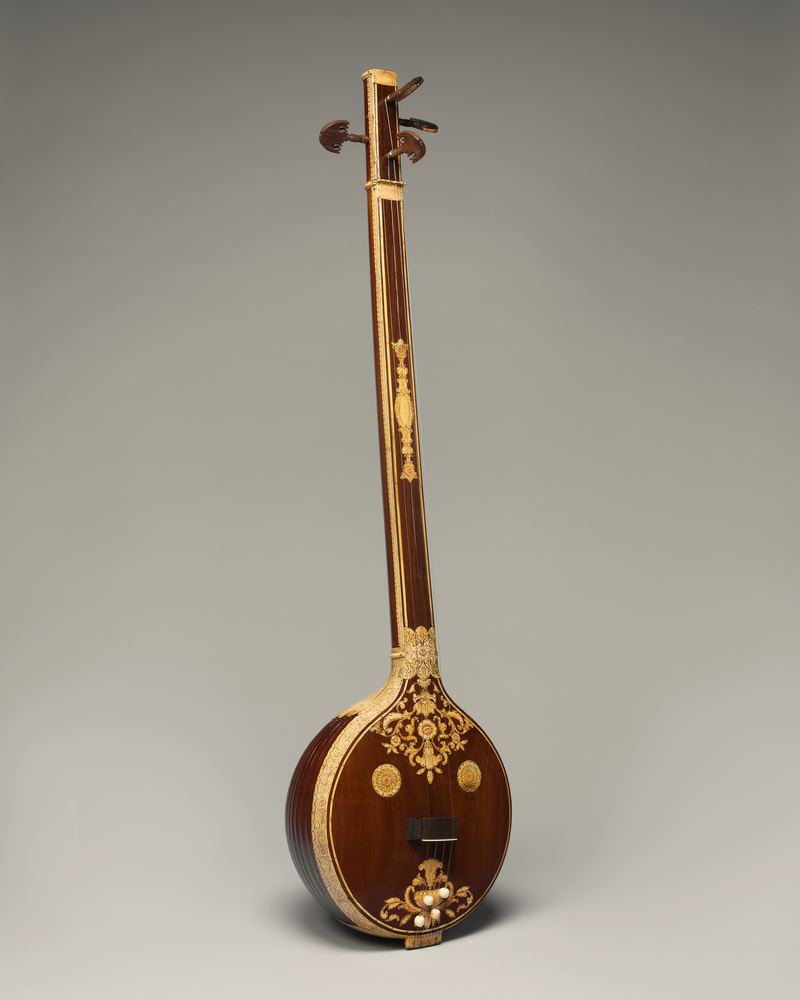
Tanpura drone
The tanpura plays the steady drone beneath Indian classical music. You choose its key.
Sargam is the set of note names in Indian classical music: Sa, Re, Ga, Ma, Pa, Dha and Ni. Sa is the tonic, and singers choose its pitch. Re, Ga, Dha and Ni can be lowered, which makes them komal. Ma can be raised, which makes it tivra. With Sa on C, the natural swaras match the C major scale.
Kali Jan sings a khyal in Raag Behag on this early record. Khyal is the main form of classical song in Hindustani music. Find Sa, which is the note the melody keeps returning to, and hum it softly as you listen. Then try to sing back a short phrase of the melody in sargam.
The notes of the sargam are swaras. The seven names are short forms of longer names: Shadja, Rishabh, Gandhar, Madhyam, Pancham, Dhaivat and Nishad.
Sa can be any pitch. The table gives the swaras with Sa on C.
| Swara | Full name | With Sa on C | Listen |
|---|---|---|---|
| Sa | Shadja | C | |
| Re | Rishabh | D | |
| Ga | Gandhar | E | |
| Ma | Madhyam | F | |
| Pa | Pancham | G | |
| Dha | Dhaivat | A | |
| Ni | Nishad | B |
The natural form of a swara is shuddha. Komal means soft, and a komal swara lies a half step below the shuddha one. Re, Ga, Dha and Ni have komal forms.
Tivra means intense. Tivra Ma lies a half step above shuddha Ma. Sa and Pa never change. With these forms, the octave holds twelve swaras.
On this site a stroke after Ma, as in Ma′, shows tivra Ma.
| Swara | With Sa on C | Listen |
|---|---|---|
| Sa | C | |
| komal Re | D♭ | |
| Re | D | |
| komal Ga | E♭ | |
| Ga | E | |
| Ma | F | |
| tivra Ma (Ma′) | F♯ | |
| Pa | G | |
| komal Dha | A♭ | |
| Dha | A | |
| komal Ni | B♭ | |
| Ni | B |
The middle octave is called madhya saptak. The octave below it is mandra saptak, and the octave above it is taar saptak.
In written sargam, a dot under a swara marks the lower octave, as in Ṇi. A dot over a swara marks the upper octave, as in Ṡa.
Choose a Sa that suits your voice and set the tanpura to it. Hold Sa until your voice blends with the drone. Next, sing Pa and return to Sa. Sing the whole sargam slowly up and down.
The tanpura plays the steady drone beneath Indian classical music. You choose its key.
A thaat is a parent scale of seven swaras. Hindustani music sorts its ragas into ten thaats. Hear the thaats rising from Sa. On this page Sa is C.
| Thaat | Swaras | Listen |
|---|---|---|
| Bilawal | Sa Re Ga Ma Pa Dha Ni | |
| Kalyan | Sa Re Ga Ma′ Pa Dha Ni | |
| Khamaj | Sa Re Ga Ma Pa Dha komal Ni | |
| Bhairav | Sa komal Re Ga Ma Pa komal Dha Ni | |
| Poorvi | Sa komal Re Ga Ma′ Pa komal Dha Ni | |
| Marwa | Sa komal Re Ga Ma′ Pa Dha Ni | |
| Kafi | Sa Re komal Ga Ma Pa Dha komal Ni | |
| Asavari | Sa Re komal Ga Ma Pa komal Dha komal Ni | |
| Bhairavi | Sa komal Re komal Ga Ma Pa komal Dha komal Ni | |
| Todi | Sa komal Re komal Ga Ma′ Pa komal Dha Ni |
An alankar, also called a palta, is a practice pattern on the sargam. In a common alankar, the groups of three swaras start one swara higher in turn: Sa Re Ga, Re Ga Ma, Ga Ma Pa. The pattern climbs this way to the upper Sa. Sing it slowly over the tanpura.
Both give the steps of the scale their own syllables. Sargam belongs to Indian music, and solfège belongs to Western music. Sa and movable do both stand for the tonic.
Komal means soft. In sargam it marks a swara a half step lower than its natural form.
Tivra means intense. Only Ma has a tivra form. It lies a half step above shuddha Ma.
Hum a relaxed note in the middle of your voice. The tanpura page can set Sa from that note.
A thaat is one of the ten parent scales that group the ragas. A thaat has seven swaras in rising order.
With Sa on C, Sa Re Ga Ma Pa Dha Ni are C D E F G A B. If Sa moves to another pitch, all the swaras move with it.