Tanpura drone
The tanpura plays the steady drone beneath Indian classical music. You choose its key.
A raga is a melodic framework in Indian classical music. It sets the swaras (the notes of Indian music) that may be used and the ways they move up and down. It also sets which notes matter most and the phrases that identify it. Many ragas can share one scale, and one raga can give endless melodies.
Ustad Imdad Khan plays a gat in Raag Yaman Kalyan on the sitar. A gat is an instrumental composition set to a tala, which is a repeating cycle of beats. The disc comes from the first decade of recording in India.
A scale lists notes in order. A raga also fixes which swaras lead, which phrases belong to it and how it rises and falls.
Desh belongs to Khamaj thaat, yet its aroh leaves out Ga and Dha. Its avroh brings in komal Ni, which is the lowered Ni. Its aroh uses shuddha Ni. That is the natural Ni.
A raga is also more than a tune. A single raga can give an endless number of melodies. Its characteristic movement is called the chalan. The chalan shows how a melody moves between the swaras of the raga. It also shows which notes the melody holds and which it only touches. Ragas that share the same swaras can sound quite different, because their chalans differ. A musician who knows the chalan can improvise freely and still stay inside the raga.
A thaat is a parent scale of seven swaras. The musicologist Vishnu Narayan Bhatkhande grouped the ragas of Hindustani music under ten thaats in the early twentieth century. The thaats take their names from well-known ragas: Bilawal, Kalyan, Khamaj, Bhairav, Purvi, Marwa, Kafi, Asavari, Bhairavi and Todi. The thaat serves to classify ragas. A raga need not use all the swaras of its thaat, and some ragas add notes from outside it. Bhupali belongs to Kalyan thaat, though it leaves out Ma and Ni. Bhatkhande also devised a system of notation that is still widely used.
Musicians link a raga with a mood. This mood is called rasa. The word rasa also means juice or essence. The idea comes from old Indian writing on drama and the arts, where rasa is the feeling that a work awakens in its audience. A singer builds the mood of a raga slowly. Long notes rest on its most important swaras, and its phrases return again and again. Darbari Kanada, a raga of the late night, is solemn and slow. The same swaras in a different order and pace can give a quite different mood.
Hindustani tradition links ragas to times of day and to seasons. Bhairav belongs to the early morning. Bhupali and Yaman belong to the evening and the first part of the night. Malkauns belongs to late night.
The tradition divides the day and the night into eight parts of about three hours apiece. These parts are called prahars. The day from sunrise to sunset holds four prahars, and the night holds the other four. A raga has its prahar. Some ragas belong to a season. The Malhar ragas are linked to the monsoon rains.
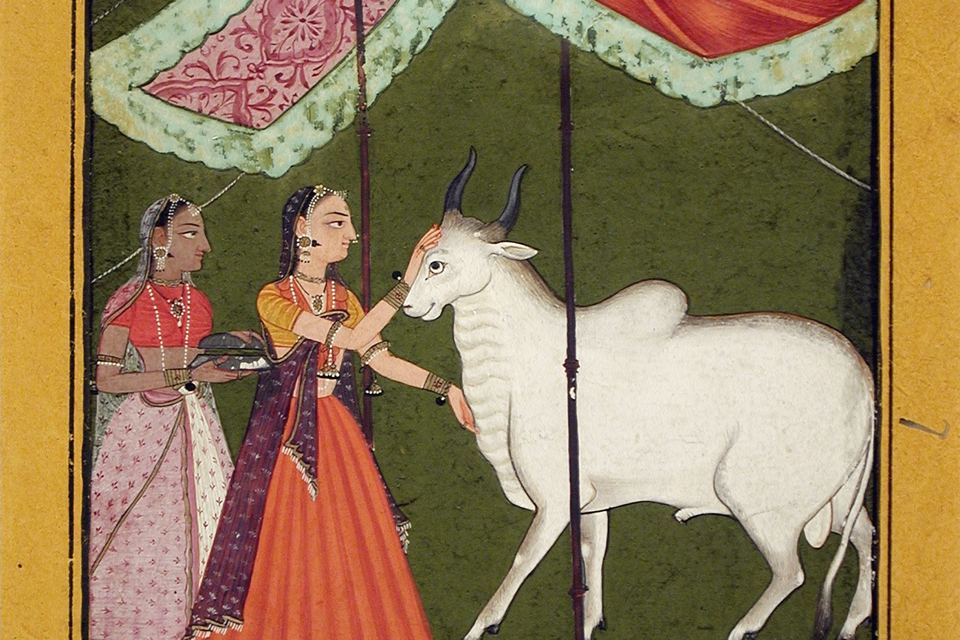
Indian painters also gave the ragas a visible form. A ragamala, which means a garland of ragas, is a series of small paintings with one raga to a page. A painting shows the raga as a person or a god in a scene. A short verse often gives its mood, its season and its hour. Ragamala painting flourished in the courts of Rajasthan, the Deccan, the Mughal empire and the hills of the Punjab. The older system grouped the ragas into families. A male raga had several wives. They were called raginis. Bhairavi Ragini was one of the wives of Bhairava Raga, and both were linked to the god Shiva. In the painting below, the white bull is Nandi. Nandi is the mount of Shiva.
Hear the swaras of the ragas rising from Sa and falling again. On this page Sa is C. A stroke after Ma, as in Ma′, shows tivra Ma. Tivra Ma is the raised fourth. For Yaman, the swaras begin on the lower Ni, as its aroh does.
| Raga | Thaat | Swaras | Time |
|---|---|---|---|
| Bhupali | Kalyan | Sa Re Ga Pa Dha | Evening |
| Yaman | Kalyan | Sa Re Ga Ma′ Pa Dha Ni | First part of the night |
| Bhairav | Bhairav | Sa komal Re Ga Ma Pa komal Dha Ni | Early morning |
| Malkauns | Bhairavi | Sa komal Ga Ma komal Dha komal Ni | Late night |
| Desh | Khamaj | Sa Re Ga Ma Pa Dha Ni, with komal Ni on the way down | Night |
| Kafi | Kafi | Sa Re komal Ga Ma Pa Dha komal Ni | Night |
The tanpura plays the steady drone beneath Indian classical music. You choose its key.
In this recording, a sitar and a violin play Raag Bihag over a drone. Bihag is also spelled Behag. It belongs to Bilawal thaat. Musicians perform it in the late evening, after the hours of Yaman and Bhupali.
Music: Envato (KabbalisticVillage)
The pages below teach one raga apiece in full. It gives the aroh and the avroh in sargam and on the staff. It also gives the pakad, the most important swaras and the time of the raga. Several pages add a recording and a short check. Start with Yaman or Bhupali, which many teachers give first. Move on to the morning ragas when the evening ragas feel secure.
An evening raga of Kalyan thaat. Its tivra Ma, the raised fourth, gives it a bright color.
A raga of five swaras for the evening. It leaves out Ma and Ni.
A raga of dawn. Singers make komal Re and komal Dha sway slowly in pitch.
A morning raga with four komal swaras. Many concerts end with it.
A morning raga with the seven shuddha swaras. With Sa on C, its notes are the white keys.
A solemn raga of the late night. Singers make komal Ga and komal Dha sway slowly in pitch.
A full performance moves from freedom to strict rhythm. It opens with the alap. In this slow opening the musician presents the raga swara by swara. No drum plays, and there is no fixed beat. On instruments, the jor follows with a steady pulse, and the jhala closes this part with fast strokes on the drone strings.
Then the tabla enters with a composition set in a tala. Singers call it a bandish, and instrumentalists call it a gat. Between returns of the composition, the musician improvises phrases and fast runs called taans. The tempo rises toward the end. The tanpura sounds Sa and Pa beneath the whole performance.
The first disc below holds a gat in Yaman Kalyan on the sitar. Sing Sa softly before you play it. Listen for the swaras that the sitar returns to most often. In Yaman they are Ga and Ni. Notice tivra Ma on the way up. Tivra Ma is the raised fourth.
On the second disc, Ustad Abdul Karim Khan sings a thumri in Raag Bhairavi. A thumri is a light classical song. Compare the two ragas. Yaman sounds bright with its raised notes. Bhairavi sounds darker, because four of its swaras are komal. Both discs are old, so they carry some surface noise.
Begin with the aroh and the avroh over the tanpura. Sing them slowly until all the swaras are steady. Next, learn the pakad, and listen to recordings of the raga by several performers.
Then learn a short bandish in the raga from a teacher or a book of notation. Sing it daily for a week before you add your own phrases. The Ear Lab trains you to identify the swaras of a raga. Its first raga is Bhupali.
Play the basic stroke pattern, or theka, of a tala on the tabla. Add the tanpura beneath it.
A raga is a set of rules for a melody. It gives the swaras, the way they rise and fall and the phrases that make the raga recognizable.
There is no fixed count. Writers on Indian music describe thousands of possible ragas.
A thaat is a parent scale of seven swaras. A raga belongs to a thaat and adds its own rules: which swaras it leaves out, how it moves and which notes lead.
Yaman is often the first raga that students learn.
Hindustani tradition assigns ragas to parts of the day and night. It links Bhairav to the early morning and Malkauns to the late night.
A pakad is a characteristic phrase. A listener can tell the raga from others with the same swaras by hearing it.
A ragamala is a series of Indian paintings with one raga to a page. A painting shows the mood, the season and the hour of its raga.
CurriculumRaag YamanTanpuraLevel 3 courseGandharva theory exam
