Tala player
Choose Teentaal and a slow tempo, and press play. Clap on matras one, five and thirteen. Wave on matra nine.
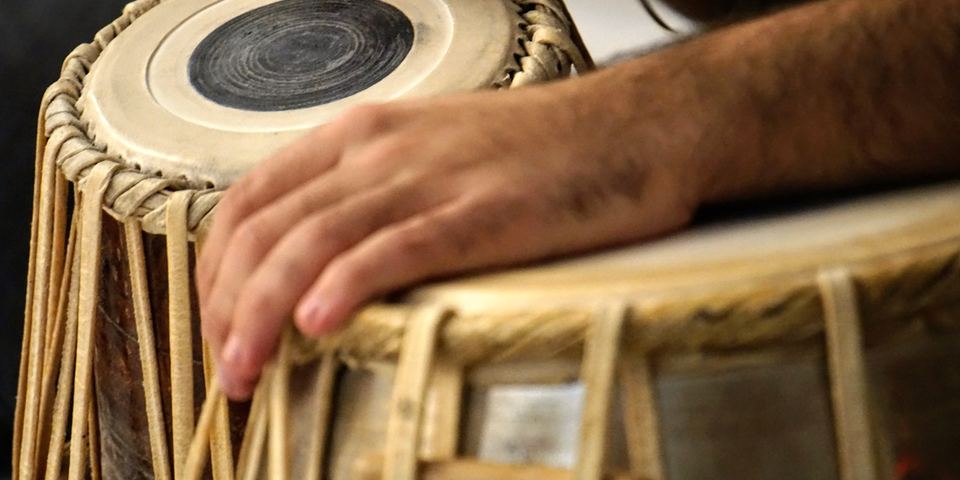
Teentaal is the most common tala of Hindustani music. A tala is a repeating cycle of beats, and a beat is called a matra. Teentaal has sixteen matras in four sections called vibhags. Players clap on matras one, five and thirteen. On matra nine they wave the hand. That matra is called khali.
A band from Amritsar plays Raag Bhairavi in teentaal on this early record. Count the sixteen matras with the music. Clap on one, five and thirteen, and wave on nine.
The theka is the basic pattern of drum strokes for one cycle of a tala. The spoken syllable for a stroke is its bol. Tabla players say the bols aloud before they play them.
The table shows the four vibhags. Teen means three in Hindi, and the name refers to the three claps of the cycle.
| Vibhag | Matras | Bols | Hand |
|---|---|---|---|
| First | 1 to 4 | Dha Dhin Dhin Dha | Clap on sam, marked X |
| Second | 5 to 8 | Dha Dhin Dhin Dha | Clap, marked 2 |
| Third | 9 to 12 | Dha Tin Tin Ta | Wave on khali, marked 0 |
| Fourth | 13 to 16 | Ta Dhin Dhin Dha | Clap, marked 3 |
Some teachers say Na in place of Ta in the third and fourth vibhags. The shape of the cycle stays the same.
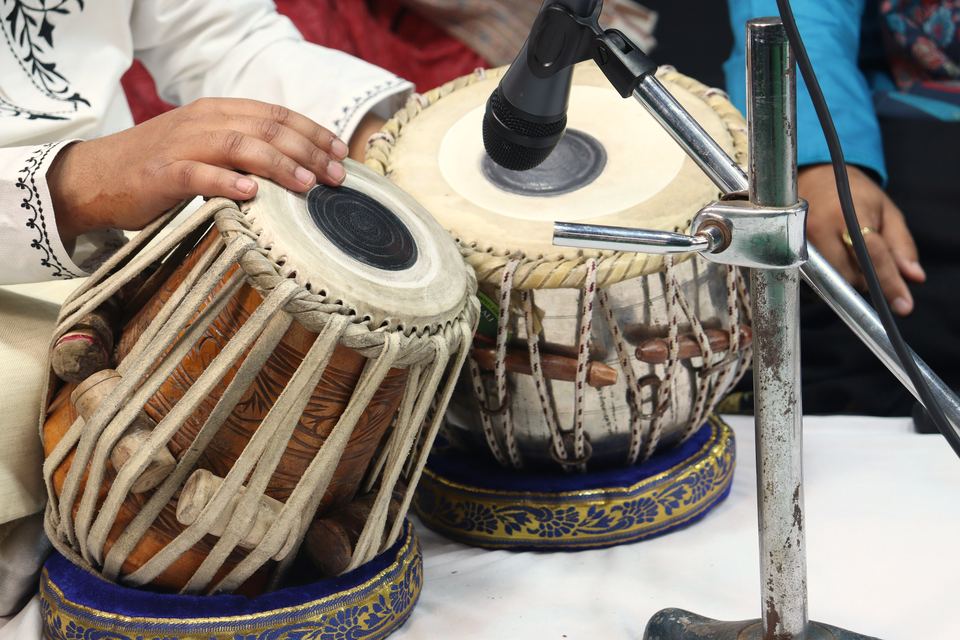
Sam is the first matra of the cycle. Musicians mark it X. A tali is a clap that opens a vibhag. The two other talis of teentaal are numbered 2 and 3.
Khali means empty. The tabla is a pair of drums: the dayan is the higher drum, and the bayan is the lower drum. In the khali vibhag the bayan stays silent, so the strokes Tin and Ta sound light. When the light strokes begin, sam is eight matras away.
In the recording, a tabla player performs a solo in teentaal. A melody plays above the drums. Listen for the heavy Dha strokes. Then listen for the lighter sound of the khali vibhag.
The tala player below sounds the plain theka at a slow, a medium or a fast tempo. In its menu the tala is listed as Teentaal.
Count the sixteen matras aloud at an even speed. Clap on one, five and thirteen. On nine, wave the hand with the palm turned up.
When the claps feel steady, speak the bols in place of the numbers. Say Dha Dhin Dhin Dha twice. Then say Dha Tin Tin Ta, and close with Ta Dhin Dhin Dha.
Choose Teentaal and a slow tempo, and press play. Clap on matras one, five and thirteen. Wave on matra nine.
Laya is the tempo of a tala. Teentaal works well at a slow tempo and at a fast tempo. The slow tempo is called vilambit, and the fast tempo is called drut. Singers set many compositions in it.
Tabla players build their solo pieces on teentaal. A kaida is a theme of bols that the player varies. A paran is a composition built on the heavy strokes of the pakhawaj. The pakhawaj is the barrel drum of dhrupad.
A single cycle of teentaal lasts as long as four bars of 4/4 time. A Western bar starts again after four beats. A tala cycle runs on for all sixteen matras, and only sam marks its start.
Choose one answer per question. The explanation appears below the correct answer.
What is the length of a teentaal cycle?
Teentaal has sixteen matras in four vibhags of four.
On which matra does khali fall in teentaal?
The third vibhag begins on matra nine. It is the khali, so it is shown with a wave of the hand.
Which bols open the theka of teentaal?
The theka opens with Dha Dhin Dhin Dha. Ka Dhi Ta Dhi Ta opens dhamar, and Dhi Na opens jhaptal.
It is a Hindustani tala of sixteen matras. Its four vibhags of four matras are marked by three claps and one wave.
Dha Dhin Dhin Dha | Dha Dhin Dhin Dha | Dha Tin Tin Ta | Ta Dhin Dhin Dha. The vertical lines divide the four vibhags.
Yes. Tintal, teental and trital are other spellings and names of the same tala.
Khali falls on the ninth matra. Musicians mark it 0 and show it with a wave.
Listen for the light strokes of khali. Sam always comes eight matras after khali begins.
Yes. Slow teentaal accompanies many vocal pieces, and fast teentaal is common in solos.