Wolfgang Amadeus Mozart
Wolfgang Amadeus Mozart was an Austrian composer of the Classical period. He was born in Salzburg and spent his last ten years in Vienna. He wrote more than six hundred works, among them operas, symphonies, piano concertos and chamber music. His melodies are clear and singable, and his phrases fall into balanced pairs.
An orchestra plays the first movement of Symphony No. 40 in G minor, K. 550. A movement is a complete section of a longer work. K. stands for the Köchel catalog, which is the numbered list of Mozart's works.
Recording: Musopen
Life in brief
Mozart was born in Salzburg on January 27, 1756. His father, Leopold Mozart, was a violinist in the orchestra of the Prince-Archbishop of Salzburg. Leopold also wrote a well-known book on violin playing. He taught Wolfgang and Wolfgang's older sister, Maria Anna, who was known as Nannerl. Wolfgang played the keyboard and the violin as a small child. He wrote his first pieces at the age of five.
From the age of six he toured Europe with his family. The children played at the courts of Munich, Vienna, Paris and London. In London the boy met Johann Christian Bach, the youngest son of Johann Sebastian Bach. On later journeys to Italy he learned the art of Italian opera. He wrote operas for Milan while he was still in his teens.
Back in Salzburg, Mozart served Archbishop Colloredo as a court musician, and he was unhappy in the post. At twenty-five he left the archbishop's service and settled in Vienna. He earned his living by teaching, by publishing and by public concerts. At these concerts he played his own piano concertos. The next year he married the singer Constanze Weber. Joseph Haydn became a close friend, and Mozart dedicated six string quartets to him.
In Vienna he wrote The Marriage of Figaro, Don Giovanni and Così fan tutte with the poet Lorenzo Da Ponte. His German opera Die Zauberflöte had its first performance in Vienna two months before his death. He fell ill in November and died in Vienna on December 5, 1791. He left his Requiem unfinished. His pupil Franz Xaver Süssmayr completed it for Constanze.
How to hear his style
Mozart's melodies move in balanced phrases. A phrase of four measures is often answered by another of four measures, like a question and a reply. Musicians call such a pair antecedent and consequent. The first phrase pauses on the dominant chord. The second phrase closes firmly in the tonic key.
His textures are clear. In the piano music the left hand often plays an Alberti bass. This is a broken chord in the order low, high, middle, high. The right hand plays the melody above it. In the orchestra the strings usually carry the melody, and the winds add color and long held chords.
The opera house shaped much of his music. Themes in his concertos and symphonies sound like characters on a stage. The mood can change in a moment from comedy to sorrow. His works in minor keys are few and intense. They include the Symphony No. 40 in G minor and the Piano Concerto No. 20 in D minor.
Listen also for chromatic notes. These are notes from outside the key. Mozart used them to give a melody longing or tension. In the last movement of Symphony No. 40, the middle section opens with a passage that uses eleven of the twelve notes of the chromatic scale.
The best-known works
The list opens with three operas and closes with the Requiem.
| Work | What to listen for |
|---|---|
| The Marriage of Figaro | This comic opera has four acts. In many of its numbers several characters sing different thoughts at the same time. |
| Don Giovanni | The opera mixes comedy and terror. The scene with the statue near the end brings back the dark D minor chords of the overture. |
| Die Zauberflöte (The Magic Flute) | This German opera has spoken dialogue between the songs. The second aria of the Queen of the Night climbs to a high F. |
| Eine kleine Nachtmusik | This serenade for strings opens with a rising figure on the notes of the G major chord. |
| Symphony No. 40 in G minor | The violins play a restless theme over a quiet, pulsing accompaniment in the violas. |
| Symphony No. 41 (Jupiter) | A coda is the closing section of a movement. In the coda of the last movement, five themes sound together, and all of them keep their own lines. |
| Piano Concerto No. 21 in C major | In the slow movement a long melody floats over muted strings. |
| Piano Sonata in A major, K. 331 | The sonata ends with the Rondo alla Turca. It imitates the sound of the Turkish military bands heard in Vienna. |
| Clarinet Concerto in A major | He wrote it for his friend, the clarinetist Anton Stadler, in the last months of his life. |
| Requiem in D minor | It was his last work. His own manuscript stops after the first eight measures of the Lacrimosa. |
Music: Envato (PremiumBeat)
The first recording is the first movement of the Piano Sonata in C major, K. 545. Listen for the Alberti bass under the melody and the clear return of the opening theme. The Rondo alla Turca is the last movement of the Piano Sonata in A major, K. 331. The third recording is a short passage from the first movement of the Bassoon Concerto, K. 191. Mozart wrote it at eighteen.
How the music is built
Mozart used sonata form in the first movements of his sonatas, symphonies and concertos. The exposition sets the first theme in the tonic key. A bridge passage modulates to a second key. To modulate is to change key. The second key is usually the dominant. When a movement is in a minor key, the second key is usually the relative major. This is the major key with the same key signature. The development is often short. The recapitulation brings both themes back in the tonic.
His concertos add the ritornello, a passage for the orchestra that returns between the solo sections. Near the end of a movement the orchestra pauses on a chord, and the soloist plays a cadenza. A cadenza is a solo passage in free time. Mozart wrote out cadenzas for many of his concertos.
His harmony is built on the primary chords I, IV and V. Cadences close the phrases. The Alberti bass spells out these chords note by note, so the harmony is easy to hear. Practicing the major scales and their primary chords prepares the hands for his music.
The Köchel catalog lists his works in the order in which he wrote them. Ludwig von Köchel published its first edition in the nineteenth century. A number such as K. 331 points to one work.
Pieces students learn
Mozart's piano music begins with the small minuets he wrote as a child. Exam boards often set the pieces below. Check the current syllabus of your board before you choose one.
| Stage | Piece | What it teaches |
|---|---|---|
| Beginner | Minuet in F major, K. 2 | Even quarter notes in a clear phrase |
| Early grades | Allegro in B♭ major, K. 3 | Short phrases that answer one another |
| Intermediate | Sonata in C major, K. 545 | Scales, Alberti bass and sonata form |
| Late intermediate | Fantasia in D minor, K. 397 | Free tempo, pauses and sudden changes of mood |
| Advanced | Sonata in A major, K. 331 | Variations and the Rondo alla Turca |
| Advanced | Sonata in A minor, K. 310 | Drive and tension in a minor key |
| Diploma | Piano Concerto in A major, K. 488 | Playing with an orchestra |
Mozart also wrote concertos that other players study. Clarinetists learn the Clarinet Concerto, and bassoonists learn the Bassoon Concerto. Horn players learn his four horn concertos, and flutists play the Flute Concerto in G major. Violinists learn his five violin concertos. Orchestras often ask for a Mozart concerto at auditions for these instruments.
Where the music lives
Mozart was born on the third floor of the house at Getreidegasse 9 in Salzburg. The International Mozarteum Foundation keeps it as a museum. Its collection includes his childhood violin and his clavichord. The family later moved across the river to a larger home on Makartplatz. This house, now called the Mozart Residence, is also a museum.
The foundation's library collects editions of his music and writings about him. Its research team publishes the scholarly edition of his works online. The foundation also holds the Mozart Week festival in Salzburg.
In Vienna, the Mozarthaus at Domgasse 5 is the only one of his Viennese homes that survives. He wrote The Marriage of Figaro while he lived there. Mozart was buried in St. Marx Cemetery in an ordinary grave, and its exact place is unknown.
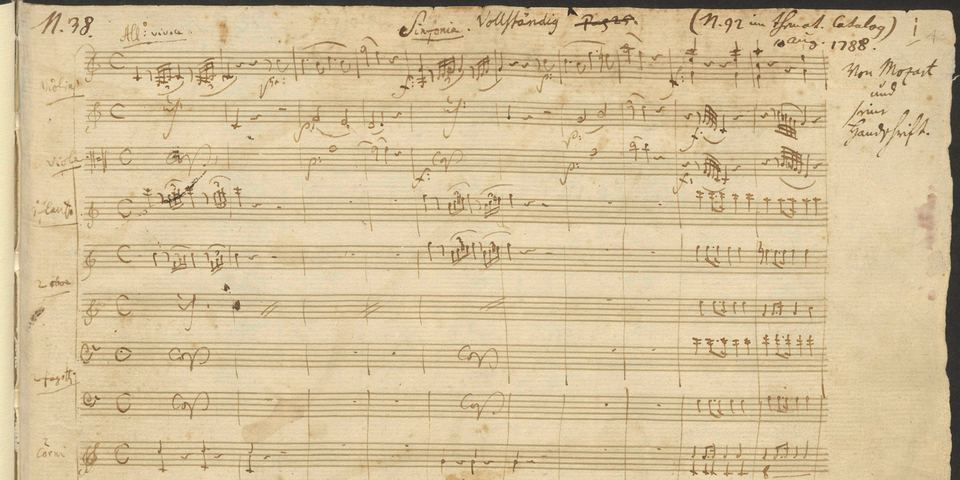
The Staatsbibliothek zu Berlin holds many of the scores that Mozart wrote out in his own hand. The Jupiter Symphony is among them. The image at the top of this page shows its first page.
A short check
Choose one answer per question.
Where was Mozart born?
He was born in Salzburg. He spent the last ten years of his life in Vienna.
What does the letter K stand for in a number such as K. 331?
Ludwig von Köchel listed Mozart's works in order of composition. His works all have their own K numbers.
What is an Alberti bass?
The left hand spells out the chords note by note. Mozart used it often in his piano sonatas.
Which of these operas did Mozart write with the poet Lorenzo Da Ponte?
Da Ponte wrote the words of The Marriage of Figaro, Don Giovanni and Così fan tutte.
Common questions
When did Mozart live?
He was born in Salzburg on January 27, 1756, and died in Vienna on December 5, 1791. He was thirty-five years old.
How many works did Mozart write?
The Köchel catalog lists more than six hundred works. They include about twenty operas and stage works, more than forty symphonies and twenty-seven piano concertos.
Did Mozart and Beethoven meet?
No record of a meeting survives. A story from the nineteenth century says that Mozart heard the young Beethoven play, but scholars doubt it.
Did Salieri kill Mozart?
No. The story is a legend that a play and a film made famous. Mozart died of an illness, and Salieri later taught Mozart's younger son.
What is the easiest Mozart piece for piano?
The minuets he wrote as a child, such as the Minuet in F major, K. 2, are within reach of beginners.
Why is Mozart called a Classical composer?
He worked in the Classical period of Western music. Its music is built on clear melody, balanced phrases and forms such as the sonata and the symphony.
