
The circle of fifths
The circle of fifths places the twelve major keys around a circle. Clockwise from C, a step moves up a perfect fifth and adds one sharp. Counterclockwise from C, a step moves down a fifth and adds one flat. The relative minor of a key is written inside it. Press a key in the chart to hear it.
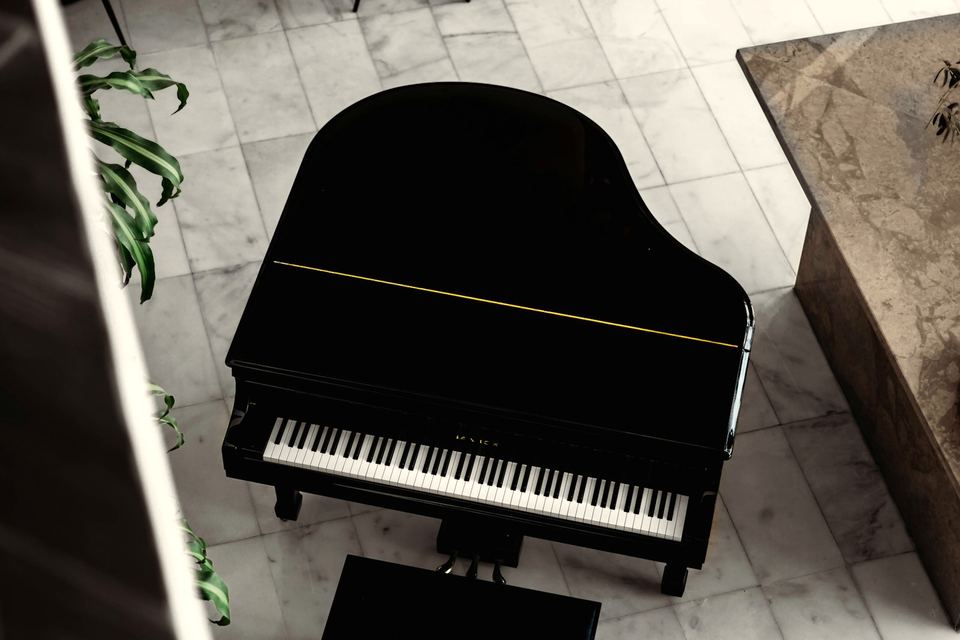
A solo piano plays this piece in A minor. A minor shares its key signature with C major. Find A minor on the inner ring, next to C at the top of the circle.
Music: Envato (SyncHits)
How to use the circle
Find a key on the outer ring and count the steps from C. A step clockwise adds one sharp, and a step counterclockwise adds one flat. Neighboring keys lie a fifth apart, and their key signatures differ by one sharp or one flat.
The minor key inside shares the key signature. It is the relative minor, and its tonic lies a minor third below the major tonic.
To find the key signature of A♭ major, count the steps counterclockwise from C: F, B♭, E♭ and A♭. That makes four steps, so A♭ major has four flats. They are the first four flats in order: B♭, E♭, A♭ and D♭.
To find the relative minor of E♭ major, look at the inner ring directly inside E♭. C minor lies a minor third below E♭, and it also has three flats.
To move a song up a fifth, move all the chords one step clockwise. The chords C, F and G in C major become G, C and D in G major. The chords keep their Roman numerals in the new key.
The keys in order
Press “Scale” to hear the major scale of a key, or “Chord” to hear its tonic chord.
| Key | Key signature | Relative minor | Listen |
|---|---|---|---|
| C major | No sharps or flats | A minor | |
| G major | One sharp | E minor | |
| D major | Two sharps | B minor | |
| A major | Three sharps | F♯ minor | |
| E major | Four sharps | C♯ minor | |
| B major | Five sharps | G♯ minor | |
| F♯ major | Six sharps | D♯ minor | |
| D♭ major | Five flats | B♭ minor | |
| A♭ major | Four flats | F minor | |
| E♭ major | Three flats | C minor | |
| B♭ major | Two flats | G minor | |
| F major | One flat | D minor |
Chords around the circle
The chords on either side of a key are its chords IV and V. In C major, F lies one step counterclockwise and G one step clockwise. Chords I, IV and V are the three major chords of the key.
A progression that moves counterclockwise falls by fifths. The progression ii–V–I in C major is Dm7, G7 and C. A chord root lies a fifth above the next.
Many songs chain these falling fifths together. In I–vi–ii–V, A falls a fifth to D, and D falls a fifth to G. The circle progression passes through all seven chords of C major. All the roots fall a perfect fifth except one. The step from F to B is a diminished fifth, which keeps all the chords inside C major.
| Progression | Chords in C major | Listen |
|---|---|---|
| ii – V – I | Dm7 – G7 – C | |
| I – vi – ii – V | C – Am – Dm – G7 | |
| The circle progression | C – F – Bdim – Em – Am – Dm – G – C | |
| I – IV – V – I | C – F – G – C |
Modulation
Modulation is a change of key within a piece. Most modulations move to a closely related key, whose key signature differs by one sharp or one flat at most. The closely related keys of C major are A minor, G major, E minor, F major and D minor.
A piece in a major key often moves first to its dominant key. That key lies one step clockwise. A sonata is a large instrumental work in several movements. In the first movement of a sonata in C major, the second theme usually comes in G major.
A pivot chord belongs to both keys, so it makes the change smooth. A minor is chord vi in C major and chord ii in G major. The progression below starts in C major and reaches the A minor chord. D7 then leads into G major.
| Progression | Chords | Listen |
|---|---|---|
| A pivot chord from C major to G major | C – Am – D7 – G |
Keys written in sharps or flats
At the bottom of the circle, one key can be written in sharps or in flats. F♯ major has six sharps, and G♭ major has six flats. On the piano the two keys sound the same.
Other keys can also be spelled in two ways. B major has five sharps and sounds the same as C♭ major, which has seven flats. D♭ major has five flats and sounds the same as C♯ major, which has seven sharps. Composers usually choose the spelling with fewer sharps or flats.
The minor keys overlap in the same way. D♯ minor has six sharps, and E♭ minor has six flats. This chart and the major scales page both give F♯ major and its relative minor, D♯ minor.
History of the circle
The earliest known circle diagram of keys appears in a grammar of music by Nikolai Diletsky. He wrote it in the late seventeenth century. Later versions of the book were made in Moscow.
In the early eighteenth century the German composer Johann David Heinichen printed a circle of keys in a guide to figured bass. Figured bass is a bass line with numbers that show the chords above it. He set the relative minor keys beside their major keys. Later, David Kellner proposed two rings. The major keys stood on the outer ring and the minor keys on the inner ring. The chart on this page follows that layout.
On a piano, twelve fifths up from C land exactly seven octaves higher. For this reason the circle closes. In tunings with pure fifths, twelve fifths overshoot seven octaves by a small interval. This interval is called the Pythagorean comma.
A key signature check
Choose one answer per question.
How many flats does A♭ major have?
A♭ major lies four steps counterclockwise from C. Its flats are B♭, E♭, A♭ and D♭.
Which major key has three sharps?
A major lies three steps clockwise from C. Its sharps are F♯, C♯ and G♯.
What is the relative minor of D major?
The relative minor lies a minor third below the tonic. A minor third below D is B.
Which key lies one step clockwise from E♭ major?
A step clockwise removes one flat. B♭ major has two flats.
Which sharp is added last in the key signature of E major?
E major has F♯, C♯, G♯ and D♯. The tonic E lies a half step above the last sharp.
Which major key has five flats?
D♭ major has B♭, E♭, A♭, D♭ and G♭. The next-to-last flat, D♭, gives the key.
Sources
The keys and key signatures on this page follow standard theory texts. The history and the modulation facts come from these references.
Common questions
What is the circle of fifths used for?
It shows the key signature of any key and its relative minor. It also shows which keys and chords are closely related.
How do I remember the order of sharps?
Many students say “Father Charles Goes Down And Ends Battle.” The first letters give F, C, G, D, A, E and B.
Why is it called the circle of fifths?
A key lies a perfect fifth above the key before it. After twelve fifths the circle returns to C.
Which key has no sharps or flats?
C major has none, and so does its relative minor, A minor. They are at the top of the circle.
How many sharps does E major have?
E major has four sharps: F♯, C♯, G♯ and D♯.
What is the relative minor of F major?
The relative minor of F major is D minor. Both keys have one flat, B♭.
What is the circle of fourths?
It is the same circle read counterclockwise. A step rises a perfect fourth. Rising a fourth lands on the same note name as falling a fifth. Jazz players often practice in this order.