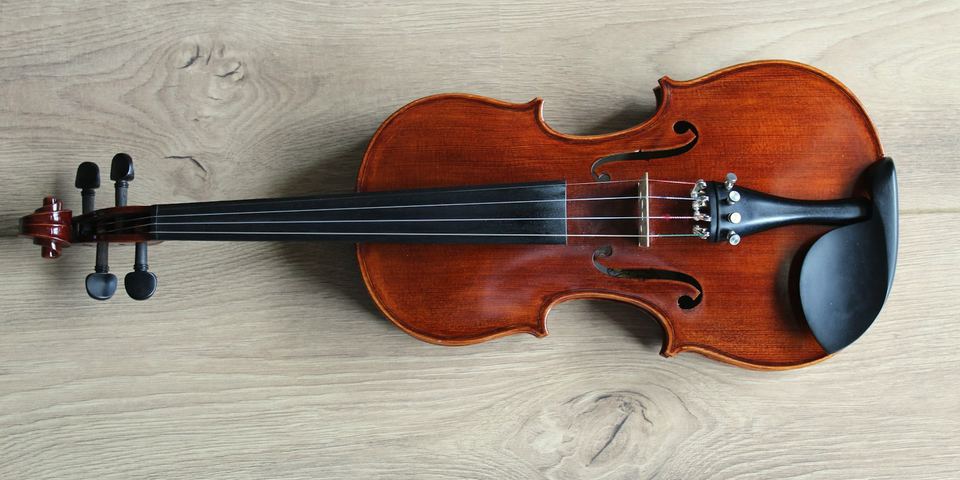
The violin
The violin is a bowed string instrument with four strings tuned G, D, A and E. It is the smallest and highest member of the violin family. The player holds it under the chin and draws a bow of horsehair across the strings. The violin leads the orchestra, and it is called the fiddle in folk music.
A solo violin plays this piece. Listen for the changes of bow direction between the notes.
Music: Envato (Orchestralis)
The sound of the violin
The first button below plays the opening of the first sonata for solo violin by Bach. It begins with a full chord in G minor. The bow crosses three or four strings at once, so the notes of the chord sound as a quick spread. Listen to how the bow then keeps the long notes singing.
A dance movement by Bach, an allemande, follows. You also hear a low note, a high note, a plucked note and a tremolo. A tremolo repeats one note with rapid bow strokes. On the last button a recorded grand piano plays the four open strings, from the G below middle C upward.
History of the violin
The violin took its form in northern Italy early in the sixteenth century. The new craft grew up in Brescia and in Cremona. In Cremona, Andrea Amati made the oldest violins that survive today.
In the second half of that century, the French court of Charles IX ordered a set of painted string instruments from Amati. Violins from that set survive in Oxford and in Cremona. A bass instrument from the same order, now cut down to a cello, is the oldest known bass of the violin family.
The craft passed from father to son. Andrea Amati's grandson kept the Cremona workshops alive after the plague of the next century. Among his pupils was the founder of the Guarneri family of makers. Antonio Stradivari worked in Cremona for about seventy years. His violins from the early eighteenth century are the most admired of all. Giuseppe Guarneri, called del Gesù, built violins with a darker and more powerful tone than that of a Stradivari.
The violin of Bach's time differed from the modern one. In the eighteenth and nineteenth centuries, makers lengthened the neck and tilted it farther back. They also fitted heavier strings and a heavier bass bar. The bass bar is a strip of wood glued inside the top. These changes made the sound stronger. Many old Italian violins were rebuilt in this way. François Tourte of Paris gave the bow its modern form. Its stick curves inward toward the hair.
In the nineteenth century, workshops in Mirecourt in France and in Saxony and Bohemia made violins in great numbers. These trade violins put the instrument into the hands of students and folk players around the world.
The role of the violin in music
In the orchestra the violins form the largest section. They divide into first violins, which often play the melody, and second violins, which play the harmony below. The leader of the first violins, called the concertmaster in the United States, plays the violin solos and leads the tuning. In a string quartet two violins play with a viola and a cello.
Fiddle is the name of the same instrument in folk music. The fiddle plays the dance music of Ireland, Scotland and Scandinavia, and the bluegrass, Cajun and country music of North America. The violin is heard in the mariachi of Mexico and in Arabic and Iranian music.
In South India the violin became a main instrument of Carnatic music. The player sits cross-legged on the floor and rests the scroll on the right foot. The strings are tuned to Sa and Pa, and the left hand is free to slide between notes in the ornaments of the music.
Music for the violin
Solo music for the violin grew up in Italy in the seventeenth century. Arcangelo Corelli's sonatas and concertos became models for players across Europe. Antonio Vivaldi wrote hundreds of concertos. The best known of them are the four concertos of The Four Seasons. Bach wrote six sonatas and partitas for violin alone. In them one violin plays melody, bass and harmony together by bowing chords across the strings. The partita in D minor ends with the Chaconne. It is a long set of variations over a repeated bass.
The concertos of the classical and Romantic periods form the center of the solo repertoire. Mozart wrote five violin concertos as a young man. The concertos of Beethoven, Mendelssohn, Brahms and Tchaikovsky followed. Paganini's caprices for solo violin stretched what the left hand and the bow could do. In the twentieth century Bartók, Prokofiev and Shostakovich wrote two concertos apiece.
Chamber music gives the violin an equal voice beside other instruments. Students learn the string quartets of Haydn, Mozart and Beethoven, and the sonatas for violin and piano by Mozart, Beethoven and Brahms.
Music: Envato (Orchestralis)
A solo violin plays a melody over a drone. Listen to how the bow keeps the notes sounding.
How the violin is made
A violin is built from more than seventy pieces of wood. The maker shapes them by hand and joins them with hide glue. The top is spruce, which is light and has a straight grain. The back, the sides and the neck are maple. The fingerboard is ebony, which is hard enough to resist the wear of the strings. Makers use hide glue because a joint can be opened later for repair.
The top and the back are carved from solid wood into gentle arches. The f-holes are cut into the top beside the bridge. Thin inlaid strips called purfling run around the edges. They stop cracks from spreading, and they let the top move more freely. Inside, a bass bar is glued under the top along the low strings. It strengthens the top and spreads the vibration of the low notes.
The sound post is a thin rod of spruce that stands between the top and the back, near the treble foot of the bridge. It carries vibration to the back and supports the top against the pressure of the strings. Its name in French and Italian means soul. The bridge is cut from maple and stands on the top without glue. The strings hold it in place and pass their vibration through it into the body.
The bow is a stick of wood strung with hair from a horse's tail. A violin bow holds about one hundred fifty to two hundred hairs. A screw in the frog, the part under the hand, tightens the hair. The player rubs rosin on the hair so that it grips the string. Pernambuco from Brazil is the traditional wood for the stick. It is now a protected wood, so many bows are made of carbon fiber.
How the violin is played
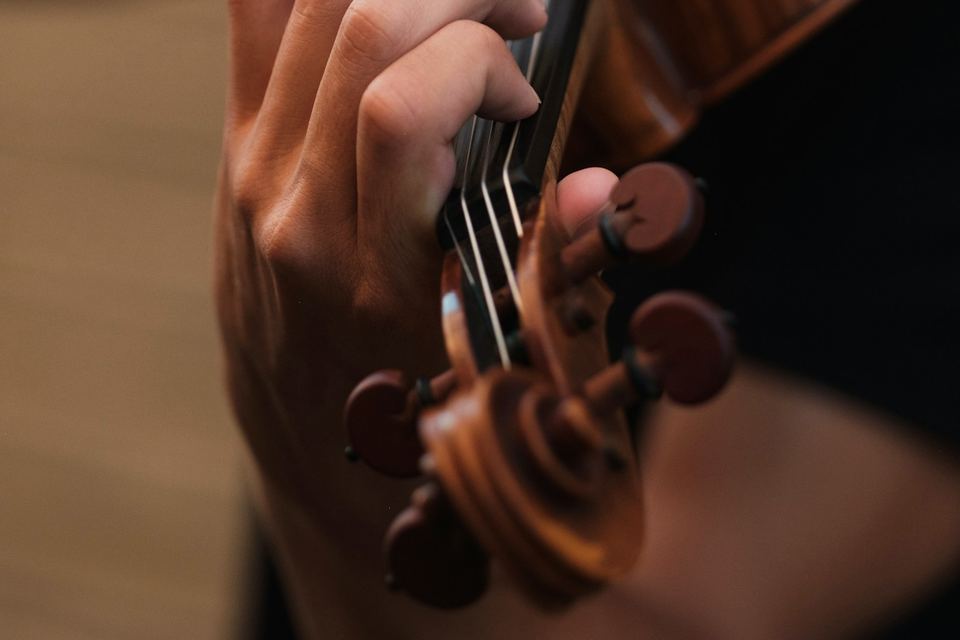
The violin rests on the left collarbone, and the jaw holds it lightly in place. Most players fit a chinrest and a shoulder rest. The left hand supports the neck and presses the strings onto the fingerboard. The fingerboard has no frets, so the player finds the pitches by ear. Many teachers put thin strips of tape on a beginner's fingerboard to mark the first finger places.
The left hand moves along the neck in positions. In first position the fingers play the notes nearest the scroll. Higher positions reach the high notes and let the player choose a string for its color. Vibrato is a regular rocking of the finger on the string. It makes the pitch waver slightly and warms the long notes.
The right arm controls the tone. The sound depends on the speed of the bow, its weight on the string and its distance from the bridge. Near the bridge the tone is bright and strong. Over the fingerboard it is soft and veiled. In legato the bow joins the notes smoothly. In spiccato it bounces lightly off the string. Players also pluck the strings, which is called pizzicato.
What makes a fine violin
The quality of a violin starts with the choice of wood. Makers choose spruce with straight, even grain for the top, and they season it for years before use. Maple for the back often shows a rippled figure called flame. A maker judges a plate by its weight, its stiffness and the note it gives when tapped.
Graduation is the carving of the top and the back to their final thickness. The top is thin, and the back is thicker at its center. The maker thins the plates by hand and tests them as the work goes on. A plate left too thick sounds tight. A plate carved too thin gives a weak, hollow tone. The shape of the arching matters as much as the thickness.
Varnish protects the wood and gives the violin its color and glow. A thin, elastic coat lets the plates vibrate freely, while a thick, hard coat can dull the tone. Setup is the last stage and the one a player feels most. It covers the cut of the bridge, the place of the sound post, the angle of the neck and the choice of strings. A careful setup brings out the voice of a modest violin.
Later makers measured the wood, the arching and the graduation of the Cremona violins. Many modern violins follow a Stradivari or a Guarneri model. Age alone does not make a violin fine. A new violin from a skilled maker can match the tone of an old one. A well-made student violin with a good setup is the right first instrument.
Choosing a violin
Violins come in fractional sizes for children. The fractions are names and do not give true proportions. A three-quarter violin is slightly smaller than a full one. A teacher or a violin shop measures the arm held straight out to the side. The measurement runs from the neck to the wrist. The table gives the usual ranges. A child between two sizes usually takes the smaller one.
A beginner's outfit usually includes a bow, a case and rosin. Check that the pegs turn smoothly and hold their place. The strings should sit low enough over the fingerboard to press easily. Ask a teacher or a violin shop to check the bridge and the sound post. Many families rent violins while a child grows through the sizes.
| Size | Arm length in inches | Arm length in centimeters |
|---|---|---|
| Full size (4/4) | over 23¾ | over 60 |
| Three-quarter (3/4) | 22¼ to 23¾ | 56.5 to 60 |
| Half (1/2) | 20¼ to 22¼ | 51.5 to 56.5 |
| Quarter (1/4) | 18½ to 20¼ | 47 to 51.5 |
| Eighth (1/8) | 16¾ to 18½ | 42.5 to 47 |
| Tenth (1/10) | 15¼ to 16¾ | 39 to 42.5 |
| Sixteenth (1/16) | 14 to 15¼ | 35.5 to 39 |
Who keeps these instruments
Museums, libraries and foundations care for the finest old violins. The Ashmolean Museum in Oxford keeps the Messiah. This Stradivari violin is in almost new condition. By the terms of its gift it is not played. The Museo del Violino in Cremona holds the city's collection. It includes violins by Andrea Amati, Stradivari and Guarneri del Gesù. Genoa keeps Paganini's Guarneri violin, Il Cannone, in the Palazzo Doria-Tursi.
Some collections are kept to be heard. The Library of Congress in Washington holds Stradivari instruments that were given on the condition that they be played. They still sound in its concert hall. The National Music Museum in Vermillion, South Dakota, keeps the bass instrument that Andrea Amati made for Charles IX. Orchestras and foundations also own fine violins and lend them to their players.
Violin making continues in Cremona today. UNESCO lists traditional violin making in Cremona as intangible cultural heritage. Students train at a school of violin making and then in local workshops. The instruments are still built by hand around an inner mold.
First steps on the violin
Tune the four strings to G, D, A and E with the tuner. Rub rosin along the bow hair a few times.
Rest the violin on the left shoulder, and hold it with the jaw. Draw long, slow bows on the open strings first. Keep the bow halfway between the bridge and the fingerboard, and keep it parallel to the bridge.
Then place the first finger on the A string. It plays B, which lies a whole step above the open string. Play the notes slowly with the metronome, and check all the notes with the tuner.
A short check
Choose one answer per question.
Which notes are the open strings of the violin?
From the lowest string, the violin is tuned G, D, A and E. The strings lie a perfect fifth apart.
What is pizzicato?
In pizzicato the player plucks the string with a finger. Most violinists keep holding the bow while they pluck.
What does rosin do for the bow?
Rosin gives the horsehair grip. Without rosin the bow slides over the string and makes almost no sound.
Which instrument of the violin family plays highest?
The violin is the smallest and highest member of the family. The viola, the cello and the double bass play lower.
Which string is this?
This is G. It is the lowest open string of the violin and the G below middle C.
Sources
- Wikipedia: Violin
- Wikipedia: Nicolò Amati
- Google Arts and Culture: the King cello by Andrea Amati
- Ashmolean Museum: the Messiah violin by Stradivari
- Wikipedia: Museo del Violino
- Wikipedia: Il Cannone Guarnerius
- Library of Congress: musical instruments at the Library
- UNESCO: traditional violin craftsmanship in Cremona
- Wikipedia: Bow (music)
- Johnson String Instrument: sizing chart
Common questions
Is the violin hard to learn?
A first goal is a clear, even tone on the open strings, and most beginners reach it in the first weeks. Placing the fingers in tune takes longer, because nothing on the fingerboard marks the notes.
What is the difference between a violin and a fiddle?
They are the same instrument. Fiddle is the usual name in folk music, and some fiddlers set up the bridge a little flatter for playing two strings at once.
What is the difference between a violin and a viola?
The viola is larger and plays a fifth lower. Its strings are C, G, D and A, and it reads the alto clef.
What size violin does a child need?
It depends on the length of the arm. With the arm held straight out, measure from the neck to the wrist and compare the length with a size chart.
How long does it take to learn the violin?
With daily practice, many students play their first folk tunes and easy pieces within a few months. A clear, even tone in the high positions takes years.
What clef does the violin read?
The violin reads the treble clef. Its lowest note, the open G string, is the G below middle C.
What wood is a violin made of?
Most violins have a spruce top with a maple back, maple sides and a maple neck. The fingerboard is usually ebony, and the bow stick is pernambuco or carbon fiber.
Why are Stradivari violins so famous?
Antonio Stradivari refined the Cremona model over a long career. His best violins join choice wood with exact carving, and they give a strong, even tone that players still prize.