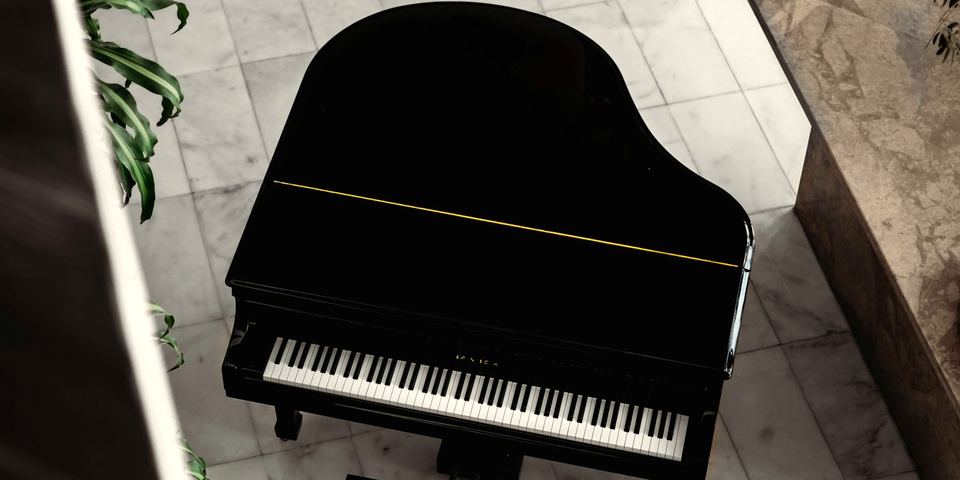
The piano
The piano is a keyboard instrument with strings inside. When you press a key, a felt hammer strikes the strings. The harder you press, the louder the note sounds. A modern piano has eighty-eight keys. They run from the lowest A to the highest C. Bartolomeo Cristofori invented the piano in Florence at the turn of the eighteenth century.
A pianist plays Clair de lune by Debussy. It is the third piece of his Suite bergamasque.
Music: Envato (StanNau)
The sound of the piano
The first button below plays the Nocturne in E♭ major, opus 9 number 2, by Chopin. A nocturne is a night piece. The left hand plays a wide, rocking accompaniment, and the right hand sings an ornamented melody above it. Listen to how the sustain pedal, the right pedal, lets the notes of a harmony ring together.
On a recorded Steinway grand piano you can also hear the C major scale, a C major chord and the keyboard's A notes. The A notes run from the lowest key up to the A near the top. The low notes ring long and dark, and the high notes fade quickly.
Names of the piano
The first Italian name of the instrument was gravicembalo col piano e forte. The words mean "harpsichord with soft and loud," and the name was later shortened to pianoforte and to piano. Pianoforte means "soft-loud" in Italian. Early pianos of the eighteenth and early nineteenth centuries are often called fortepianos today. The name sets them apart from the modern instrument. In German the piano is das Klavier, and in French it is le piano.
The name tells what was new about the instrument. A harpsichord plucks its strings with quills at the same strength, however the key is pressed. On the piano, the speed of the hammer follows the finger. The player can make any note soft or loud.
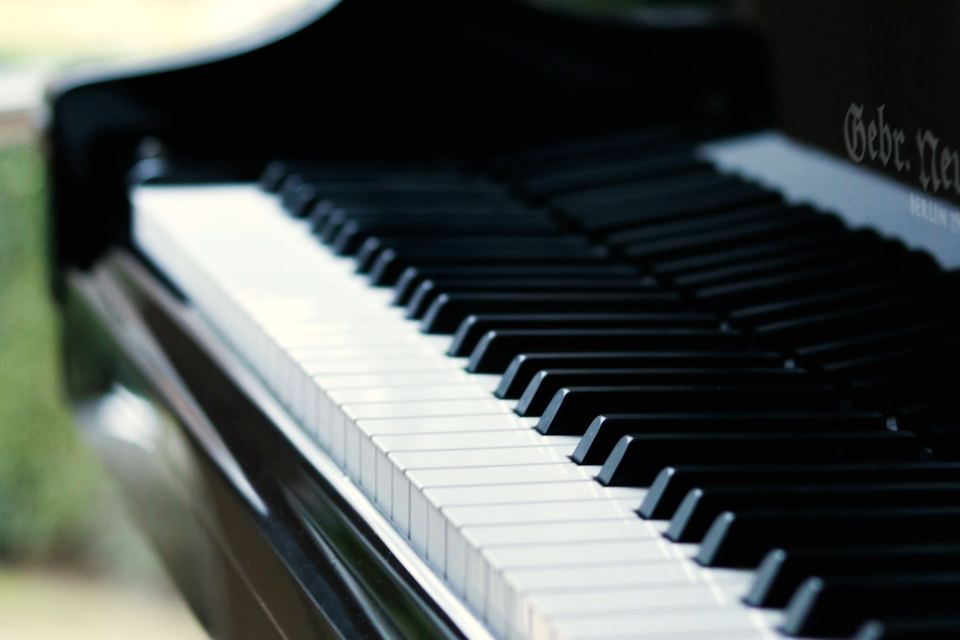
History of the piano
Bartolomeo Cristofori was a harpsichord maker from Padua. He worked for Prince Ferdinando de Medici in Florence. An inventory of the Medici instruments from the turn of the eighteenth century describes his new harpsichord "that makes soft and loud" in detail. It is the first clear record of the piano. About a decade later the writer Scipione Maffei described the instrument and its action in a journal article. Only three of Cristofori's pianos survive.
At first the piano sounded softer than the harpsichord, and it spread slowly. In Germany, Gottfried Silbermann built pianos on Cristofori's design. Late in the eighteenth century two schools of making grew up. Viennese makers such as Johann Andreas Stein and Anton Walter built pianos with light actions, wooden frames and hammers covered in leather. Mozart played and admired their instruments. In London, the firm of Broadwood built heavier pianos with a louder, fuller tone.
In the nineteenth century Paris became the center of piano making. The firm of Pleyel built the pianos that Chopin played, and Érard built those of Liszt. Sébastien Érard invented the double escapement, which lets a note repeat before the key has risen fully. Jean-Henri Pape first covered hammers with felt. In Boston, makers cast the frame of the piano in a single piece of iron, which could hold far greater tension. In New York, Steinway patented a grand piano with crossed strings. Its long bass strings run over the others.
These changes produced the modern concert grand. It has a range of more than seven octaves and a far louder tone than the early piano. The upright piano brought the instrument into ordinary homes. The twentieth century added the player piano, the electric piano and the digital piano.
The role of the piano in music
The piano plays melody, harmony and bass at once, and its range covers almost the whole orchestra. It is a solo instrument with one of the largest repertoires in music. It also accompanies singers, choirs and other instruments. In the concerto, a solo pianist plays with and against a full orchestra.
In chamber music the piano joins string players in the piano trio, the piano quartet and the piano quintet. In jazz it plays chords with the bass and the drums and takes solos. Composers and arrangers work at the piano because it lets them hear the full harmony of a score. Teachers use it to give pitches in ear training and in singing lessons.
Music for the piano
Mozart wrote sonatas and more than twenty concertos for the piano. Beethoven wrote thirty-two piano sonatas. They include the Pathétique, the Moonlight and the Appassionata. Schubert wrote sonatas, impromptus and hundreds of songs with piano.
In the Romantic period the piano became the main instrument of concert halls and of music making in families. Chopin wrote nearly all his music for it: nocturnes, études, preludes, ballades, mazurkas and polonaises. Schumann wrote cycles of short character pieces. Liszt wrote études and rhapsodies that demand great speed and power. Brahms wrote intermezzos, variations and two concertos.
In France, Debussy and Ravel drew new colors from the pedal and from the softest playing. Rachmaninoff and Prokofiev wrote concertos for the strongest players. Ragtime, blues, gospel and jazz all grew up around the piano. In jazz, Art Tatum, Thelonious Monk and Bill Evans all found their own new styles of harmony and touch.
Clair de lune, the piece at the top of the page, is the third of the four pieces of the Suite bergamasque by Debussy. Its title means "moonlight," and it comes from a poem by Paul Verlaine. The piece is in D♭ major and in nine-eight time. It opens pianissimo. Piano means soft in Italian, and pianissimo is softer still. In the right hand, two voices move together, and the melody floats across the bar lines. In the middle section the left hand plays flowing arpeggios. An arpeggio is a chord played one note at a time. The music grows warmer and louder before the opening melody returns. Notice how the sustain pedal lets the harmonies ring under the melody.
How the piano works
A piano has three main systems: the strings with their frame, the soundboard and the action. A grand piano has more than two hundred strings. Most notes in the treble have three strings tuned to the same pitch. The tenor notes have two strings, and the lowest bass notes have one. The bass strings are wound with copper wire. The extra weight lets them sound low without great length.
The strings pull on the piano with a total force that can exceed twenty tons in a concert grand. A frame of cast iron, called the plate, takes this force. The strings run from hitch pins on the plate, across the bridges, to tuning pins set in a block of hard laminated wood. A tuner turns these pins to set the pitch. Under the strings lies the soundboard, a broad, thin panel of spruce. The bridges carry the vibration of the strings into it, and its large surface moves enough air to fill a hall.
The action links the keys to their hammers. A key is a lever. When the finger presses the front of the key, the back end rises and lifts a part called the wippen. A jack on the wippen pushes the hammer up toward the strings. The jack slips out from under the hammer an instant before it strikes. The hammer flies free, strikes the strings and falls back at once, so the strings can ring. This release is called escapement. At the same moment the key lifts a felt damper off the strings. When the key is released, the damper falls back and stops the sound.
A grand action has a second lever, the repetition lever, which catches the hammer as it falls. The player can strike the same note again before the key rises all the way. This is the double escapement of Érard. In an upright piano the action stands on end, and springs help the hammers return. Fast repeated notes are harder on an upright for this reason.
How the piano is played
The pianist sits at the center of the keyboard, near middle C. The forearms are about level with the keys. The height of the bench and its distance from the keys let the arms move freely. In piano fingering the thumb is 1 and the little finger is 5. Good fingering lets the hand pass smoothly from one group of notes to the next. In a scale the thumb passes under the hand, and the hand crosses over the thumb.
Tone on the piano comes from the speed of the hammer, and that speed comes from the way the key goes down. A light, quick touch gives a soft note. The weight of the arm gives a full, deep note. In legato a key is held until the next one sounds, so the notes join smoothly. In staccato the notes are short and detached. Pianists also balance the voices. They play the melody a little louder than the accompaniment, even when one hand plays both.
Most pianos have three pedals. The right pedal, the sustain pedal, lifts all the dampers. The notes keep sounding after the keys come up, and the other strings ring in sympathy. On a grand piano the left pedal, called una corda, shifts the whole action sideways, so the hammers strike fewer strings. On an upright it moves the hammers closer to the strings. The middle pedal of a grand, the sostenuto pedal, holds only the notes already sounding when it goes down.
Piano music is written on a grand staff. The treble clef usually holds the music of the right hand, and the bass clef holds the left. Beginners start with a five-finger position around middle C. They learn to read both clefs, to play with both hands together and to count a steady beat.
What makes a fine piano
A piano is built to a scale design. This is the plan of the lengths, the thicknesses and the tensions of its strings. Long strings give a rich tone with overtones close to their true pitches. A short string must be thicker or tighter to reach the same note. It is then stiffer, and its overtones go slightly sharp. This effect is called inharmonicity, and it makes the bass of a small piano sound harsh. A concert grand, about two and three-quarter meters long, has the longest strings and the clearest bass.
The soundboard is cut from spruce with fine, even grain. Makers choose wood that is light and stiff, and they dry it slowly. Ribs glued across the underside give the board a slight arch, called crown, which pushes back against the strings. The rim of a grand is bent from layers of hardwood such as maple, and it holds the soundboard firm.
The hammers are wool felt pressed over a wooden core, and their density shapes the tone. Hard felt sounds bright, and soft felt sounds round. A technician voices the hammers by pricking the felt with needles, so the tone stays even from key to key. Regulation sets the many small distances in the action. They include the point of escapement and the depth of the keys. A well-regulated action lets the player control the softest notes.
Pianos wear with use. The hammers grow hard and grooved, the felts compress, and the soundboard can lose its crown. A technician can restore them, but a neglected piano may no longer hold its tuning. A fine digital piano copies these qualities in its own way. It uses weighted keys with a hammer motion and recordings of a concert grand at many levels of loudness.
Choosing a piano
An acoustic piano needs space and a room with steady temperature and humidity. A technician should tune it once or twice a year. An upright fits against a wall. A grand needs more room, but it gives a faster action and a fuller tone.
A digital piano stays in tune, plays at any volume with headphones and can connect to a computer. For the first lessons, a keyboard with lighter keys is enough. For piano music at the higher levels, choose eighty-eight weighted keys with a hammer action and a sustain pedal. The buying guide lists models with the details from the makers' own pages.
Who keeps these instruments
The oldest of the three surviving pianos by Cristofori is in the Metropolitan Museum of Art in New York. The others are in the National Museum of Musical Instruments in Rome and in the Museum of Musical Instruments of Leipzig University. The National Music Museum in Vermillion, South Dakota, holds two grand pianos of the eighteenth century with the action that Cristofori designed.
The houses of two composers keep pianos that the composers owned. The Beethoven House in Bonn shows Beethoven's last piano. Conrad Graf of Vienna built it. In Salzburg, the International Mozarteum Foundation keeps Mozart's own fortepiano by Anton Walter in the house where he was born. Pianos of that time had a lighter, clearer tone than modern pianos.
The leading piano firms of the nineteenth century still build instruments by hand. Steinway & Sons builds grand pianos in New York and Hamburg. Bösendorfer builds them in Austria, and Bechstein in Germany. Conservatories and concert halls keep fleets of grand pianos, and technicians tune and regulate them before a concert.
First steps on the piano
Sit at the center of the keyboard. Find middle C. It is the white key directly to the left of the pair of black keys nearest the center. Place the right thumb on it, and rest fingers 2, 3, 4 and 5 on D, E, F and G.
Play the five notes up and down slowly with the metronome. Keep the fingers curved, and let a key rise before the next one goes down. Then place the left little finger on the C below and play the same five notes. Play hands together when both hands are steady. The piano keys page shows the names of the keys.
A short check
Choose one answer per question.
What strikes the strings of a piano?
The keys throw felt hammers against the strings. A harpsichord plucks its strings with quills.
What does the right pedal do?
The sustain pedal lifts the dampers off all the strings. The notes ring after the keys come up.
What is escapement in a piano action?
The jack slips away an instant before the hammer strikes. The hammer then falls back at once, so the strings can ring.
Who built the first pianos?
Cristofori was a harpsichord maker at the Medici court in Florence. He built the first pianos at the turn of the eighteenth century.
What is the soundboard made of?
The soundboard is a broad, thin panel of spruce. The iron plate above it holds the tension of the strings.
Sources
- Wikipedia: Piano
- Wikipedia: Bartolomeo Cristofori
- Wikipedia: Piano action
- Wikipedia: Fortepiano
- Wikipedia: Suite bergamasque
- Metropolitan Museum of Art: grand piano by Cristofori
- National Music Museum
- Wikipedia: Beethoven House
- Mozarteum Foundation: Mozart's birthplace
- Wikipedia: Anton Walter
- Wikipedia: Steinway & Sons
Common questions
How many keys does a piano have?
A modern piano has eighty-eight keys: fifty-two white keys and thirty-six black keys. They run from the lowest A to the highest C. Together they span a little more than seven octaves.
Is the piano a string instrument or a percussion instrument?
It is a string instrument whose strings are struck by hammers. Most books group the piano with the keyboard instruments.
What is the difference between a grand piano and an upright piano?
A grand piano has horizontal strings and a lid that opens. An upright piano has vertical strings in a tall case. Grands usually give more control of the sound, and uprights take less space.
What do the three pedals of a piano do?
The right pedal holds the notes after you release the keys. The left pedal softens the sound. The middle pedal, where it exists, holds only the notes that are already sounding.
Who invented the piano?
Bartolomeo Cristofori built the first pianos in Florence, Italy, at the turn of the eighteenth century. He worked from the design of the harpsichord. Hammers took the place of the quills that pluck the strings of a harpsichord.
Can I learn the piano on a keyboard?
Yes. A keyboard is enough for the first lessons. As pieces grow harder, weighted keys and a sustain pedal help you control soft and loud playing.
How often should a piano be tuned?
Most technicians advise tuning once or twice a year. A piano in a room with changing humidity, or one played for concerts, needs tuning more often.
What is a fortepiano?
A fortepiano is a piano of the eighteenth or early nineteenth century. It has a wooden frame and a lighter action. Its hammers are covered in leather, and its tone is lighter and clearer than that of a modern piano.