Ludwig van Beethoven
Ludwig van Beethoven was a German composer and pianist. He was born in Bonn and spent his working life in Vienna. He wrote nine symphonies, thirty-two piano sonatas and sixteen string quartets. A sonata is a piece in several movements for one or two instruments. He kept the forms of the Classical period and gave them a larger scale.
A pianist plays the first movement of the Moonlight Sonata, Op. 27 No. 2. A movement is a complete section of a longer work with its own tempo and character. Op. is short for opus, which is the Latin word for a work. Op. 27 No. 2 is the second piece in the set that Beethoven published as opus 27.
Recording: Musopen
Life in brief
Beethoven was baptized in Bonn on December 17, 1770. Bonn was then the seat of the court of the Elector of Cologne. The Elector was a prince who ruled the region. Beethoven's father and grandfather were singers at the court. His father was a harsh teacher, and he taught the boy the keyboard and the violin. His most important teacher in Bonn was the court organist Christian Gottlob Neefe. Neefe gave the boy the preludes and fugues of Bach's Well-Tempered Clavier to study. As a teenager Beethoven played the organ and the viola at court.
At twenty-one he moved to Vienna to study with Joseph Haydn, and he never lived in Bonn again. He also studied counterpoint with Johann Georg Albrechtsberger. Counterpoint is the art of combining independent melodies. Antonio Salieri taught him to write for the voice. Noble families of Vienna became his patrons. He first became famous as a pianist. His improvisations at the keyboard astonished his listeners.
Before he was thirty, Beethoven noticed that his hearing was failing. In October 1802, while staying in the village of Heiligenstadt, he wrote a letter to his two brothers. In it he described his despair and his resolve to live for his art. The letter is known as the Heiligenstadt Testament. It was found among his papers after his death.
The next years brought the works of his heroic style. They include the Eroica Symphony, the Fifth Symphony and his only opera, Fidelio. In his last decade he was almost completely deaf. Visitors wrote their side of a conversation in small notebooks, and many of these conversation books survive. His late works include the Ninth Symphony, the Missa solemnis, the last piano sonatas and the last five string quartets.
The Ninth Symphony was first performed in Vienna on May 7, 1824. Beethoven died in Vienna on March 26, 1827. Thousands of people followed his funeral procession through the city.
How to hear his style
Beethoven built long movements from short ideas. The Fifth Symphony opens with a motif of four notes. The motif has three quick repeated notes and a long note a third lower. The whole first movement grows from this rhythm. Listen for a short motif at the start of a movement. Follow it as it returns in new keys and on new instruments.
His music moves by strong contrast. A sudden loud chord, marked sforzando, can break into a quiet passage. He often placed accents on weak beats, so the rhythm pushes against the meter. Long crescendos build tension over many measures before a climax.
He enlarged the forms he learned from Haydn and Mozart. His development sections, where the themes are broken up and recombined, grew longer and more dramatic. A coda is the closing section of a movement. His codas became so long that they worked as second developments. A minuet is a graceful dance in triple time. He often replaced it with the scherzo, which is a faster and more forceful movement in triple time. In the Fifth Symphony the scherzo leads without a break into the finale, and the music turns from C minor to C major.
Scholars often divide his work into three periods. The early works follow the Viennese Classical style. The middle works are on a heroic scale. The late works are inward and experimental. They use fugue and variation, and some have six or seven movements.
The best-known works
Start with these works. The table gives one thing to listen for per work.
| Work | What to listen for |
|---|---|
| Symphony No. 3 (Eroica) | It was longer than any symphony written before it. Beethoven scratched out the name of Napoleon from the title page when Napoleon declared himself emperor. |
| Symphony No. 5 in C minor | The motif of four notes returns in all the movements. In the finale the music breaks into C major, and trombones, a piccolo and a contrabassoon join the orchestra. |
| Symphony No. 6 (Pastoral) | This symphony pictures life in the country. At the end of the slow movement the flute, the oboe and the clarinet imitate the calls of birds. |
| Symphony No. 9 in D minor | The finale sets the Ode to Joy for soloists, choir and orchestra. The cellos and basses play the famous melody alone before the voices enter. |
| Piano Sonata No. 8 (Pathétique) | A slow, heavy introduction opens the sonata. The second movement has one of his best-loved melodies. |
| Piano Sonata No. 14 (Moonlight) | The first movement is a slow stream of triplets under a simple melody. A critic gave the sonata its nickname after Beethoven's death. |
| Für Elise | Für Elise is a short piano rondo in A minor. In a rondo the main theme returns between contrasting sections. The piece was published only after Beethoven's death. |
| Violin Concerto in D major | The timpani open the concerto with four soft strokes. This rhythm returns throughout the first movement. |
| String Quartet in C♯ minor, Op. 131 | Its seven movements are played without a pause. It opens with a slow fugue. |
This recording is the second movement of the Pathétique Sonata. It is marked Adagio cantabile. Its singing melody lies in the middle of the keyboard, and the inner voices keep a gentle pulse below it.
How the music is built
Much of Beethoven's music uses sonata form. A movement in sonata form has three parts. The exposition presents two groups of themes in two keys. The development breaks the themes into fragments and moves through distant keys. The recapitulation brings the themes back in the tonic key. Beethoven often ends with a long coda.
He liked to move to keys a third away. The Waldstein Sonata is in C major, but its second theme arrives in E major. Earlier composers usually moved to the dominant, G major. The circle of fifths shows how far E major lies from C major.
For moments of crisis his harmony uses the diminished seventh chord. It is built of minor thirds stacked one on another, and it can lead into several keys. The slow introduction of the Pathétique Sonata is full of these chords. C minor is the key of some of his most dramatic music. The Pathétique Sonata, the Fifth Symphony and the Third Piano Concerto are all in C minor.
In his late music he returned to the counterpoint of Bach. The Hammerklavier Sonata ends with a long and difficult fugue. The Grosse Fuge for string quartet is a single fugue of great length.
Pieces students learn
Beethoven's piano music runs from short dances to some of the hardest sonatas in the repertoire. The table lists pieces that teachers and exam boards often choose at the different stages. Lists change, so check the current syllabus of your board.
| Stage | Piece | What it teaches |
|---|---|---|
| Beginner | Ode to Joy in an easy arrangement | A stepwise melody in one hand position |
| Early grades | Sonatina in G major (attributed to Beethoven) | Balanced phrases over a simple bass |
| Intermediate | Für Elise | Broken chords shared evenly between the hands |
| Intermediate | Sonata in G minor, Op. 49 No. 1 | Sonata form on a small scale |
| Late intermediate | Bagatelles, Op. 119 | Character in short pieces |
| Advanced | Moonlight Sonata, first movement | A melody voiced above soft triplets |
| Advanced | Pathétique Sonata | Tremolo octaves and sudden contrasts |
| Diploma | Waldstein Sonata | Speed, stamina and long-range planning |
Beethoven also wrote for string players. Violinists learn the Spring Sonata, Op. 24, and the two Romances for violin and orchestra. Cellists learn his five sonatas for cello and piano.
Where the music lives
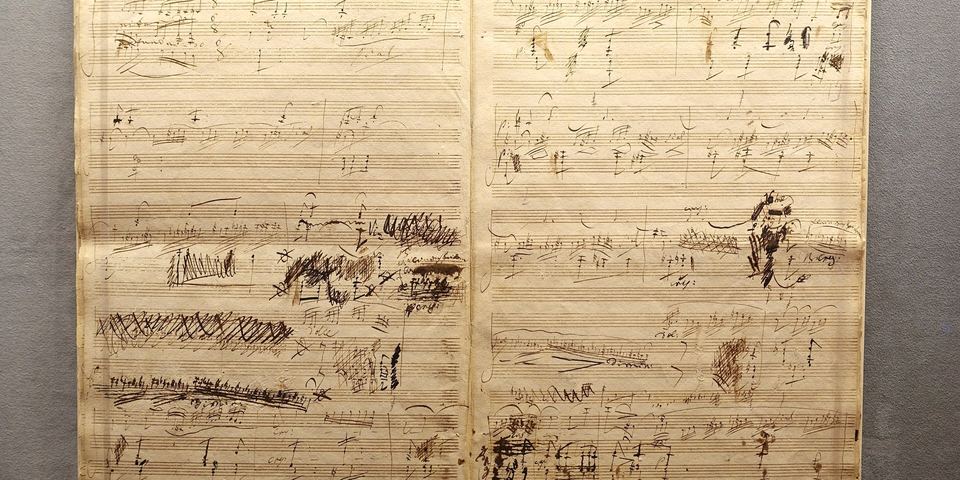
The house where Beethoven was born, at Bonngasse 20 in Bonn, is now the Beethoven-Haus. It is a museum, a research archive and a concert hall. Its collection holds letters and scores in Beethoven's own hand. Scholars call such a handwritten score an autograph. The Beethoven-Haus also keeps his last piano, built by Conrad Graf of Vienna, and the ear trumpets he used as his hearing failed.
In Vienna he moved often, and several of his homes are now museums. He lived in the Pasqualati House while he wrote much of Fidelio. The Beethoven Museum in Heiligenstadt stands in the house where he wrote the Testament. In the Eroica House in Döbling he worked on the Third Symphony.
His grave lies among the graves of honor for musicians at the Central Cemetery of Vienna. Schubert and Brahms lie nearby, and a memorial to Mozart stands among them.
Many of his manuscripts are in the Staatsbibliothek zu Berlin. They include most of the autograph score of the Ninth Symphony, which UNESCO lists in its Memory of the World Register. The Morgan Library and Museum in New York holds the autograph of the Violin Sonata in G major, Op. 96. Its pages appear at the top of this page.
A short check
Choose one answer per question.
In which city was Beethoven born?
He was born in Bonn. He moved to Vienna at twenty-one and stayed there for the rest of his life.
Which form did Beethoven use for most of his first movements?
Sonata form has an exposition, a development and a recapitulation. Beethoven often added a long coda.
Which poem does the finale of the Ninth Symphony set?
Soloists, a choir and the orchestra sing and play the Ode to Joy by Friedrich Schiller.
Which fast movement often replaced the minuet in Beethoven's music?
A scherzo is a fast movement in triple time. Scherzo means joke in Italian.
Common questions
When was Beethoven born?
The day of his birth was not recorded. He was baptized in Bonn on December 17, 1770, and he was probably born the day before.
How many symphonies did Beethoven write?
He completed nine symphonies. Sketches for a tenth symphony survive.
Was Beethoven completely deaf?
His hearing began to fail in his late twenties and grew steadily worse. In his last years he was almost totally deaf. He composed by hearing the music in his head.
Who was Für Elise written for?
No one knows for certain. The autograph is lost, and its first editor read the title as Für Elise. Scholars have proposed several women, among them Therese Malfatti.
Did Beethoven study with Mozart?
There is no firm evidence that he did. He visited Vienna as a teenager and may have met Mozart. His main teacher in Vienna was Haydn.
What is Beethoven's most famous music?
The opening of the Fifth Symphony, the Ode to Joy from the Ninth, Für Elise and the Moonlight Sonata are known around the world.
