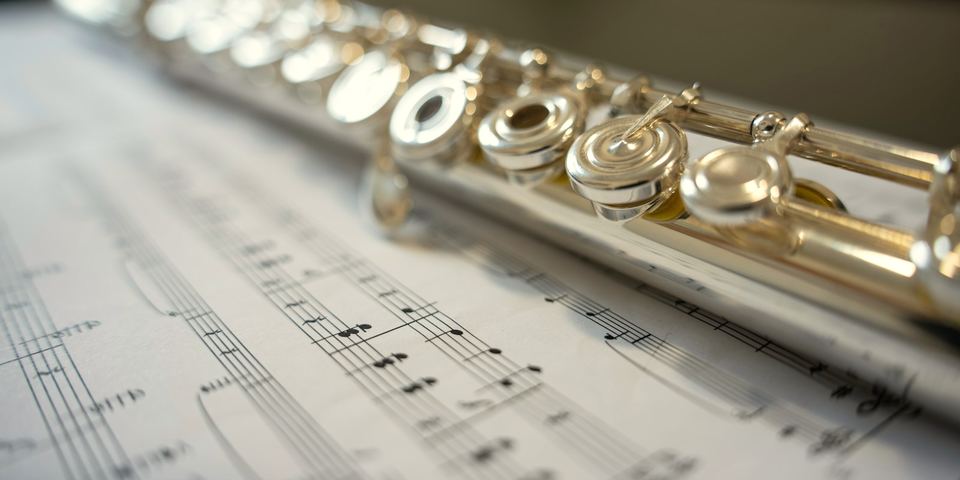
The flute
Flutes are wind instruments that sound when the player's breath flows across an opening and meets its edge. The concert flute is a metal tube held out to the right. The player blows across a hole in the head joint, and keys cover the tone holes. Its lowest note is middle C, and it plays about three octaves.
A solo flute opens the Prelude to the Afternoon of a Faun by Debussy, and the orchestra joins it.
Music: Envato (PremiumBeat)
The sound of the flute
The recording at the top of the page begins with one of the most famous flute solos. Debussy gave the opening of his Prelude to the Afternoon of a Faun to the flute alone. The line starts on C♯ and falls by half steps to G. That note lies a tritone, or three whole steps, below the first. The line then turns and climbs again. After the first phrase the orchestra enters softly. Debussy based the music on a poem by Mallarmé. In the poem a faun, a creature of the woods in ancient myth, plays his pipes on a hot afternoon.
The first button below plays the Badinerie by Bach. It is the quick last movement of his second orchestral suite. The flute plays the melody above the strings.
Single notes follow. You hear the lowest note, which is middle C. The C an octave higher and a high A come next. The fourth note is staccato, which means short and detached.
Names of the flute
The word flute entered English in the Middle Ages, probably from Old French. A person who plays the flute is a flutist in American English and a flautist in British English. The concert flute is also called the C flute or the Boehm flute. The second name comes from the maker who designed it. Older scores use the Italian flauto traverso for the side-blown flute, and Europeans long called it the German flute.
History of the flute
Flutes are among the oldest known instruments. Bone flutes found in caves in southern Germany are tens of thousands of years old. The bamboo flute has a long history in China and India, where the bansuri is still a main instrument of classical music.
The transverse flute is held to the side. It reached Europe from Asia through the Byzantine Empire and spread to Germany and France. Swiss soldiers used it for signals, and armies carried it across Europe. Renaissance flutes were made in one piece. Their bore, the inside of the tube, was narrow and kept the same width along its length. Players used them in several sizes as a family, and their tone was soft.
In the Baroque period, makers redesigned the flute. The new traverso was built in three or four joints, and its bore narrowed from the head joint down. It had six finger holes and a single key. Its tone was soft and mellow, and the player corrected the pitch of many notes with the lips. Composers now wrote solos for it. The Prussian king Frederick the Great played the flute and composed for it.
Later makers added more keys for the chromatic notes. In the nineteenth century Theobald Boehm rebuilt the flute. He was the son of a Munich goldsmith. He became a court flutist and studied acoustics. He made the tube of metal, with a wide, straight bore and a tapered head joint. Large tone holes sat where the acoustics required them, and linked keys let the fingers close holes they could not reach. His fingering system, patented in the middle of the century, still shapes the modern flute.
The wooden flute did not disappear. Wooden flutes with six holes, pitched in D, are still played in Irish traditional music. Players of early music use copies of the Baroque traverso.
The role of the flute in music
The flute plays in orchestras, concert bands, military bands and marching bands. In the orchestra the flutes often carry high melodies above the strings. Many orchestral scores call for two or three flutes, and one of the players often changes to the piccolo.
The flute is also a member of the wind quintet with the oboe, the clarinet, the bassoon and the horn. Flute choirs join flutes of several sizes. They range from the piccolo down to the bass flute. The flute appears in jazz combos and big bands, and in rock as well.
Music for the flute
Vivaldi wrote some of the first concertos for the flute. Bach wrote sonatas for flute and keyboard, a partita for flute alone and the second orchestral suite, which ends with the Badinerie. Telemann wrote twelve fantasias for flute alone. Johann Joachim Quantz taught the flute to Frederick the Great and wrote a famous book on how to play it. Mozart wrote concertos for the flute and a concerto for flute and harp.
Debussy opened his Prelude to the Afternoon of a Faun with a flute solo that falls by half steps. The flutist Georges Barrère played it at the first performance in Paris. Debussy's Syrinx is a short piece for flute alone. Ravel gave the flute a long solo in Daphnis and Chloe. Fauré wrote a Fantaisie for flute and piano, and Poulenc and Prokofiev both wrote sonatas for the same pair.
Play the two flute recordings on this page one after the other. In the Badinerie the flute plays quick, light notes in a Baroque dance. In the music by Debussy it plays slow, floating lines, and the orchestra adds soft colors around them.
How the flute is made
A concert flute has three parts: the head joint, the body and the foot joint. The head joint carries the lip plate and the embouchure hole. The player blows across this hole. The crown at the top of the head joint screws off. Below it, a cork seals the closed end of the tube, and its position affects the tuning of the whole flute. The head joint narrows slightly toward the closed end.
Student flutes are usually made of silver-plated brass or nickel silver. More costly flutes are solid silver, and some are gold. A few makers use other materials, among them wood and platinum.
The keys are cast and then finished by machine, and their posts are soldered to the tube. Needle springs of bronze, steel or gold push the keys back. Pads of fine skin over felt seal the tone holes. On professional flutes a technician seats the pads on thin paper shims. The work takes a long time, because the pads must close their holes exactly.
How the flute is played
The player rests the lower lip on the lip plate and aims a narrow stream of air across the embouchure hole. The air strikes the far edge of the hole.
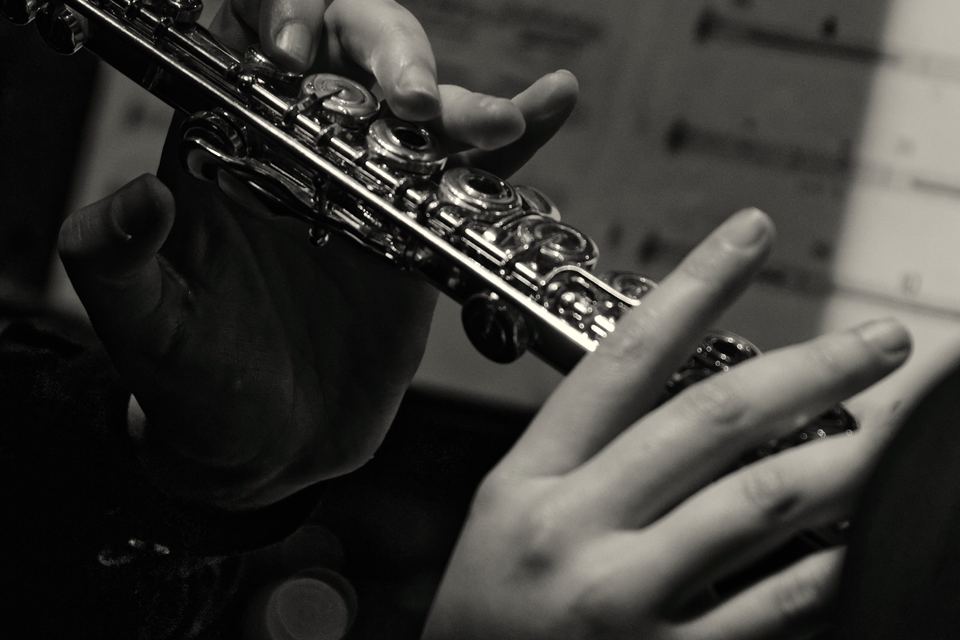
Keys over about sixteen tone holes change the length of the vibrating air. A faster air stream lifts the same fingering into a higher octave, which is called overblowing. The usual range runs from middle C to the C three octaves above it.
The tongue starts the notes. In fast passages flutists use double tonguing, with the syllables ta and ka, or triple tonguing. Flutter tonguing rolls the tongue and gives a buzzing sound. Most flutists add vibrato, a gentle waver in the pitch, to long notes. The highest notes of the third octave need a fast, narrow air stream and exact fingerings.
What makes a fine flute
The head joint has the strongest effect on the sound. The lip plate and the embouchure hole have exact sizes, edges and angles. Small differences in them change the tone and the response. A player usually chooses a flute by playing it. Teachers often suggest a finer head joint to improve the tone of a student flute.
The scale is the placement and the size of the tone holes. A good scale lets all the notes sound in tune with little effort. The pads must seal the tone holes completely. A flute with a small leak feels stuffy, and its low notes are hard to play.
Players disagree about the metal. Some hear a warmer tone in silver or gold. The American flute maker Verne Q. Powell said that the player makes most of the tone. Open-hole keys and a B foot joint are features of many advanced flutes.
Boehm and his partner Mendler built flutes in Munich. Louis Lot made silver flutes in Paris, and some professional flutists still play them. The London firm of Rudall Carte held the British rights to Boehm's design and built flutes to it.
Choosing a flute
Student flutes have a C foot joint, so their lowest note is middle C. Some have a curved head joint for young children with short arms.
Keys come closed or open. An open-hole key has a small hole in its center, and the finger must cover it. A B foot joint adds one lower note. That note is the B below middle C.
Many flutes have an offset G key, which sits a little to the side of the other keys. Players with small hands reach it more easily. Before you buy, play the lowest notes. A flute with a leaking pad will not sound them clearly.
The flute family
The concert flute has smaller and larger relatives. The piccolo sounds an octave higher. The alto flute sounds a fourth lower, and the bass flute sounds an octave lower.
Flutes from other traditions differ in how the air meets the edge. The bansuri of India is held to the side like the concert flute. The shakuhachi of Japan is blown across the open upper end of its bamboo tube. The pan flute joins pipes of different lengths. A pipe sounds one note. The tin whistle has a duct. A duct is a narrow channel in the mouthpiece that aims the air at the edge.
Who keeps these instruments
The Library of Congress in Washington keeps the Dayton C. Miller Collection. Miller was a physicist who studied the sound of the flute and played it himself. He gave the Library nearly seventeen hundred flutes and other wind instruments from around the world. Among them are eighteen crystal flutes from the Paris workshop of Claude Laurent. President James Madison received one of these as a gift. The collection also holds music, books, letters and the catalogs of flute makers.
The Metropolitan Museum of Art in New York keeps flutes by Theobald Boehm and by his Munich firm, Boehm and Mendler. Among them is an alto flute, a size that Boehm made possible with his keywork. The museum also keeps flutes and a piccolo by Louis Lot of Paris.
First steps on the flute
Begin with the head joint alone. Cover its open end with the palm of the right hand, and blow across the hole until a clear note sounds.
Then fit the flute together, and hold it out to the right. With the left hand, play B, A and G in turn. The notes add one finger at a time.
Hold long, even notes, and check them on the tuner. A clear tone on these three notes is the first goal.
A short check
Choose one answer per question. The explanation appears below the correct answer.
How does a flute make its sound?
The player blows across the embouchure hole. The air meets the far edge of the hole and sets the air inside the tube vibrating.
What is the lowest note of a student flute?
A student flute has a C foot joint, so its lowest note is middle C.
What is overblowing?
A faster air stream makes the same fingering sound in a higher register.
Which flute has a duct in its mouthpiece?
The tin whistle has a narrow duct that aims the air at the edge. The other three are blown across an open edge.
Sources
Common questions
Why is the flute a woodwind if it is made of metal?
Woodwinds are grouped by how they make sound. The flute sounds when air meets an edge, as the wooden flutes before it did.
Is the flute hard to learn?
The first hurdle is a clear note on the head joint alone, because the lips must aim the air exactly. Most beginners then play B, A and G within their first lessons.
What is the difference between a flute and a piccolo?
The piccolo is a small flute that sounds an octave higher. Its music is written an octave below the sound.
What is the difference between a flute and a recorder?
The recorder is held straight down and has a duct that aims the air for the player. On the flute, the lips shape the air stream.
Is flute music written in the treble clef?
Yes. The concert flute is pitched in C, so its music sounds as written.
What is a B foot joint?
It is a longer foot joint with an extra key. It adds the B below middle C and is common on more advanced flutes.
What is the most famous flute solo?
The opening of the Prelude to the Afternoon of a Faun by Debussy is one of the best known. The flute plays it alone before the orchestra enters.