Johann Sebastian Bach
Johann Sebastian Bach was a German composer and organist of the Baroque period. He served churches and courts in central Germany, and he worked in Leipzig for his last twenty-seven years. He wrote cantatas, passions, organ music, keyboard music and concertos. Musicians still study his counterpoint, the art of combining independent melodies.
A string ensemble plays the Air from the Orchestral Suite No. 3 in D major, BWV 1068. BWV is the catalog of Bach's works, and the pieces have their own BWV numbers.
Life in brief
Bach was born in Eisenach on March 21, 1685. The date follows the old calendar then used in Protestant Germany. He came from a large family of town and church musicians. Both his parents died before he was ten. He then lived with his eldest brother, Johann Christoph, who was an organist in Ohrdruf and taught him the keyboard.
At fifteen he went north to Lüneburg as a choirboy at St. Michael's School. His first posts were as an organist in Arnstadt and in Mühlhausen. While he worked at Arnstadt, he traveled more than four hundred kilometers to Lübeck. Early accounts say that he walked. In Lübeck he heard the great organist Dieterich Buxtehude.
In Weimar he served the duke as court organist. Later he became concertmaster, which meant that he led the court orchestra. Many of his great organ works come from these years. When he asked to leave, the duke held him under arrest for almost a month. In Köthen he then led the court music for Prince Leopold. The court church was Calvinist and used little music, so Bach wrote mainly instrumental works there. They include the Brandenburg Concertos, the cello suites, the music for solo violin and Book One of The Well-Tempered Clavier.
From his late thirties until his death, Bach was Thomaskantor in Leipzig. In this post he taught at the St. Thomas School and directed the music of the city's main churches. In his first years there he wrote a new cantata for almost all the Sundays of the church year. A cantata is a work in several sections for voices and instruments. The St. John Passion and the St. Matthew Passion were first heard in Leipzig on Good Friday. A passion tells the Gospel story of the death of Jesus in music for soloists, choir and orchestra.
His eyesight failed in his last years, and two eye operations did not help. He died in Leipzig on July 28, 1750. His sons Wilhelm Friedemann, Carl Philipp Emanuel, Johann Christoph Friedrich and Johann Christian also became composers. In Berlin the young Felix Mendelssohn conducted the St. Matthew Passion about a century after its first performance. That concert started a wide revival of Bach's music.
How to hear his style
Bach's music is built from lines that move independently. In a fugue the voices state the same theme in turn. In a two-part invention the two hands imitate one another. Listen to one line at a time. Then listen to how the lines fit together into harmony.
A steady rhythmic drive runs through most of his fast movements. The bass moves in even notes, and the harmony changes at a regular pace. Many movements are dances. The suite has four main dances. The allemande is moderate, the courante is quicker, the sarabande is slow and stately, and the gigue is a fast jig. Bach often added a minuet, a bourrée or a gavotte.
His melodies are richly ornamented. Trills, mordents and turns decorate the main notes. A mordent is a quick move to the next note down and back. In slow movements such as the Air from the third Orchestral Suite, long notes hang over a walking bass.
Bach often based a work on a Lutheran chorale. A chorale is a hymn tune that the congregation sings. A cantata may end with the chorale in plain harmony for four voices. In the chorale preludes for organ, the tune sounds in long notes against faster counterpoint. He also mixed the national styles of his day. He wrote French overtures, Italian concertos in the manner of Vivaldi and German counterpoint.
The best-known works
Keyboard, string, orchestral and choral works all appear in this list.
| Work | What to listen for |
|---|---|
| The Well-Tempered Clavier | Its two books both hold one prelude and fugue per key in all twenty-four major and minor keys. The first prelude, in C major, is a calm stream of broken chords. |
| Brandenburg Concertos | He wrote the six concertos for six different groups of instruments. In the fifth, the harpsichord plays a long solo cadenza. |
| Cello Suites | Bach wrote six suites for cello alone. The Prelude of the first suite opens with broken chords over the low open G string. |
| Sonatas and Partitas for solo violin | The Partita in D minor ends with the Chaconne. It is a long set of variations over a repeated bass. |
| Orchestral Suite No. 3 in D major | Its second movement is the Air. A later arrangement for violin made it famous as the Air on the G String. |
| Goldberg Variations | An aria opens and closes the work. Between them come thirty variations. Variations 3, 6, 9, 12, 15, 18, 21, 24 and 27 are canons. In a canon all the voices play the same melody, and the voices enter one after another. |
| St. Matthew Passion | It tells the story of the Passion with two choirs and two orchestras. The chorales give the response of the congregation. |
| Mass in B minor | It sets the full Latin Mass. Bach assembled it in his last years, partly from earlier music. |
| Toccata and Fugue in D minor | This organ piece opens with a famous flourish. Some scholars doubt that Bach wrote it. |
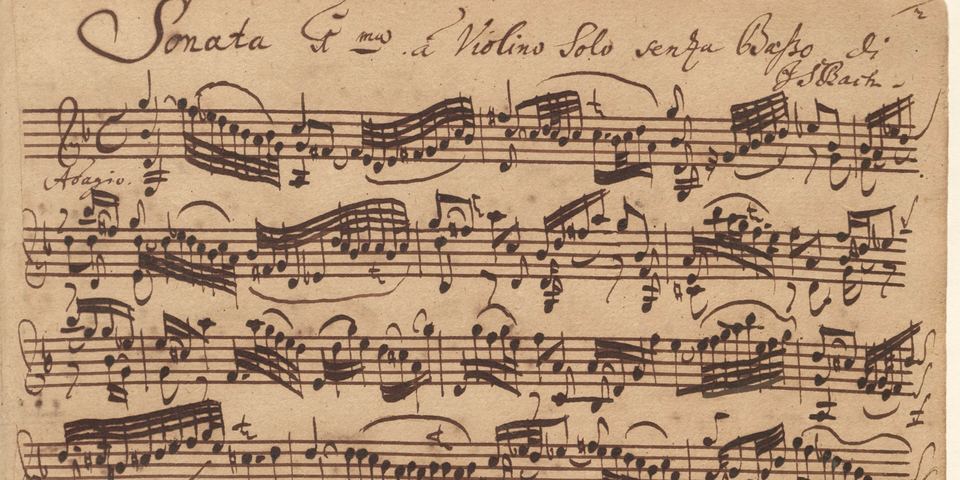
A pianist plays the Aria of the Goldberg Variations. Its melody carries many ornaments over a slow bass. The opening of the Adagio from the first sonata for solo violin follows. Its manuscript in Bach's hand appears at the top of this page. The last recording is the opening of the Prelude from the first cello suite.
How the music is built
Counterpoint is the basis of Bach's music. The voices are melodies in their own right, and together the voices make the harmony. The fugue is his central form. A fugue states a short subject in one voice. The other voices answer it in turn. The answer usually comes a fifth higher or a fourth lower.
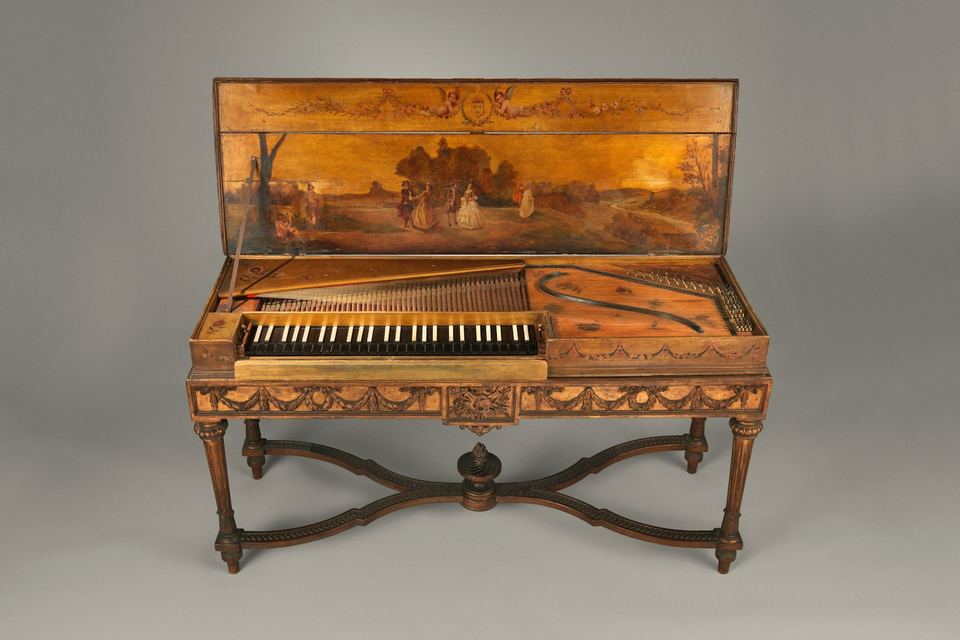
Much of his music has a basso continuo. The bass line is written out, and figures above it show the chords. A keyboard player or a lute player fills in the harmony from these figures.
Bach used the major and minor keys as a full system. The Well-Tempered Clavier shows that a keyboard tuned in a well temperament can play in all twenty-four keys. A temperament is a system of tuning. The circle of fifths maps these keys. His harmony often moves in a chain of fifths, in which one chord after another leads to the chord a fifth below.
Students learn harmony from his chorales. Bach harmonized hundreds of chorale melodies for soprano, alto, tenor and bass. Teachers use them to show how voices move from chord to chord.
Pieces students learn
Most piano students first play Bach's music in the dances from the notebook of Anna Magdalena Bach. Teachers and exam boards often set the pieces below. Confirm your choices against the current syllabus of your board.
| Stage | Piece | What it teaches |
|---|---|---|
| Beginner | Minuet in G major from the notebook of Anna Magdalena Bach | Two independent hands in a dance |
| Early grades | Little Prelude in C major, BWV 939 | Broken chords over a steady bass |
| Intermediate | Two-Part Inventions | Imitation between the hands |
| Late intermediate | Three-Part Sinfonias | Three voices in two hands |
| Advanced | The Well-Tempered Clavier | Fugues in three and four voices |
| Advanced | French Suites | Dance styles and ornaments |
| Diploma | Italian Concerto | A concerto for one keyboard |
The famous Minuet in G major is now credited to Christian Petzold. It reached us through a notebook of music that Bach and his wife Anna Magdalena kept for the family. Violinists study the solo sonatas and partitas, and cellists study the six suites. Audition lists for string players often include a movement of solo Bach.
Where the music lives
The Bach House in Eisenach is a museum of his life and of the instruments of his time. The old house at its center was once thought to be his birthplace, but the house where he was born no longer stands. Visitors hear short performances on its historic keyboards.
In Leipzig, Bach is buried in St. Thomas Church, where he worked as cantor. The St. Thomas Boys Choir still sings there. Across the square, the Bach-Archiv Leipzig runs the Bach Museum and a research library. The Bach-Archiv also holds the Leipzig Bach Festival.
The largest collection of Bach's manuscripts is in the Staatsbibliothek zu Berlin. It includes the scores of the Mass in B minor and the St. Matthew Passion in Bach's own hand. His handwritten score of the sonatas and partitas for solo violin is also in Berlin. Bach Digital, an online archive, shows many of his manuscripts free of charge.
A short check
Choose one answer per question.
In which city did Bach work for the last twenty-seven years of his life?
He was Thomaskantor in Leipzig from his late thirties until his death.
What is the subject of a fugue?
The fugue opens with the subject in one voice. The other voices enter with it one after another.
How many preludes and fugues are in one book of The Well-Tempered Clavier?
Both books have one prelude and fugue per key in all twelve major and twelve minor keys.
Who probably wrote the famous Minuet in G major from the notebook of Anna Magdalena Bach?
The Dresden organist Christian Petzold probably wrote it. The Bach family copied it into their notebook.
Common questions
When did Bach live?
Bach lived for sixty-five years. He was born in Eisenach on March 21, 1685, by the old calendar. He died in Leipzig on July 28, 1750.
How many children did Bach have?
He had twenty children by his two wives. About half of them died in childhood.
What instrument did Bach play?
He was famous as an organist and a keyboard player. He also played the violin and the viola, and he liked to play viola in an ensemble.
What does BWV mean?
BWV stands for Bach-Werke-Verzeichnis, the catalog of Bach's works. The numbers group his music by kind. BWV 1001, for example, is a work for solo violin.
Was Bach famous in his lifetime?
He was known across Germany as an organist and a master of counterpoint. His music was less known than that of Handel or Telemann, and many of his works were published only after his death.
What is the easiest Bach piece for piano?
Beginners often start with the minuets and marches from the notebook of Anna Magdalena Bach. Several of these short dances were written by other composers of the time.
