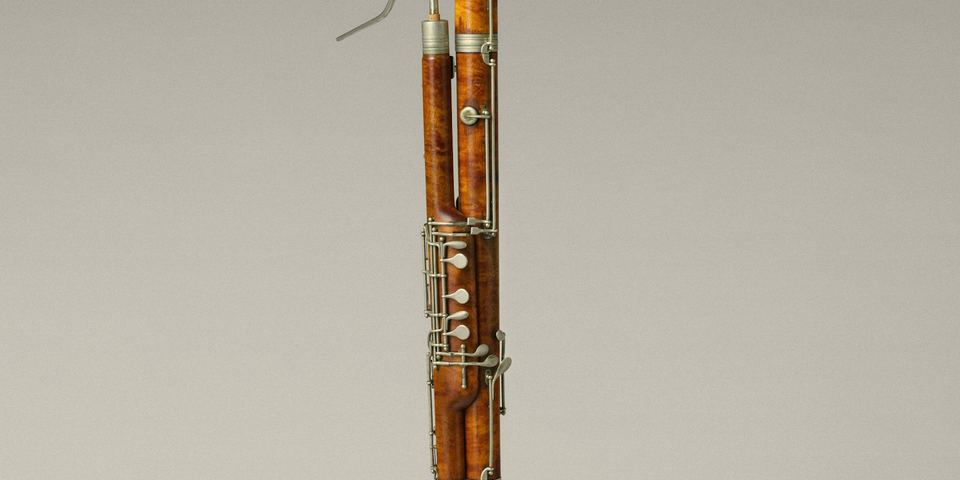
The bassoon
The bassoon is a woodwind instrument with a double reed and a long wooden tube folded in two. It plays the bass and tenor range of the woodwind section. The reed sits on a curved metal tube called the bocal. The bassoon has a warm, reedy tone, and its music is written in the bass clef.
A bassoon and an orchestra play the first movement of the Bassoon Concerto in B-flat major by Mozart.
The sound of the bassoon
Mozart wrote this concerto as a young man, and it is still the central concerto for the bassoon. In the first movement the orchestra plays the main themes first. Then the bassoon enters with the same themes. Listen to how it leaps between deep notes and tenor melodies, and how crisp its short staccato notes sound. Near the end the orchestra stops, and the bassoon plays a cadenza. A cadenza is a free solo passage.
The first button below plays the solo entry of the same movement. The second recording is the bassoon part of the overture to the opera The Marriage of Figaro by Mozart. In that overture the bassoons run with the strings at high speed. A low note and a higher note follow.
Names of the bassoon
Scores often use the Italian name fagotto. At first the word meant the dulcian, which came before the bassoon. German has the related word Fagott, and other European languages use the forms fagot and fagote. A player of the bassoon is a bassoonist.
The English word bassoon comes from the French basson and the Italian bassone. Both words mean an instrument in the bass register. The contrabassoon is a larger bassoon that plays an octave lower.
History of the bassoon
The bassoon descends from the dulcian, a double-reed instrument of the Renaissance. A dulcian was carved from a single piece of maple. Its two bores were drilled side by side and joined at the bottom, so the tube folded back on itself. By the middle of the sixteenth century, makers built dulcians in as many as eight sizes. The smallest was the soprano, and the largest was the great bass. Church musicians and town bands played them in Europe and in the Americas.
The true bassoon appeared in France in the seventeenth century. Martin Hotteterre, of a family of woodwind makers, is the person most often credited. He built the instrument in four joints: the wing joint, the boot, the bass joint and the bell. Separate joints let a maker shape the bore more exactly. The oldest bassoons that survive were made by Johann Christoph Denner of Nuremberg and by Richard Haka. During the eighteenth century, makers added keys one at a time.
The modern German bassoon began with Carl Almenräder, a bassoonist who advised the music publisher Schott. With the acoustician Gottfried Weber, he reworked the keys to improve the tuning and the response, and he published his ideas in a treatise. He then opened a workshop with Johann Adam Heckel. Heckel and two generations of his descendants refined the instrument. By the early twentieth century their German model was standard in most of the world.
The French bassoon, called the Buffet system, kept a narrower bore and a simpler mechanism. It has a lighter, more vocal tone and different fingerings. It is still played in France, in Belgium and in parts of Latin America. The two systems differ so much that a player who changes from one to the other must learn the fingerings again.
The role of the bassoon in music
In Mozart's time an orchestra usually had two bassoons. Modern orchestras often have three or four bassoonists, and the fourth player usually plays the contrabassoon as well. The bassoons play the bass of the woodwind section and often double the cellos.
The bassoon also plays tenor melodies and comic parts. Composers have long compared its tone to the human voice. It is a member of the wind quintet with the flute, the oboe, the clarinet and the horn. A concert band usually has one or two bassoons.
Music for the bassoon
Vivaldi wrote thirty-nine concertos for the bassoon. In the concerto by Mozart, the slow second movement is admired for its singing line. Carl Maria von Weber also wrote a bassoon concerto in F major.
In the orchestra the bassoon often has the bass, but composers also wrote memorable solos for it. Mozart gave it a running part with the strings in the overture to The Marriage of Figaro. Dukas used its staccato for the broom in The Sorcerer's Apprentice. Rimsky-Korsakov wrote a solo with a cadenza for it in Sheherazade.
The Rite of Spring by Stravinsky opens with a bassoon solo near the top of the instrument's range. In Peter and the Wolf by Prokofiev, the bassoon plays the grandfather.
How the bassoon is made
A modern bassoon is usually made of maple. Makers prefer medium-hard kinds such as sycamore maple and sugar maple. Some student bassoons are made of plastic, which suits outdoor playing. The tube is about eight feet four inches long, and the folded instrument stands about four and a half feet tall.
The bassoon comes apart in five pieces: the bocal, the wing joint, the boot, the long joint and the bell. The reed fits on the end of the bocal. In the boot, a U-shaped metal tube joins the two halves of the bore. The bore is conical, as the bore of the oboe is.
The walls of the wing joint and the boot are thick. Makers drill the tone holes through them at a slant. Holes that lie far apart inside the tube then open close together on the outside. There the fingers can reach them. Keys cover the holes that the fingers still cannot reach. The bore and the holes are machined with great precision, and the instrument is finished by hand to tune it.
The reed is made of cane from the giant reed, Arundo donax. The reed maker splits a tube of cane, gouges it thin, folds it and shapes it over a steel mandrel. Wire and thread hold the two blades together. Finally the maker cuts the end of the reed open and scrapes it with a knife until the reed vibrates freely. When the bassoon sounds, the two blades of cane vibrate against one another.
How the bassoon is played
The player sits and holds the bassoon at an angle across the body. A seat strap or a neck strap carries its weight. Both lips cover the reed, which rests on the bocal.
Both thumbs work many keys. The left thumb alone has several, which makes the fingering harder than on other woodwinds. Its lowest note is the B-flat more than two octaves below middle C. Its highest is about the E in the top space of the treble staff.
The bassoon has two fingering habits of its own. The left thumb holds the whisper key on the low notes, which keeps them from cracking into a higher octave. Flicking is a quick tap on a high key at the start of certain notes in the middle range. It makes a clean slur upward.
Bassoon music is written in the bass clef. High passages use the tenor clef, a C clef that places middle C on the fourth line of the staff. The highest passages use the treble clef.
What makes a fine bassoon
A fine bassoon responds easily in all three registers and stays in tune from soft to loud. Most of this depends on the bore. Small changes to its shape move the pitch and the color of many notes at once. For this reason makers machine the bore precisely and finish all their instruments by hand.
The bocal affects the tone almost as much as the body does. Bocals are made in several lengths, and a number on the bocal shows its length. A longer bocal lowers the pitch of the whole instrument and a shorter one raises it. Players try several bocals on one bassoon and choose the one that gives the best tone and tuning.
Many players regard the bassoons from the Heckel workshop as the finest, and many other makers build instruments on the Heckel model. A make has its own tone and response. Players choose the model that matches their own sound and the reeds they make.
The reed shapes the tone as much as the instrument does. The cane, the gouge and the scrape all change the response. Advanced players make their own reeds and adjust them to suit their playing. A fine bassoon with a poor reed still sounds poor, so a good reed comes first.
Choosing a bassoon
A bassoon is costly, so many students start on an instrument that a school lends. Short-reach bassoons, with keys placed closer together, suit smaller hands.
Reeds are made of cane. Many professionals make their own reeds. Beginners usually buy reeds from a reed maker or use reeds made by their teacher.
Who keeps these instruments
Museums keep the ancestors of the bassoon. A set of dulcians in several sizes, thought to be Spanish, survives in Brussels. A dulcian covered in leather, with a mute built into its bell, survives in Linz.
The workshop that Johann Adam Heckel founded still makes bassoons in Wiesbaden, and the family still owns it. It also makes contrabassoons and the heckelphone, a low oboe. The heckelphone was first suggested by Wagner and completed after his death. In France, Buffet Crampon makes bassoons of the French system.
The best-known makers in the history of the bassoon include the Hotteterre family in France and Denner in Nuremberg. They also include Almenräder and Heckel in Germany and the Buffet makers in Paris. Their instruments show how the bassoon gained its keys one by one on the way from the dulcian to the modern instrument.
First steps on the bassoon
Soak the reed in water for a few minutes before you play. Cover the reed with both lips, and keep the lips over the teeth.
Start with long notes in the low register. Play the notes with the metronome at a slow tempo, and keep the sound steady to the end of the breath.
A short check
Choose one answer per question.
What makes the sound of a bassoon?
The bassoon uses a double reed. Its two blades of cane vibrate against one another.
What is the bocal?
The bocal is a thin curved metal tube. The reed sits on its end, and it joins the wing joint.
Why is the bassoon folded?
The tube doubles back on itself in the boot joint. The bassoon is then short enough to hold.
Which clefs does bassoon music use?
Bassoon music is written in the bass clef. High passages use the tenor clef, and the highest use the treble clef.
Sources
Common questions
Is the bassoon hard to learn?
A first goal is a steady low note with a soaked reed. The fingerings use both thumbs, and a steady tone depends on a good reed. Many bassoonists first play another woodwind.
What is the difference between a bassoon and an oboe?
Both use a double reed. The oboe is small and straight, and it plays in the treble range. The bassoon is long and folded, and it plays in the bass and tenor range.
How long is a bassoon?
The folded bassoon stands about four and a half feet tall. The tube inside is more than eight feet long.
What is a contrabassoon?
It is the largest member of the family. It sounds an octave below the bassoon and plays the lowest notes of the orchestra's woodwinds.
What is the bassoon made of?
Most bassoons are made of maple. Some student instruments are plastic, which stands up better to heat and moisture.
What is a short-reach bassoon?
It is a bassoon with keys placed for smaller hands. Young students often learn on one.
What is the difference between a German and a French bassoon?
The German or Heckel bassoon is played in most of the world. The French or Buffet bassoon has a narrower bore, different fingerings and a lighter tone.