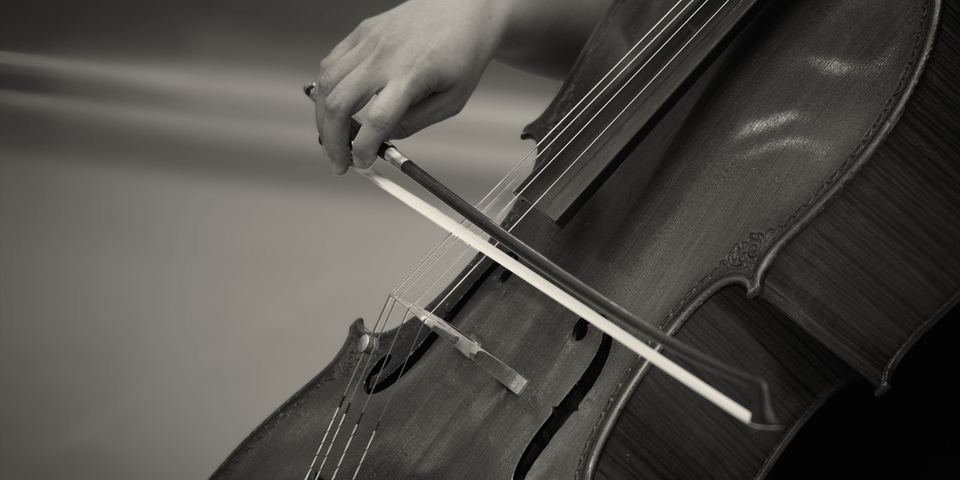
The cello
The cello is a bowed string instrument of the violin family. It sounds below the viola and above the double bass. The cellist sits, and a metal endpin rests on the floor. Its strings are tuned C, G, D and A. A string lies a fifth above the one below it. Most cello music is written in the bass clef.
A cellist plays music from the first of the six cello suites by Bach. Listen for the deep tone of the lowest strings.
Music: Envato (Manriquedelara)
The sound of the cello
The page opens with the prelude of the first suite that Bach wrote for cello alone. On the cello the lowest notes come from the thick C and G strings. The highest come from the A string, where the tone is brighter and more focused. Notice how the tone changes when the music moves from one string to another.
The first button below plays the opening of the same prelude in a performance by another cellist. Notice how the bow moves across the strings in broken chords.
In the concerto by Saint-Saëns, the orchestra plays one chord, and the cello enters at once with a rushing theme. The slow movement of the sonata by Chopin follows. A piano plays with the cello.
A section of cellos then plays a low C, a higher A, a plucked note and a tremolo. In a tremolo the bow moves rapidly back and forth on one note. The last button plays the four open strings on a recorded grand piano.
History of the cello
Cello is short for the Italian violoncello, which means "little violone." The violone was a large bowed bass. A person who plays the cello is a cellist. The cello belongs to the violin family, which took shape in northern Italy early in the sixteenth century. The earliest Italian pictures of the family show three sizes. They match the violin, the viola and the cello of today. The cello did not grow out of the viola da gamba. The gamba is a bowed instrument of another family, and its neck has frets. The two families existed side by side for about two and a half centuries.
The direct ancestor of the cello was the bass violin. It was larger than the modern instrument, and players often called it a violone as well. Monteverdi called for it in the score of his opera Orfeo. In Cremona, Andrea Amati made a bass of this kind for the French court of Charles IX. Later it was cut down to the size of a cello, and it survives in that form.
Late in the seventeenth century, new ways of making strings let a shorter string sound the low notes. Makers could then build a smaller body. Antonio Stradivari first made large cellos on the old pattern. In the early eighteenth century he changed to a smaller model, and many old bass violins were cut down to match it. Italian players made the cello popular in northern Europe at about the same time. Its size became standard around the middle of the eighteenth century.
The Baroque cello had gut strings and no endpin, so the player held it between the calves. Its neck was set at another angle, and its fingerboard was shorter. Its bow curved outward, and the player held the bow nearer its point of balance. In the nineteenth century the Belgian cellist Adrien-François Servais introduced the endpin to hold the cello steady. Later, strings wound with metal came into use. They are strung at a higher tension, so the modern cello sounds louder.
The role of the cello in music
A symphony orchestra usually has ten to fourteen cellists. Their section sits at the front of the stage, and the principal cellist leads it. The principal also plays the cello solos and agrees on the bowings with the other principal string players. Bowings are the up and down strokes of the bow. The cellos often play the low harmony, and the double basses often double their line an octave lower. For short passages the cellos take the melody.
In a string quartet the cello plays the bass part. In Baroque music it often joined a keyboard in the basso continuo. The basso continuo is the bass line that carries the harmony. Cellos also play in groups of their own, sometimes called cello choirs. The overture to William Tell by Rossini opens with a small ensemble of solo cellos. Villa-Lobos wrote the first of his Bachianas Brasileiras for an ensemble of cellos.
The cello is also heard outside classical music. It plays in pop and rock, in bluegrass and in the folk music of Scotland and Ireland. In jazz, the bassist Oscar Pettiford was among the first to play solos on the cello. Cellists who play Indian classical music sit cross-legged on the floor.
Music for the cello
Bach wrote six suites for cello alone, probably while he worked at the court of Köthen. The suites open with a prelude, and dances follow. They are an allemande, a courante, a sarabande, a pair of minuets, bourrées or gavottes, and a gigue. No copy in Bach's own hand survives. A copy made by his wife, Anna Magdalena, is one of the main sources. The fifth suite asks the player to tune the A string down to G. The sixth was probably written for a smaller cello with a fifth string.
For a long time the suites were seldom played in public. As a boy, the Catalan cellist Pablo Casals found an old edition of them in a shop in Barcelona. He played them in concerts for many years before he recorded them, and his recordings made them famous. They are now among the most often performed works for solo cello. The prelude of the first suite is often heard in films and on television.
The classical period added the two concertos of Haydn and the five sonatas for cello and piano by Beethoven. The Romantic repertoire includes the concertos of Schumann, Dvořák and Saint-Saëns, the two sonatas of Brahms and the sonata of Chopin. In The Carnival of the Animals, Saint-Saëns gave the cello a slow melody called The Swan. The Cello Concerto in E minor by Elgar followed early in the twentieth century.
In the twentieth century the repertoire grew quickly. Debussy wrote a sonata for cello and piano, and Kodály wrote a large sonata for cello alone. Britten wrote three suites for solo cello and a Cello Symphony. The Russian cellist Mstislav Rostropovich inspired many new works. Among them are the Symphony-Concerto by Prokofiev and the two concertos by Shostakovich.
How the cello is made
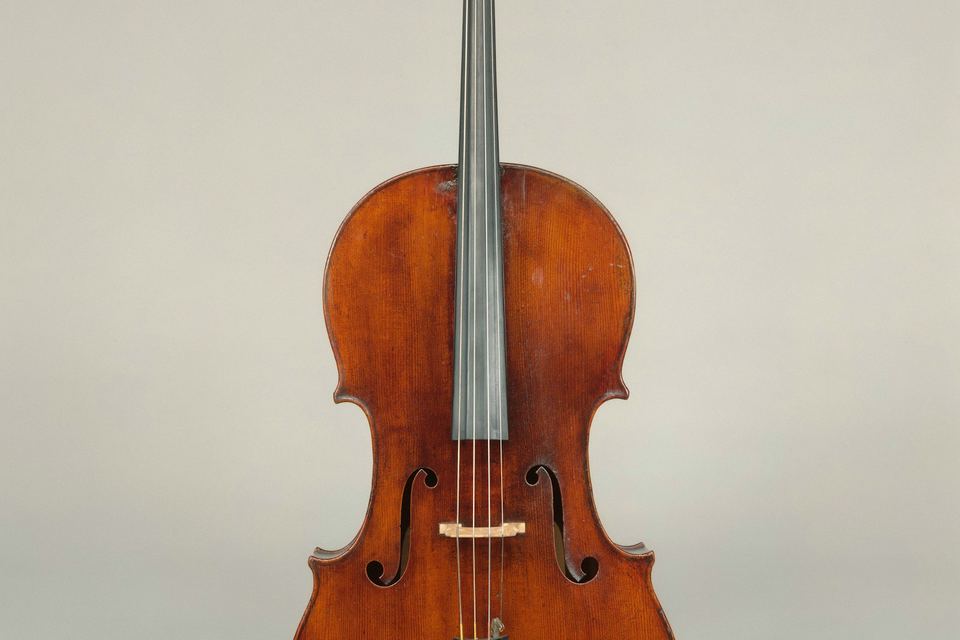
A traditional cello has a top of spruce. Its back, sides and neck are maple, although some makers use poplar or willow for the back and sides. The maker carves the top and the back into gentle arches. The sides, called ribs, are bent around a form with heat. A thin inlaid border called purfling runs around the edges and stops cracks from spreading. Many school cellos have a laminated top and back, which resist knocks better than carved wood.
The neck, the pegbox and the scroll are usually carved from one piece of maple. The fingerboard is ebony because it is hard and resists wear. It curves across its width to match the curve of the bridge, so that the bow can sound one string at a time. The pegbox holds four tapered pegs. They tune the strings and hold their place by friction. Fine tuners on the tailpiece make small adjustments.
Inside the body, a bass bar is glued under the top below the bass foot of the bridge. It supports the top and spreads the vibration through it. A round wooden sound post stands under the treble foot, between the top and the back. Neither the bridge nor the sound post is glued. The pressure of the strings holds them in place. Makers join the body with hide glue, which a repairer can later loosen with steam.
The cello bow is about seventy-three centimeters long. It is shorter than a violin bow and heavier. The stick is traditionally pernambuco, a heavy and elastic wood from Brazil, and bows are also made of carbon fiber. The hair is usually horsehair. A screw at the frog tightens it, and rosin lets it grip the string. Cello strings once had cores of gut. Most modern strings are wound with metal.
How the cello is played
The cellist sits with the cello between the knees, and the endpin holds it at the right height. The left-hand fingertips press the strings against the fingerboard. In the lower positions the thumb rests behind the neck. For the highest notes the thumb moves onto the strings, which is called thumb position.
The right hand draws the bow about halfway between the bridge and the end of the fingerboard. Near the bridge the tone grows brighter. Over the fingerboard it grows softer. A note plucked with a finger is marked pizz. The mark is short for pizzicato.
Vibrato is a small, regular rocking of the left finger that makes the pitch waver slightly. Double stops sound two strings at once. A natural harmonic comes from touching a string lightly without pressing it down. Touched at its middle, a string gives a clear, pure tone an octave above the open note. For special colors, composers ask for sul ponticello or sul tasto. Sul ponticello means bowing close to the bridge. Sul tasto means bowing over the fingerboard.
Most cello parts are written in the bass clef. The tenor clef serves higher passages, and the treble clef serves the highest.
What makes a fine cello
Makers choose spruce with straight, even grain for the top of a cello. Maple for the back often shows a rippled figure called flame. The wood is seasoned for years before use. Most fine cellos have a top and a back carved from solid wood. The thickness of the plates and the shape of their arches affect how freely the body vibrates.
Varnish protects the wood and gives the cello its color. A thin, elastic coat lets the plates move freely. Setup is the final stage, and the player feels it most. It covers the cut of the bridge, the place of the sound post, the angle of the neck and the choice of strings.
Many cellos have a wolf tone. It is a growling, unsteady note, usually near E or F♯, where a string matches the natural resonance of the body. A small weight fitted on a string between the bridge and the tailpiece, called a wolf eliminator, can reduce it. A player who tries a cello listens for an even tone from the low C string to the top of the A string.
The great cellos of the past came from Italian workshops. The Amati family, Andrea Guarneri, Antonio Stradivari, Matteo Goffriller, Domenico Montagnana and Giovanni Battista Guadagnini all made cellos that players still prize. In France, Jean-Baptiste Vuillaume was a leading maker of the nineteenth century. Age alone does not make a cello fine. A new cello from a skilled maker can match the tone of an old one.
Choosing a cello
Cellos are made in full size and in smaller sizes. The smaller sizes include three-quarter, half and quarter. These fractions describe the volume of the body, so a half-size cello is much more than half as long. A teacher or a string shop can measure a child for the right size.
Many school orchestras use laminated cellos because they are durable. Carbon-fiber cellos resist heat and damp, so some players take them outdoors. Many families rent a cello while a child grows through the sizes. Check that the pegs and the fine tuners turn smoothly. Ask a teacher or a string shop to check the bridge and the sound post. An endpin stop keeps the endpin from sliding on a smooth floor.
Who keeps these instruments
The National Music Museum in Vermillion, South Dakota, keeps the bass that Andrea Amati made for Charles IX. It is the oldest known bass of the violin family. The museum also holds early Italian string instruments by the Amati family, Andrea Guarneri and Stradivari.
The Library of Congress in Washington keeps the Castelbarco cello by Stradivari. It is one of the few large Stradivari cellos that keep their original, uncut size. It came to the Library with four other Stradivari instruments, and they still sound in its concerts. The National Museum of American History, also in Washington, keeps the Servais cello by Stradivari. It is another of his large cellos, and it still carries its original label. Adrien-François Servais played it, and it takes its name from him.
The Metropolitan Museum in New York keeps cellos from Italy, France and England in its collection of musical instruments. In Cremona, the Museo del Violino shows the city's string instruments. UNESCO lists the violin craft of Cremona as intangible cultural heritage. Workshops there still build violins, violas, cellos and double basses by hand.
First steps on the cello
Tune the four open strings to C, G, D and A with the tuner. Sit near the front edge of a chair with both feet flat on the floor. Set the endpin so that the cello leans against your chest.
Start on the open C string. Draw the bow from one end to the other at an even speed, and keep it between the bridge and the fingerboard. Repeat the stroke on the G, D and A strings.
On the D string, the first finger plays E. That note lies a whole step above the open string. Check the notes against the tuner at a slow metronome tempo.
A short check
Choose one answer per question. The explanation appears below the correct answer.
Which four strings does the cello have?
From low to high, the cello is tuned C, G, D and A. A string is a perfect fifth above the one below it.
What is the endpin?
The endpin comes out of the bottom of the cello. It rests on the floor and holds the cello at the right height.
What is thumb position?
In the lower positions the thumb rests behind the neck. For the highest notes it moves onto the strings.
Which clef do most cello parts use?
Most cello music is written in the bass clef. High passages use the tenor clef or the treble clef.
Sources
- Wikipedia: Cello
- Wikipedia: Cello Suites by Bach
- Library of Congress: the Castelbarco cello by Stradivari
- Wikipedia: Servais Stradivarius
- Wikipedia: National Music Museum
- Google Arts and Culture: the King cello by Andrea Amati
- UNESCO: traditional violin craftsmanship in Cremona
- The Met: the Royal George cello by William Forster
Common questions
Is the cello hard to learn?
Beginners start with long, slow bows on the open strings, and most draw a steady tone within a few weeks. The fingerboard has no frets, so finding the notes in tune takes much longer.
What is the difference between a cello and a double bass?
The double bass is larger and sounds about an octave lower. Its strings are tuned in fourths, while the strings of the cello are tuned in fifths.
What is the difference between a cello and a viola?
The viola is held under the chin and sounds an octave higher. Its strings carry the same letter names as the strings of the cello.
What size cello does a child need?
It depends on the height of the child and the reach of the arms. Fractional cellos are built like full-size ones and play the same notes.
Can a cello play melodies?
Yes. As a solo instrument it uses its whole range. That range reaches from the bass register to the soprano register. Orchestras often give the cellos a melody for a few bars.
Does a cellist stand or sit?
A cellist sits. The endpin rests on the floor, and the knees hold the sides of the instrument.
What wood is a cello made of?
Most cellos have a spruce top with a maple back, maple sides and a maple neck. The fingerboard and the pegs are usually ebony.
What is the most famous music for solo cello?
The six suites by Bach are the best known. The prelude of the first suite is one of the most often heard pieces for the instrument.