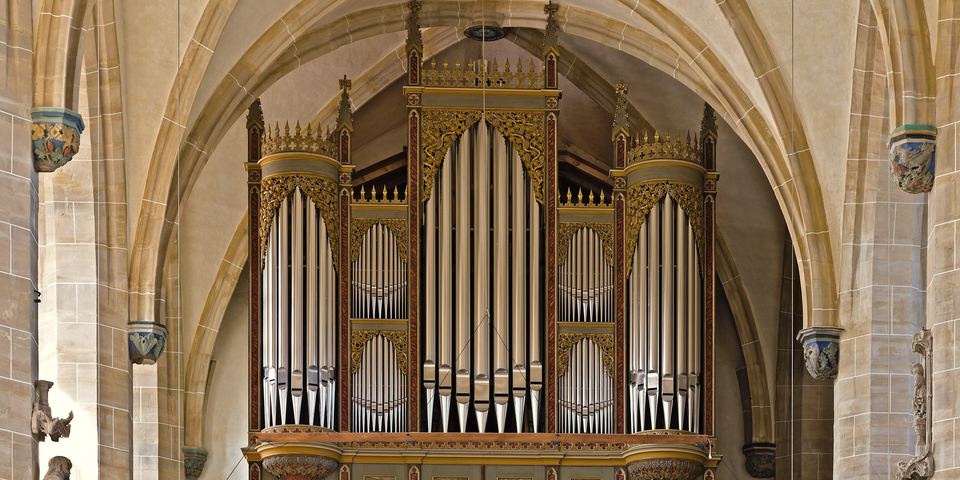
The pipe organ
The pipe organ is a keyboard instrument that sounds through pipes. Air under pressure fills a wooden box called the wind chest. When a key opens its valve, the air flows into a pipe. The player chooses sets of pipes with knobs called stops. The hands play keyboards called manuals, and the feet play the bass on a pedalboard.
The organ plays music from the Toccata and Fugue in D minor, which has long carried the name of Bach.
Music: Envato (PremiumBeat)
Listening to the organ
A toccata is a showy piece in a free form. Its name comes from the Italian word for touch. This toccata opens with a mordent high on the keyboard. A mordent is a quick ornament that moves from one note to the note below it and back. A rapid figure then falls down the keyboard to a long, low chord in D minor. The pedals add a deep bass under it. Listen for the pauses between these opening phrases. In the pauses the sound of the organ dies away in the room.
Notice that an organ note keeps its full strength for as long as the key is held. A piano note fades. In the full work a fugue follows the toccata. A fugue begins with a single melodic line, called a voice, which states a short theme called the subject. Other voices then enter one by one with the same theme.
Names of the organ
The word organ comes from the Greek organon, written ὄργανον, which means a tool or an instrument. The water organ of ancient Greece was the hydraulis, written ὕδραυλις. In German the organ is the Orgel, in French the orgue and in Italian the organo. In English the word organ alone usually means the pipe organ.
Some instruments share the name and work in other ways. A reed organ, such as the harmonium, sounds through free reeds and has no pipes. An electronic organ makes its sound with circuits or with recordings of pipes.
History of the organ
The first organ was the hydraulis of ancient Greece. It is credited to Ctesibius, who was an engineer of Alexandria in the third century before the common era. A pump pushed air into a chamber set in water, and the weight of the water kept the pressure of the air steady. The Romans played the hydraulis at games and in theaters.
In the early Middle Ages the organ was known at the court of Byzantium. A Byzantine emperor sent an organ as a gift to Pepin, king of the Franks, in the eighth century. Organs then spread through the churches of western Europe and grew larger over the centuries.
The organ reached its classic forms between the Renaissance and the eighteenth century. In northern Germany, Arp Schnitger built great organs with several keyboards and a full set of pipes for the pedals. Dieterich Buxtehude and Johann Sebastian Bach wrote for such instruments. In nineteenth-century France, Aristide Cavaillé-Coll built large organs that could swell and fade like an orchestra. César Franck and Charles-Marie Widor wrote symphonic works for them.
In the late nineteenth century, builders began to link the keys to the pipes with electric wires. This is called electric action. The console is the desk of keyboards and stops where the organist sits, and electric action let it stand far from the pipes. In the twentieth century many builders returned to the older mechanical action, which is also called tracker action. In it thin rods link the keys to their valves. They also studied how the old builders shaped the tone of their pipes. Today the largest organs have tens of thousands of pipes.
The organ in worship
For centuries the organ has been the chief instrument of Christian worship in western Europe. It accompanies hymns and the singing of the choir. It plays a prelude before the service and a postlude after it. Lutheran organists played chorale preludes to introduce the singing of the congregation. A chorale prelude is a short piece built on the melody of a hymn. Many organists also improvise during the service.
Organs also stand in concert halls, town halls and universities. There organists give solo recitals, and the organ joins the orchestra in works such as the Organ Symphony of Saint-Saëns.
Music for the organ
Bach wrote preludes and fugues, toccatas, trio sonatas and many chorale preludes for the organ. In a trio sonata the two hands and the feet play separate lines. The Toccata and Fugue in D minor is one of the best-known organ pieces of all. Scholars have questioned whether Bach wrote it, but it has long carried his name. Frescobaldi, Buxtehude and Pachelbel wrote for the organ before him.
The French organ of the nineteenth century brought the organ symphony. The Toccata from the Fifth Organ Symphony of Widor is often played at weddings. Franck and Vierne wrote major works for the organ, and Messiaen carried the French tradition into the twentieth century. Mendelssohn wrote six organ sonatas, and Liszt and Reger wrote large fantasias and fugues.
How the organ works
A blower fills the wind system with air under steady pressure. In older organs, people pumped the bellows by hand or by foot. The air flows into a wind chest, which is a wooden box under the pipes. A key opens a valve called a pallet, and air flows to the pipes of that note.
Organ pipes come in two families. A flue pipe sounds like a whistle or a recorder. Air strikes a sharp edge, the lip, at the mouth of the pipe. A reed pipe has a brass tongue that beats against an opening, as in a clarinet, and a resonator above it shapes the tone. The pipes in the front of the organ, the façade, are usually flue pipes called principals.
A set of pipes with one pipe per key is called a rank. A stop turns a rank on or off. When the player pulls a stop knob, a wooden slider under the rank moves. Holes in the slider line up with the feet of the pipes, and the rank can sound. The number on a stop gives its pitch. The number is the length in feet of the lowest pipe of an open rank at that pitch. An eight-foot stop sounds at the pitch of the piano. A four-foot stop sounds an octave higher, and a sixteen-foot stop sounds an octave lower.
The keyboards for the hands are called manuals. A large organ may have three or more manuals. The manuals control their own groups of pipes, which are called divisions. The Great is the main division. The Swell stands inside a box with shutters, and a pedal opens and closes them to make the sound louder or softer. Couplers join one keyboard to another, so a single key plays the pipes of both.
The pedalboard is a keyboard for the feet. It plays the bass, often on stops of sixteen feet. In tracker action, thin rods called trackers link the keys to their pallets. Electric and pneumatic action replace the trackers with wires or with tubes of air.
How the organ is played
The organist sits on a bench at the console. The hands play the manuals, and the feet play the pedalboard with the toes and the heels. Organists wear thin, flexible shoes for this. The player chooses the stops before a piece and changes them between sections. This choice of sound is called registration.
An organ note sounds as long as the key is held and stops at once on release. Phrasing therefore depends on exact releases and on small silences between notes. A large church adds a long echo, so the player must leave time for a chord to clear.
What makes a fine organ
The best organs are built for their rooms. The builder studies the space and voices the pipes there. Voicing shapes the mouth and the lip of a flue pipe until its tone and loudness match the rest of the rank. The room is part of the instrument. A stone church with a long echo needs a different voicing from a dry concert hall.
The metal and the wood of the pipes shape the tone. Many principals are made of an alloy of tin and lead, and more tin gives a brighter tone. Wooden pipes give a soft, round flute tone. A well-planned set of stops blends into a full chorus of principals from low to high. Mixtures are stops with several small pipes per key. They add the high harmonics that give the chorus its brilliance.
The wind must be steady, and the action must repeat quickly and quietly. A well-made tracker action lets the player control how a pipe begins to speak. Builders such as Arp Schnitger, Gottfried Silbermann and Aristide Cavaillé-Coll are still studied for their voicing and their wind.
Where to practice the organ
Most organists learn on the instruments of churches and schools. Ask a church or a university to let you practice on its organ. Many allow a student to practice at quiet hours.
For home practice, a digital organ with a full pedalboard of thirty or thirty-two notes is the usual choice. Choose one built to the standard measurements for organ consoles, so that your feet learn the same distances as on a pipe organ. A piano helps the hands, but it cannot train the feet.
Who keeps these instruments
Many historic organs still play in the churches they were built for. The Arp Schnitger organ of St. Jacobi in Hamburg and the Gottfried Silbermann organ of Freiberg Cathedral are among the best known. In Haarlem in the Netherlands, the large Christian Müller organ of St. Bavo was played by the young Mozart. In Paris, the Cavaillé-Coll organ of Saint-Sulpice still sounds as its builder made it.
The organ of the Basilica of Valère in Sion, Switzerland, is among the oldest organs that can still be played. The organ shown at the top of this page stands in the cathedral of Halle in Germany. Handel was born in Halle. Organ building continues in workshops in Europe and North America. Conservatories teach the organ, and organ societies hold recitals and competitions.
First steps on the organ
Learn the keyboard first. Most teachers ask for some piano skill before organ lessons, so that the hands need only learn the new touch of the organ. Begin at the organ with a single quiet eight-foot stop.
Practice the pedals apart from the hands. Play simple scales with the toes of both feet, and look at the pedals as little as you can. Then add a slow bass line under a hymn. Join the hands and the feet only when all the parts are secure.
A short check
Choose one answer per question.
What does a stop do on a pipe organ?
A stop controls a rank, which is a set of pipes with one pipe per key. Pulling the stop lets that rank sound.
At which pitch does an eight-foot stop sound?
An eight-foot stop sounds at the written pitch, as the piano does. A four-foot stop sounds an octave higher.
What is the pedalboard?
The pedalboard is a keyboard for the feet. It usually plays the bass line.
Sources
Common questions
How does a pipe organ make sound?
Air under pressure flows into pipes when the keys open their valves. Flue pipes sound like whistles, and reed pipes sound through beating brass tongues.
What are organ stops?
Stops are knobs that turn sets of pipes on or off. A set has its own tone color and pitch.
How many keyboards does an organ have?
Small organs have one or two manuals for the hands. Large organs usually have three to five, and the largest have seven. Most organs also have a pedalboard for the feet.
Who invented the organ?
The first organ was the hydraulis of ancient Greece. It is credited to Ctesibius, who was an engineer of Alexandria.
Did Bach write the Toccata and Fugue in D minor?
It has long carried his name, and it is listed as BWV 565 in the catalog of his works. Some scholars doubt that he wrote it.
Is the organ hard to learn?
The hands and the feet must learn to work apart. Most students first learn the piano and then add the pedals slowly.
PianoHarpsichordJohann Sebastian BachThe Baroque periodHarmonium