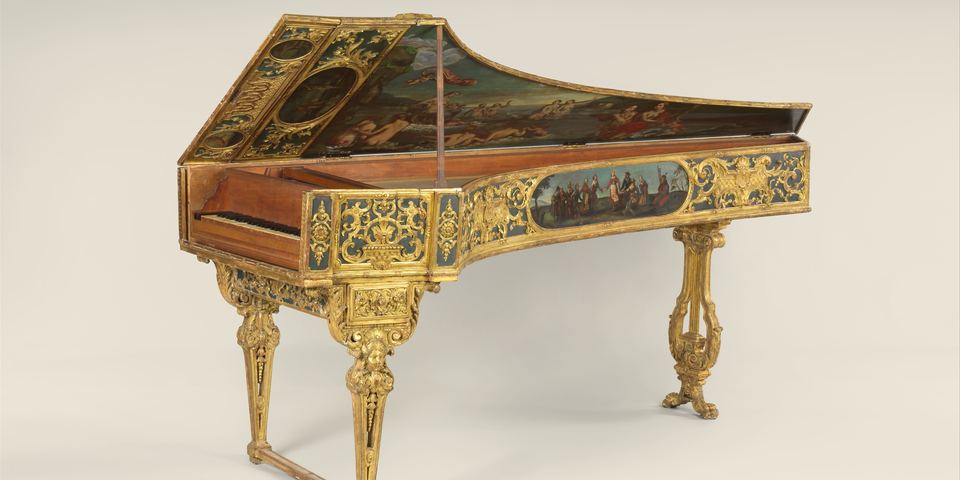
The harpsichord
The harpsichord is a keyboard instrument whose strings are plucked. When you press a key, a jack rises, and a small plectrum of quill or plastic plucks a string. A note sounds equally loud however hard you press the key. The harpsichord was a central instrument of Renaissance and Baroque music.
Listen for the bright pluck at the start of the harpsichord notes and for how soon the tone fades.
Music: Envato
The sound of the harpsichord
The first button below plays the opening of the Air from The Harmonious Blacksmith by Handel. This calm tune is the theme of a set of variations. Listen to the start of the notes. The quill plucks the string with a small, bright click, and the tone then fades. The player cannot swell a note once it has sounded. Harpsichordists shape the music with timing and ornaments.
The last two buttons play single notes. Compare the low note with the note near middle C. The low string is longer and heavier, and its tone lasts longer.
Names of the harpsichord
Harpsichord is also the word for the whole family of plucked keyboard instruments. The harpsichord itself has a long wing shape like that of a grand piano. The family also includes the small rectangular virginals and the muselar. In the spinet, the strings run at an angle to the keyboard.
In Italian the harpsichord is the clavicembalo, which is often shortened to cembalo. German musicians also say Cembalo. In French it is the clavecin, and in Spanish the clave. These names come from the Latin clavicymbalum. That name appears in the earliest written record of the instrument. Couperin called his book on playing it L'Art de toucher le clavecin, which means the art of playing the harpsichord.
History of the harpsichord
The harpsichord was most likely invented late in the fourteenth century. The earliest record is a note by a lawyer in Padua. He wrote that Hermann Poll claimed to have invented an instrument called the clavicembalum. The first harpsichords were small and sounded at a high pitch. By the sixteenth century, Italian makers had settled on a design that lasted for centuries. Their harpsichords were light. They had thin case walls and brass strings. Many were kept in a decorated outer case and lifted out to be played.
Late in the sixteenth century, makers in Antwerp took another path. The Ruckers family built heavier harpsichords with a stronger tone and iron strings in the treble. They also built the first harpsichords with two keyboards. At first the second keyboard served for transposition, which moves the music to another pitch. Their instruments were so prized that Ruckers became the great name of the harpsichord, as Stradivari is of the violin.
In the eighteenth century, makers across Europe followed the Flemish model. In Paris, the Blanchet family and Pascal Taskin built double harpsichords that are among the most admired of all. They also rebuilt old Ruckers instruments and extended their range. This practice is called ravalement. In London, the firms of Kirkman and Shudi built harpsichords of great power. In Hamburg, Hieronymus Albrecht Hass added extra sets of strings an octave below and two octaves above normal pitch.
The harpsichord maker Bartolomeo Cristofori built the first pianos in Florence at the turn of the eighteenth century. Their hammers let the player make any note soft or loud. By the end of that century the piano had largely replaced the harpsichord. The harpsichord kept a place in opera for a time. For most of the nineteenth century it almost disappeared.
The revival began early in the twentieth century. The first new harpsichords borrowed heavy strings and metal frames from piano building. The Paris firm of Pleyel built such instruments for the harpsichordist Wanda Landowska. From the middle of the century, builders such as Frank Hubbard and William Dowd in Boston and Martin Skowroneck in Germany studied old instruments. They returned to the old ways of building, and most harpsichords made today follow their example.
The role of the harpsichord in music
In Baroque music the harpsichord was a standard part of the continuo group. The continuo plays the bass line and fills in the chords above it. The composer wrote only the bass line and small figures that showed the harmony. The harpsichordist improvised the chords from them. This practice is called figured bass. A cello, a viola da gamba or a bassoon often played the bass line with the harpsichord.
The harpsichordist often directed the ensemble from the keyboard. In opera the harpsichord accompanied recitative. Recitative is the sung speech between the arias. The harpsichord was also a solo instrument and a household instrument. Families kept virginals and spinets at home, and amateur players learned dances and songs on them.
Music for the harpsichord
The English virginalists wrote the first great body of music for plucked keyboards. William Byrd led them. The Fitzwilliam Virginal Book preserves nearly three hundred of their pieces, by Byrd, John Bull, Orlando Gibbons and others. In Italy, Frescobaldi wrote toccatas full of sudden changes. In Germany, Froberger brought the dance suite to the keyboard.
France built its own school of playing. Couperin wrote four books of pieces grouped in suites called ordres. Rameau wrote harpsichord pieces with vivid titles. Bach wrote The Well-Tempered Clavier, the Goldberg Variations and the Italian Concerto. In the Fifth Brandenburg Concerto he gave the harpsichord a long solo passage. Handel wrote suites for the instrument. Domenico Scarlatti wrote five hundred fifty-five sonatas, and he wrote most of them in Spain.
Composers of the twentieth century wrote new music for the revived instrument. Manuel de Falla and Francis Poulenc both wrote concertos for Wanda Landowska. György Ligeti's Continuum is a fast study for harpsichord. Its notes follow one another so quickly that they blur into one shimmering sound.
How the harpsichord works
A key rocks on a pivot near its middle. When the front of the key goes down, the back end rises and lifts a jack. The jack is a thin strip of wood that stands upright on the end of the key. Near its top, a small pivoted tongue holds the plectrum. The plectrum is a tiny wedge of bird quill or plastic. As the jack rises, the plectrum plucks the string.
When the key comes up, the jack falls back under its own weight. The tongue swings back on its pivot, so the plectrum slides past the string without plucking it again. A small felt damper on top of the jack then touches the string and stops the sound. A rail lined with felt stops the jacks at the top of their travel.
The strings are wound on tuning pins set in a hardwood plank near the keyboard. It runs over a nut, across the soundboard and over a bridge, and a pin at the far end holds it. The soundboard is a thin panel of spruce, fir or cypress. It turns the vibration of the strings into sound loud enough to hear.
Larger harpsichords have more than one set of strings per note. These sets are called choirs. A choir at eight-foot pitch sounds at normal pitch, and a choir at four-foot pitch sounds an octave higher. The player selects the choirs with stops. A stop slides a row of jacks a little sideways, so that their plectra miss the strings. A second keyboard gives still more choices. A coupler lets one keyboard play the strings of both. The buff stop presses a strip of leather against the strings, and the tone becomes soft and close to that of a lute.
How the harpsichord is played
The player cannot make a note louder by pressing harder. A harpsichordist shapes the music with time and touch. Holding a note a little longer than written stresses it. Releasing a note early separates it from the next. A slight delay before a strong beat gives that beat weight. Chords are often spread from the bottom note upward, which also gives them weight.
Ornaments are part of the style. Trills, mordents and quick turns decorate the melody and stress the main notes. A mordent is a quick move from the main note to its neighbor and back. French composers printed tables in their books to show how to play the ornaments. Players also change the color by choosing stops, or by moving between two keyboards. Many players tune the A above middle C to about four hundred fifteen vibrations a second. That is about a half step below modern pitch.
What makes a fine harpsichord
The soundboard sets much of the voice of a harpsichord. It is a thin panel of spruce, fir or cypress. The French practice of ravalement shows how much makers valued an old soundboard. When the Paris makers rebuilt a Ruckers harpsichord, they kept its original soundboard to keep its tone. Some makers even sold new instruments as Ruckers harpsichords because of the value of the name.
The strings shape the tone too. Flemish makers used longer strings of iron under higher tension, which gave a strong tone. Italian makers used brass strings under lower tension. Their harpsichords have a lighter tone. A fine copy follows one historical model closely. It matches the length of the strings and the shape of the case.
The voicing of the plectra is the finest work. In voicing, the maker cuts the plectra to the right length and thickness, so that the notes pluck evenly and sound equally loud. Bird quill was the traditional material. Most modern harpsichords use plectra of a hard plastic called Delrin, which lasts longer. The keys of a fine harpsichord also repeat quickly and quietly.
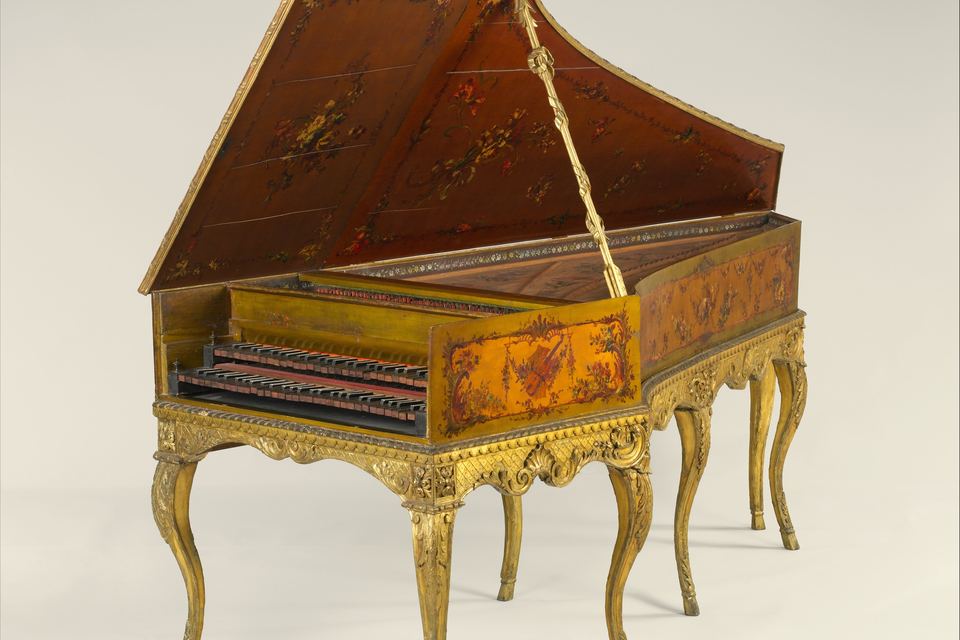
Case and decoration follow the tradition of the country where the instrument was made. Some Flemish harpsichords have plain painted cases. Their makers lined them with printed papers and decorated the soundboards with paint. French harpsichords often have rich painting and gilding. Italian harpsichords were often kept in a separate outer case.
Choosing a harpsichord
The largest harpsichords cover a little more than five octaves, and the smallest cover less than four. The virginals and the spinet take less space than a full harpsichord, and they suit a small room.
A beginner usually starts on a harpsichord with one keyboard and one or two choirs at eight-foot pitch. Check that the jacks are even. The keys should all pluck at the same depth, and no jack should stick. Ask how often the instrument needs tuning and who can replace or revoice the plectra. Many students first learn the music on a piano and then move to a harpsichord at a school or a church.
Who keeps these instruments
Museums in Europe and America keep the great harpsichords of the past. The Metropolitan Museum of Art in New York keeps a French harpsichord with two keyboards. Louis Bellot made it in Paris. The museum also keeps a gilded Italian harpsichord and a double virginal by Hans Ruckers, who founded the Antwerp dynasty of makers. The Musical Instruments Museum in Brussels holds a group of Ruckers instruments that scholars have studied in detail.
St Cecilia's Hall in Edinburgh belongs to the University of Edinburgh. It houses the Russell Collection of early keyboard instruments, which includes double harpsichords by Pascal Taskin of Paris. The National Music Museum in Vermillion, South Dakota, keeps harpsichords by Andreas Ruckers of Antwerp. Conservatories teach the harpsichord in their early music departments. Students there learn figured bass, historical fingering, tuning and the care of the plectra.
First steps on the harpsichord
Begin with short Baroque dances such as minuets. Play slowly and evenly with relaxed fingers, and keep the fingers close to the keys.
Volume does not change with touch. Listen to how long you hold a note, and lift the finger cleanly at the end of the note. Then practice a slow trill on two neighboring keys. Keep the trill slow and even before you make it faster. If no harpsichord is near, learn the notes on a piano or the online piano. Play lightly and without the pedal.
A short check
Choose one answer per question.
How does a harpsichord make its sound?
The key lifts a jack, and the plectrum in the jack plucks the string.
What happens when you press a harpsichord key harder?
A harpsichord note sounds equally loud however hard you press the key. On a piano, the hammers give the player that control.
What stops the sound when the key comes up?
When the jack falls back, a felt damper on top of it touches the string and stops the note.
How does a set of strings at four-foot pitch sound?
Strings at eight-foot pitch sound at normal pitch. Strings at four-foot pitch sound an octave higher.
Sources
- Wikipedia: Harpsichord
- Wikipedia: History of the harpsichord
- Wikipedia: Ruckers
- Wikipedia: Pascal Taskin
- Metropolitan Museum of Art: harpsichord by Louis Bellot
- Metropolitan Museum of Art: gilded Italian harpsichord by Michele Todini
- University of Edinburgh: St Cecilia's Hall
- Wikipedia: Wanda Landowska
- Wikipedia: Fitzwilliam Virginal Book
- Wikipedia: Continuum by Ligeti
Common questions
What is the difference between a harpsichord and a piano?
A harpsichord plucks its strings with plectra. A piano strikes them with hammers, so a pianist can play any note soft or loud.
Why do some harpsichords have two keyboards?
The keyboards can control different sets of strings. A coupler can join the two, so that one keyboard plays both sets. The first two-keyboard harpsichords were made for transposition.
What is a harpsichord plectrum made of?
Plectra were made of bird quill or leather in the past. Many modern harpsichords use plastic.
Is the harpsichord a string instrument?
Yes. It is a keyboard instrument whose strings are plucked. Scholars place it in the zither family, together with the piano and the clavichord.
What is The Harmonious Blacksmith?
It is the popular name of the last movement of the Suite No. 5 in E major by Handel. An air is followed by five variations.
What is a short octave?
On some early harpsichords, the lowest keys were tuned to other notes. This gave the player the low C and D that common chords needed. No extra keys were required.
Who made the most famous harpsichords?
The Ruckers family of Antwerp is the best known. Instruments by the Blanchets and Pascal Taskin of Paris are also highly prized. So are those of the London firms of Kirkman and Shudi.
Why did the piano replace the harpsichord?
The hammers of the piano let the player make any note soft or loud. As composers came to value that control, the piano took the harpsichord's place.