Frédéric Chopin
Frédéric Chopin was a Polish composer and pianist of the Romantic period. He grew up in Warsaw and spent his adult life in Paris. Nearly all his music is for solo piano. His nocturnes, études, preludes, ballades, mazurkas and polonaises joined a singing melody to rich harmony and a new use of the pedal.
A pianist plays a nocturne in C♯ minor, which was published after Chopin's death. A nocturne is a slow night piece with a singing melody over broken chords.
Recording: Musopen
Life in brief
Chopin was born in 1810 in the village of Żelazowa Wola, west of Warsaw. His father, Nicolas Chopin, was a Frenchman who taught French in Warsaw. His mother, Justyna Krzyżanowska, was Polish. His first professional piano teacher was Wojciech Żywny. He had a polonaise printed at the age of seven, and he played in public concerts as a child.
He studied composition at the Warsaw Conservatory with Józef Elsner. He wrote his two piano concertos in Warsaw before he was twenty-one. He left Poland at twenty. While he was abroad, the November Uprising against Russian rule broke out in Warsaw, and he never returned to Poland.
In Paris he earned his living mainly by teaching and by publishing. He gave few public concerts. He preferred the salon, where he played for small audiences of friends and patrons. His friends included Liszt, the painter Delacroix and the novelist George Sand. For about nine years Chopin and Sand lived together.
They spent a winter on the island of Majorca, where he finished his twenty-four Preludes, Op. 28. Op. is short for opus, which is the Latin word for a work. Summers at Sand's country house in Nohant were his most productive time. Chopin was in poor health for most of his adult life. He died in Paris on October 17, 1849, probably of tuberculosis. He was buried in Père Lachaise Cemetery, and his sister carried his heart back to Warsaw.
How to hear his style
Chopin loved Italian opera, and he shaped his melodies like its singing lines. He decorated long lines with turns, trills and rapid runs of small notes. In the nocturnes the left hand plays wide broken chords, and the right hand carries the melody.
Listen for rubato. The melody pushes ahead and holds back while the left hand keeps a steadier pulse. His pupils reported that he asked for this freedom in the melody over a strict accompaniment.
The pedal is part of the sound. Chopin marked it in detail, so the harmonies blend and the bass notes ring under the melody.
Polish dance runs through his music. The mazurka is a dance in triple time that stresses the second or third beat. Chopin wrote about sixty mazurkas, and they hold some of his boldest harmony. The polonaise is a stately dance, also in triple time. Its first beat often divides into an eighth note and two sixteenths.
The best-known works
All of these works are for solo piano.
| Work | What to listen for |
|---|---|
| Nocturne in E♭ major, Op. 9 No. 2 | This night piece is in twelve-eight time. The melody returns with richer ornaments whenever it comes back. |
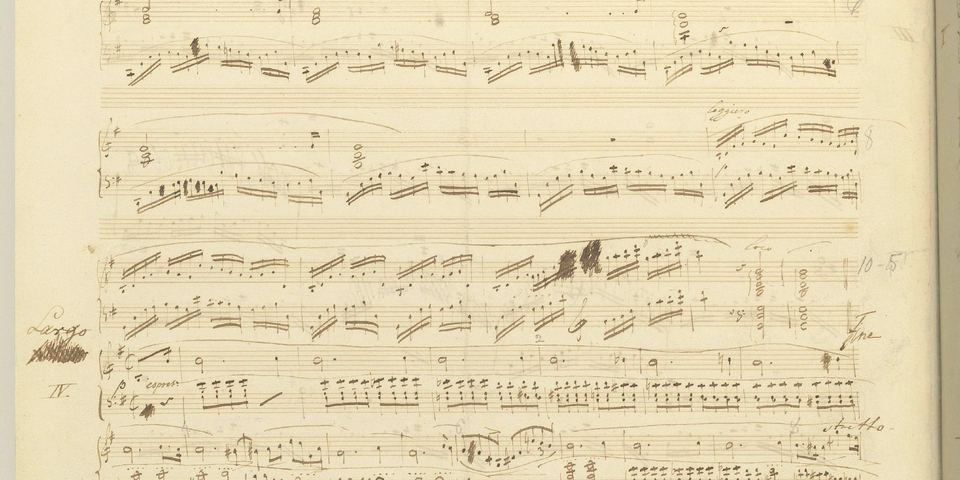
| Prelude in E minor, Op. 28 No. 4 | The melody hardly moves while the chords below it change. The manuscript at the top of this page is the score of this prelude. |
| Prelude in D♭ major, Op. 28 No. 15 (Raindrop) | A repeated A♭ sounds through the whole prelude like falling rain. In the middle section it becomes G♯ under dark chords. |
| Waltz in C♯ minor, Op. 64 No. 2 | A sad waltz theme alternates with a fast, whirling section and a slower one in D♭ major. |
| Fantaisie-Impromptu in C♯ minor | The right hand plays four notes against three in the left hand. Chopin never published it. |
| Étude in C minor, Op. 10 No. 12 (Revolutionary) | An étude is a study that trains one skill. In this one, fast runs of sixteenth notes fill the left hand. Tradition links it with the fall of Warsaw. |
| Polonaise in A♭ major, Op. 53 (Heroic) | Its middle section rides on driving octaves in the left hand. |
| Ballade No. 1 in G minor | A ballade is a long piece that tells a story without words. This one ends with a stormy coda, which is a closing section. |
| Piano Sonata No. 2 in B♭ minor | This sonata has four movements, which are complete sections with their own tempo. The third is the famous funeral march. |
The Waltz in C♯ minor, Op. 64 No. 2, comes first, and the Nocturne in E♭ major, Op. 9 No. 2, follows. The Cello Sonata in G minor was the last large work he published. The last recording is the opening of its slow movement for cello and piano.
How the music is built
Chopin used the forms of his time in his own way. Many nocturnes and mazurkas are in three parts, ABA. A contrasting middle section leads back to the opening, often with new ornaments. The ballades and scherzos are larger forms that he shaped freely.
His harmony is rich in chromatic notes. Chords slide by half steps, and seventh chords follow one another without resolving. In the Prelude in E minor the left-hand chords sink by half steps while the melody stays almost still. Diminished seventh chords and sudden turns to distant keys add color.
Chopin's Preludes, Op. 28, are a set of twenty-four. There is one per major and minor key. They move around the circle of fifths. A major key is always followed by its relative minor, which is the minor key with the same key signature. The order runs C major, A minor, G major, E minor and so on. Chopin admired Bach and practiced The Well-Tempered Clavier throughout his life.
His études turn technical problems into music. An étude trains a single skill, such as arpeggios, thirds, octaves or speed in the left hand.
Pieces students learn
Chopin wrote little for beginners, so students usually first play his music at the intermediate stage. The pieces below appear often on exam lists, which change from time to time. Confirm a piece against the current syllabus of your board.
| Stage | Piece | What it teaches |
|---|---|---|
| Intermediate | Prelude in E minor, Op. 28 No. 4 | A melody voiced over soft repeated chords |
| Intermediate | Prelude in A major, Op. 28 No. 7 | A mazurka rhythm with a clean pedal |
| Intermediate | Waltz in A minor (published after his death) | A waltz bass with a singing melody |
| Late intermediate | Nocturne in C♯ minor (published after his death) | Ornaments and a free tempo |
| Advanced | Nocturne in E♭ major, Op. 9 No. 2 | Ornaments shaped with rubato |
| Advanced | Waltz in C♯ minor, Op. 64 No. 2 | Speed and lightness in the right hand |
| Diploma | Ballade No. 1 in G minor | Long-range drama and virtuoso writing |
| Diploma | Études, Op. 10 and Op. 25 | Speed and control at concert level |
Cellists learn the Cello Sonata and the Polonaise brillante for cello and piano. Pianists who play Chopin need careful pedaling and a relaxed wrist.
Where the music lives
The manor house in Żelazowa Wola where he was born is now a museum in a park. The Fryderyk Chopin Institute in Warsaw runs it. The institute also runs the Fryderyk Chopin Museum in the Ostrogski Palace and organizes the International Chopin Piano Competition in Warsaw.
Chopin's heart is sealed in a pillar of the Church of the Holy Cross in Warsaw. His grave is in Père Lachaise Cemetery in Paris.
In Majorca, visitors see the rooms of the Valldemossa Charterhouse where he and Sand spent their winter. George Sand's house in Nohant, in central France, is a museum. The Chopin Institute and the National Library of Poland keep many of his manuscripts.
A short check
Choose one answer per question.
Where did Chopin spend his adult life?
He left Poland at twenty and settled in Paris. He never returned to Poland.
What is rubato?
In rubato the melody pushes ahead and holds back. Chopin's pupils said he kept the left hand steadier.
In which meter is the mazurka?
The mazurka is a Polish dance in triple time. It often stresses the second or third beat.
Which note repeats through the Raindrop Prelude?
The repeated A♭ runs through the prelude in D♭ major. In the middle section, which is in C♯ minor, the same note is written as G♯.
Common questions
When was Chopin born?
He was born in 1810. His baptismal record gives February 22, but Chopin and his family kept March 1 as his birthday.
Was Chopin Polish or French?
He was Polish. His father was French and his mother Polish, and he grew up in Warsaw. He lived in Paris for most of his adult life.
What is a nocturne?
A nocturne is a night piece. Chopin took the name from the Irish composer John Field and gave the form richer harmony and longer ornaments.
Why is Chopin's heart in Warsaw?
He asked that his heart be taken to Poland. His sister Ludwika carried it to Warsaw, and it rests in the Church of the Holy Cross.
What is the easiest Chopin piece?
The Prelude in E minor and the Prelude in A major from Op. 28 are short and slow. Many students start with one of them.
How many nocturnes did Chopin write?
He published eighteen nocturnes in his lifetime. Editions add three that appeared after his death, so most print twenty-one.
