Online piano
Play the tune on the recorded grand piano. Tap the keys on the screen, use a computer keyboard or connect a digital piano.
To start the piano, sit at the middle of the keyboard with your forearms level with the keys. Curve your fingers gently. The thumb is finger 1, and the little finger is finger 5. Put your right thumb on middle C and the other fingers on the next four white keys. You can then play your first tune.
Sit on the front half of the bench and face the middle of the keyboard. Your back is straight and your elbows hang loosely.
To find the right distance from the piano, hold your arms out with loose fists. Your knuckles should touch the edge of the keys. Raise or lower the seat until your forearms are about level with the keys. A child can sit on a firm cushion.
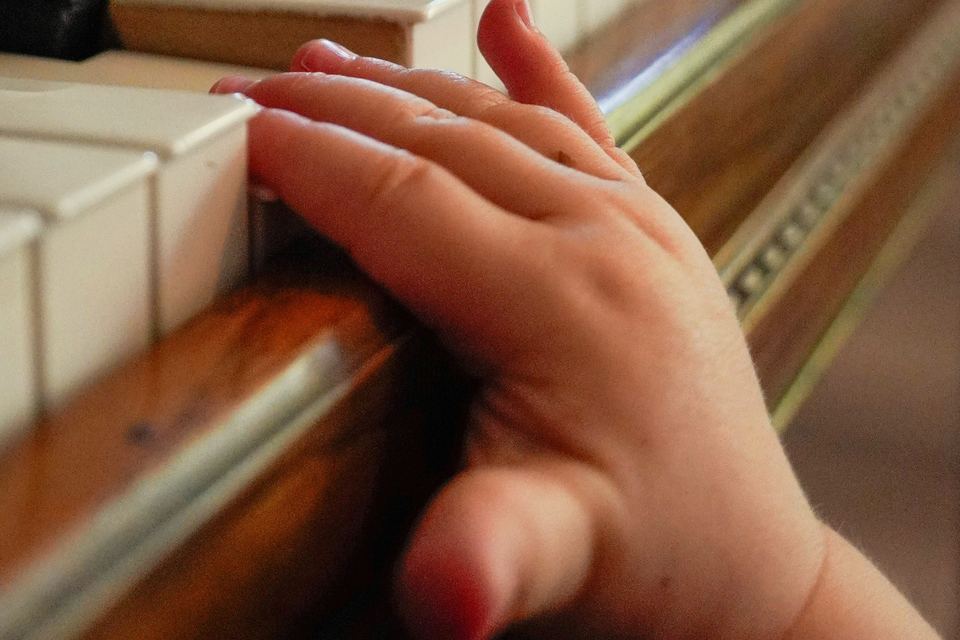
Let your hands hang loosely at your sides. Lift them onto the keys in the same rounded shape. The fingertips touch the keys, and the wrists stay level.
Play the keys with the pad at the end of the finger. Keep the thumb relaxed beside the hand.
Piano music marks the fingers with numbers. In both hands the thumb is 1 and the index finger is 2. The middle finger is 3, the ring finger is 4 and the little finger is 5.
The numbers are the same for both hands. In the left hand, finger 5 plays the lowest note of a five-finger position.
Look for the groups of two black keys. The white key to the left of any pair is a C.
Middle C is the C nearest the middle of the keyboard. On a piano with eighty-eight keys, it is the fourth C from the left. Tap the keys below to hear them.
Put your right thumb on middle C. Fingers 2, 3, 4 and 5 rest on D, E, F and G. This is the C position.
"Hot Cross Buns" uses only E, D and C. Play E with finger 3, D with finger 2 and C with the thumb. Play the first line twice. Then play C four times and D four times, and end with E, D and C.
| Phrase | Notes | Fingers | Listen |
|---|---|---|---|
| First line | E D C | 3 2 1 | |
| Middle line | C C C C D D D D | 1 1 1 1 2 2 2 2 | |
| Whole tune | E D C, E D C, C C C C D D D D, E D C | 3 2 1 |
Play the tune on the recorded grand piano. Tap the keys on the screen, use a computer keyboard or connect a digital piano.
Choose one answer per question.
Which finger is finger 1?
On both hands, the thumb is finger 1, and the little finger is finger 5.
Where is middle C?
Any C is to the left of a group of two black keys. Middle C is the C nearest the middle of the keyboard.
In the C position, which finger of the right hand plays G?
The thumb plays C, and the other fingers take the next white keys in turn. Finger 5 lands on G.
Which notes does this tune use?
The tune falls from E to D to C. This is the opening of "Hot Cross Buns."
Play the five notes of the C position up and down with one hand at a time. Then learn the notes of the treble clef. Music for the right hand is usually written on the treble staff.
A digital piano or a keyboard at home lets you practice daily.
You can learn the first steps on your own: posture, finger numbers, note names and simple tunes. Lessons that check your notes and timing help you correct mistakes early.
A beginner who practices most days can play simple tunes with either hand within a few weeks. Pieces with both hands together take months of steady practice.
Most beginners learn the hands separately first. Once both hands play their parts easily, they put the hands together slowly.
No. You can play by ear, but reading music lets you learn far more pieces. Most courses teach reading from the first weeks.
It is a five-finger position for the first tunes. The right thumb plays middle C, and the next four fingers play D, E, F and G.
Practice most days for a short time. A session of fifteen to twenty minutes works well. Short, regular practice builds skill faster than one long session.