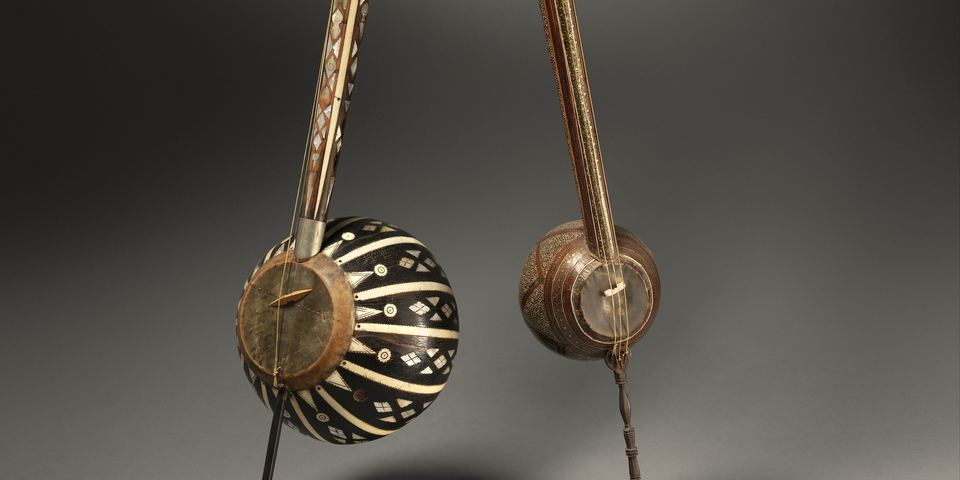
The kamancheh
The kamancheh, also spelled kamancha, is a bowed string instrument of Iran, Azerbaijan, Armenia and their neighbors. A round bowl covered with skin sits on a metal spike, and a long neck rises above it. The player holds it upright, as a cellist holds a cello, and turns it to meet the bow.
A single musician plays the kamancheh and sings in this home recording. The song is a tasnif, which is a composed Persian song with a regular meter. The words come from a poem by Ali-Akbar Dehkhoda. Unlike avaz, the other main kind of Persian classical song, a tasnif keeps a steady beat. Tap the beat as you listen.
The sound of the kamancheh
The recording in this section is a passage on the kamancheh alone. Listen to how the phrases grow and fade under the bow.
Names of the kamancheh
Kamancheh means little bow in Persian. It joins kaman, which means bow, with the ending -cheh, which makes a word smaller.
In Azerbaijan and Armenia the name is often written kamancha. The Turkish word kemençe comes from the same Persian word, but the Turkish kemençe is a different instrument. In English the kamancheh is sometimes called the spiked fiddle.
Where the kamancheh is played
The kamancheh belongs to the music of Iran, Azerbaijan, Armenia and Georgia. Kurdish, Turkmen and Uzbek musicians play their own forms of it. Their designs differ slightly. UNESCO lists the art of crafting and playing the kamancheh, shared by Iran and Azerbaijan, as intangible cultural heritage.
The role of the kamancheh in music
The kamancheh is a major instrument of both classical and folk music in Iran and Azerbaijan. It is played alone or in ensembles, and it is heard at many social and cultural gatherings in both countries.
Music for the kamancheh
Persian classical music rests on the radif. The radif is a large body of melodies that students learn by heart from a teacher. The melodies are grouped into modal systems called dastgah. A kamancheh player learns the radif and improvises within it.
In Azerbaijan the kamancha belongs to mugham. Mugham is a classical art that joins poetry with improvisation in set modes. A mugham trio has a singer, a tar player and a kamancha player. The tar is a plucked lute.
How the kamancheh is made
The bowl is carved from wood such as walnut or mulberry, or it is made from a gourd. A thin skin of lamb, goat or sometimes fish covers its open face. The bridge stands on the skin.
The neck has a long fingerboard with no frets. Pegs on both sides of the pegbox hold the strings. Older instruments had three silk strings, and modern ones have four metal strings. A spike runs through the bottom of the body.
How the kamancheh is played
The player sits and rests the spike on the knee or the thigh. The kamancheh is about as long as a viola, but the player holds it upright like a cello.
To reach another string, the player turns the whole instrument on its spike, so that the bow meets that string. The fingers of the bow hand press against the horsehair to tighten it while the player bows. The kamancheh is usually tuned like a violin. From the lowest string to the highest, the open strings are G, D, A and E. The strings are a perfect fifth apart.
How the kamancheh has changed
The kamancheh is related to the rebab, an older bowed instrument, and to the bowed lyra of Byzantium. Over time its three silk strings gave way to four metal strings.
Families pass on the crafts of making and playing the kamancheh. State music schools in Iran and Azerbaijan also teach it.
Choosing a kamancheh
The design differs slightly from one tradition to another. Choose the design used in the tradition that you will learn.
Look closely at the skin and the bridge. The skin should be tight and whole, and the bridge should stand firmly on it. Check that the pegs turn smoothly and hold their tuning.
First steps on the kamancheh
Use the tuner to set the four open strings to G, D, A and E. The lowest string is G. Sit upright and rest the spike on your knee. Draw the bow slowly across one open string, and keep the tone even from one end of the bow to the other.
Turn the instrument a little on its spike to reach the next string, and keep the bow moving in a straight line. Next, play a slow scale on one string. The fingerboard has no frets, so listen closely as you place the fingers.
A short check
Choose one answer per question. The explanation appears below the correct answer.
What does the name kamancheh mean?
In Persian, kaman means bow, and the ending -cheh makes a word smaller.
How does a kamancheh player move the bow to another string?
The player turns the whole instrument on its spike, so that the bow meets a different string.
Where does the bridge of the kamancheh stand?
A thin skin covers the open face of the bowl, and the bridge stands on that skin.
Sources
Common questions
What is the kamancha instrument?
Kamancha is another spelling of kamancheh. The kamancheh is the bowed spiked fiddle of Iran and the Caucasus. The player holds it upright on a metal spike.
How many strings does a kamancheh have?
Modern instruments have four metal strings. Older ones had three strings of silk.
Is the kamancheh the same as the Turkish kemençe?
No. The names share a Persian root, but the Turkish kemençe differs in shape and sound. The Turkish kabak kemane is much closer to the kamancheh.
How is a kamancheh tuned?
Most players tune it like a violin. The open strings are G, D, A and E from the lowest string up.
What is the kamancheh made of?
The bowl is wood or gourd, and a thin skin covers it. The neck is wood, and the strings are metal.
What is the bow of the kamancheh like?
It is strung with horsehair. The player sets the tension of the hair with the fingers while bowing.