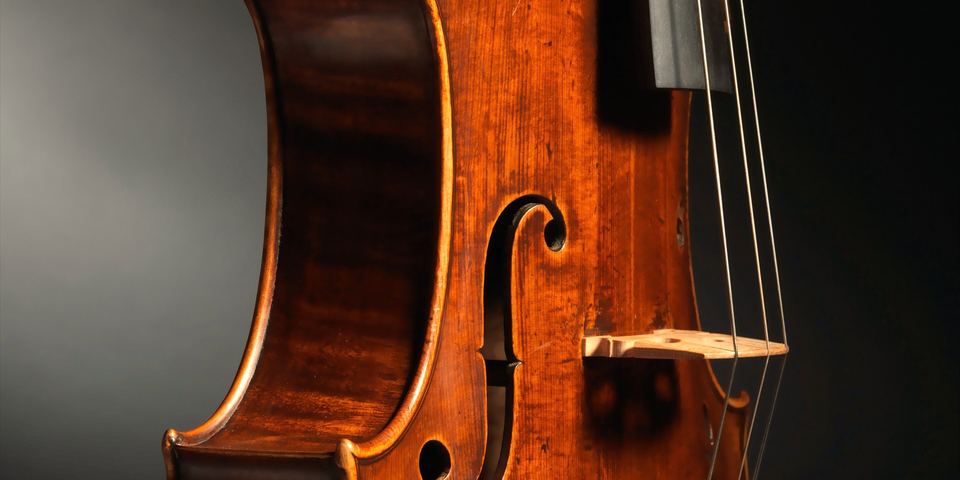
The viola
The viola is a bowed string instrument of the violin family. It is a little larger than the violin and sounds a fifth lower. Its four strings are tuned C, G, D and A. The viola plays the middle parts of the harmony. Its music uses the alto clef, which puts middle C on the middle line.
A solo viola plays this minimalist piece. Listen for the dark tone that sets the viola apart from the violin.
Music: Envato (Orchestralis)
The sound of the viola
Listen to the color of the sound in the piece for solo viola. The viola has the violin's G, D and A strings, but its body is larger and its strings are thicker. Its tone is darker and softer than the tone of the violin. On the low C string it comes close to the cello.
Below, a single viola plays first. You hear the open C string, which is the lowest note of the viola. Middle C and a high C follow. A few plucked chords come last.
Next a section of violas holds the open strings in turn: C, G, D and A. A plucked note and a tremolo end the set. A tremolo repeats one note with short, fast bow strokes. The recorded grand piano on the last button gives the pitches of the four open strings for tuning.
Names of the viola
Italians once called it the viola da braccio. The name means "viola of the arm." It set the instrument apart from the viola da gamba, which the player held between the legs. In German it is the Bratsche. This word comes from the Italian braccio. In French it is the alto, and the name comes from its range.
In Italian today the word viola alone means this instrument. A person who plays the viola is a violist.
History of the viola
The viola took shape in northern Italy early in the sixteenth century. The violin and the cello appeared at the same time. Andrea Amati of Cremona made some of the earliest violas that survive. Later in that century Gasparo da Salò of Brescia built both alto and tenor violas. Before the eighteenth century, violas were built in two sizes. A large tenor viola played the lower inner part, and a smaller alto viola played the upper one.
Antonio Stradivari made few violas, and only about a dozen of them survive. He built a set of instruments for Prince Ferdinando de' Medici of Florence. The set included an alto viola and a tenor viola. The tenor viola survives in its original state. Its neck was never reset, and its body was never cut down. Many large violas of that time were later made smaller so that players could hold them more easily.
In the Baroque and Classical periods the viola mostly filled in the harmony. In the nineteenth century the viola received more melodies. Harold in Italy by Berlioz is a symphony with a solo viola. Early in the twentieth century the English violist Lionel Tertis played the viola as a solo instrument and asked composers for new works. The violist William Primrose did the same, and a large repertoire followed.
The role of the viola in music
The viola usually plays the inner voices. These are the middle parts of the harmony, between the melody above and the bass below. In a string quartet one viola plays between two violins and a cello. A string quintet by Mozart or Brahms often adds a second viola.
An orchestra has a section of violas between the second violins and the cellos. Sometimes the viola takes a solo. In Don Quixote by Richard Strauss, a solo viola plays beside the solo cello. The viola is heard less often in popular music, but some folk, rock and jazz musicians play it.
Music for the viola
Telemann wrote one of the earliest known viola concertos. In the sixth Brandenburg Concerto by Bach, two violas carry the main melody. Mozart wrote the Sinfonia Concertante for violin and viola. In it the viola is tuned a half step higher than usual, and its part is written in D major. The higher strings make the viola sound brighter beside the solo violin.
Brahms arranged his two late clarinet sonatas for viola and piano. Schumann's Märchenbilder are fairy-tale pictures for viola and piano. Violists also play the cello suites of Bach. On the viola they sound an octave above the cello.
The viola concertos of Walton, Bartók and Hindemith stand at the center of the modern repertoire. Hindemith was himself a fine violist, and he wrote sonatas and the concerto Der Schwanendreher for the instrument. Bartók left his viola concerto unfinished at his death, and his friend Tibor Serly completed it. Rebecca Clarke wrote a sonata for viola and piano that violists still play.
How the viola is made
The viola is built like the violin. The top is spruce, and the back, the sides and the neck are maple. The fingerboard is ebony. Inside, a bass bar runs under the low strings, and a sound post of spruce stands between the top and the back.
A full-size viola has no single standard length. Its body measures about fifteen to eighteen inches (thirty-eight to forty-six centimeters), and the average is close to sixteen inches. The strings are thicker than violin strings. The bow is heavier, and its band of hair is wider.
Size is the main problem of the viola. The viola sounds a fifth below the violin. To match the violin's strength at that pitch, its body would need to be far too long to hold under the chin. The size of a viola is therefore a compromise between the ideal length and the reach of the player. Makers have tried wider bodies, deeper sides and cut-away shapes to give a deep sound that is still easy to hold.
How the viola is played
The viola rests on the left shoulder, and the jaw holds it in place. The fingers spread wider than on the violin, because the notes lie farther apart. The thick strings respond a little slowly, so the bow must lean into them. The bow moves a little more slowly than on the violin, and it draws more weight from the arm.
Most viola music is written in the alto clef. This clef places middle C on the middle line of the staff. Passages high on the A string switch to the treble clef. Violists also use vibrato, pizzicato and the bowing strokes of the violin. Pizzicato means plucking the strings.
What makes a fine viola
A violist first chooses the length of the body. A larger body gives a deeper, fuller C string, but it tires the arm. Lionel Tertis designed his own model of about sixteen and three-quarter inches. Its wider body and deeper sides give much of the tone of a larger viola in a size that most players can manage.
The choice of wood matters as much as it does on the violin. Makers choose spruce with a straight and even grain for the top. The back is often flamed maple, which has a striped figure. They carve the top and the back to a careful thickness. A viola with plates left too thick sounds nasal and closed. A plate carved too thin loses power on the C string.
A fine viola sounds even on all four strings. Its C string sounds full and clear, and its A string does not turn shrill. Players test a viola with slow scales across the strings and with a long note on the C string. The setup brings out the voice of the instrument. It covers the bridge, the sound post, the strings and the height of the fingerboard.
Old Italian violas are rare and costly, and many fine violas come from later makers. A well-made modern viola of a size that suits the arm is the right choice for most players. A student who has a good setup and a comfortable size will make progress fastest.
Choosing a viola
Violas are sized in inches or centimeters. Fractions such as half size are not used. A teacher measures the reach of the arm to choose the size. Children often start on a small viola of about twelve inches.
Fine tuners are small screws on the tailpiece that adjust the pitch a little. They make tuning easier for a beginner. Check that the pegs turn smoothly and hold their place.
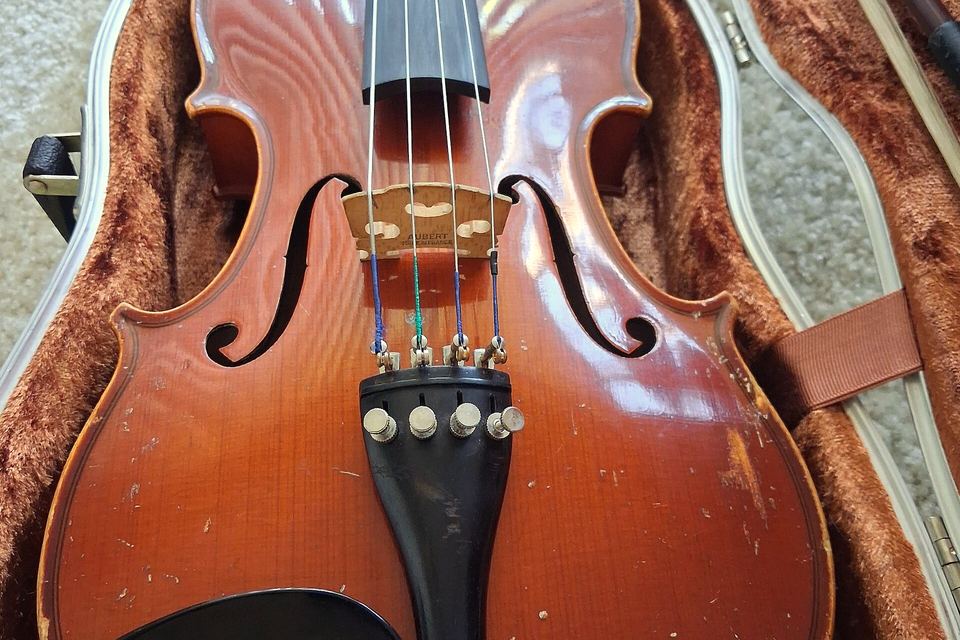
Who keeps these instruments
In Florence, the Galleria dell'Accademia displays the tenor viola that Stradivari made for the Medici. The Library of Congress in Washington holds two Stradivari violas. They are the Cassavetti viola and a Medici alto viola. Musicians still play the Library's instruments in its concert hall. The Smithsonian Institution in Washington keeps the Axelrod viola by Stradivari.
The Royal Academy of Music in London keeps the Archinto viola by Stradivari. It is often called the finest of his violas, because it survives in excellent condition. The Metropolitan Museum of Art in New York holds a large viola by Jacob Stainer. He was the leading violin maker of the Austrian Tyrol in the seventeenth century.
First steps on the viola
Tune the A string first with the tuner. Then tune the D, G and C strings. The strings lie a fifth apart. From the lowest the open strings are C, G, D and A.
Rest the viola on the left shoulder. Draw long bows on the open C string, and keep the bow parallel to the bridge. Lean a little weight into the string so that the tone is full.
On the C string, the first finger plays D. This note lies a whole step above the open string. Find it slowly, and check it against the open D string, which sounds an octave higher.
A short check
Choose one answer per question. The explanation appears below the correct answer.
Which notes are the open strings of the viola?
From the lowest, the strings are C, G, D and A. The lowest C lies an octave below middle C.
Which clef does most viola music use?
Viola music uses the alto clef, which puts middle C on the middle line. High passages switch to the treble clef.
How does the viola compare with the violin?
The viola shares the G, D and A strings with the violin. In place of the high E it has a low C.
What are the inner voices?
In a string quartet the viola usually plays a middle part. It fills the harmony between the violins and the cello.
Which string is this?
This is C. It is the lowest string of the viola. The violin has no string this low.
Sources

Common questions
Is the viola hard to learn?
The alto clef is new to most students, and the larger size calls for wider finger spacing. Violinists usually switch within a few months. Beginners learn the clef from the start.
What is the difference between a viola and a violin?
The viola is larger, and it lacks the violin's high E string. In its place it has a low C. Its tone is darker, and its music uses the alto clef.
Is the viola bigger than the violin?
Yes. A full-size viola is one to four inches longer than a full-size violin. The bow is heavier too.
What clef does the viola read?
It reads the alto clef. This C clef puts middle C on the middle line. High notes are written in the treble clef.
Can a violinist play the viola?
Yes. The fingerings are the same, and three strings share their names. The violinist must learn the alto clef and get used to the larger stretches.
What size viola do I need?
A full-size viola measures fifteen to eighteen inches. A teacher fits the size to the length of the arm.
How many violas did Stradivari make?
About a dozen violas by Stradivari are known to survive. He made far more violins and cellos.