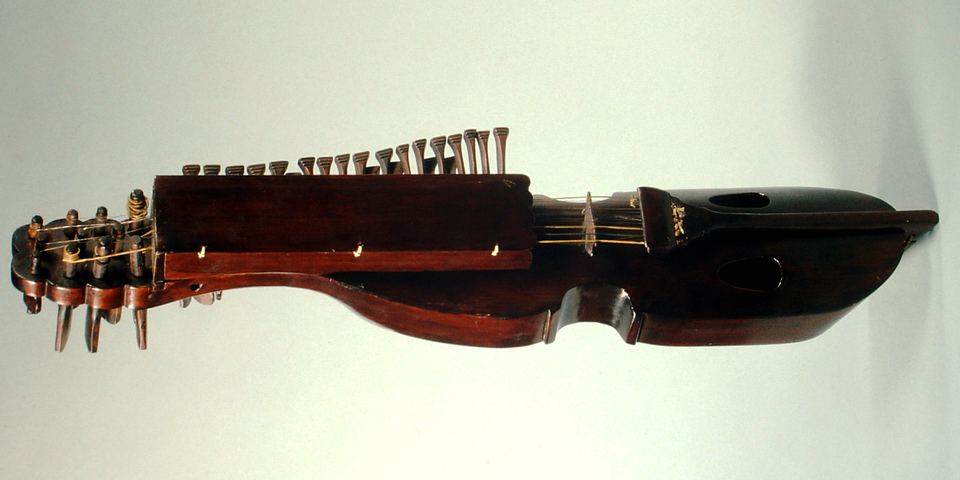
The nyckelharpa
The nyckelharpa is a keyed fiddle from Sweden. The player draws a short bow across its strings and presses wooden keys along the neck to change the notes. Its resonance strings are never bowed. They ring by themselves when the bowed strings play their notes, and they give the instrument a shimmering sound.
Ivar Tallroth, a folk musician from Uppland, plays this polska on the nyckelharpa. A polska is a Nordic couple dance in three beats. The archive tape adds a soft hiss.
The sound of the nyckelharpa
Listen for the resonance strings that ring on after the bowed notes. The recordings come from the Swedish folk music archive, and the players are from Uppland. The first is a polska. A waltz follows. Next comes a polska from the ironworks village of Lövstabruk. The last polska comes from the parish of Tofta, and two nyckelharpas play it.
Names of the nyckelharpa
Nyckelharpa means "key harp" in Swedish. Nyckel means key, and harpa is an old word for a string instrument. The plural is nyckelharpor.
Older names include nyckelgiga, which means "key fiddle." In German the instrument was called the Schlüsselfidel.
Where the nyckelharpa is played
The nyckelharpa became a popular folk instrument in the Swedish province of Uppland in the seventeenth century. From there it spread across Sweden, and it is often called the national instrument of Sweden.
Church paintings of keyed fiddles survive from Sweden, Denmark and Italy. Today the nyckelharpa is played across Europe and in North America, and it is taught at the Royal College of Music in Stockholm.
The role of the nyckelharpa in music
The nyckelharpa plays the folk dance music of Sweden. This music includes the polska and the waltz. For a long time the violin was the more common folk instrument, and the two often play together.
In the nineteenth century the nyckelharpa also reached the concert stage in Stockholm. Today it plays in folk groups and in early-music ensembles.
Music for the nyckelharpa
The polska is the central dance of the repertoire. It is a family of Nordic couple dances, and most polskas are in three beats.
Many tunes are passed on by ear from player to player. Folk groups and film composers now use the nyckelharpa in new music as well.
How the nyckelharpa is made
The body is made of wood, and it looks like a large fiddle. The wooden keys slide under the strings, and the keys carry small pegs, the tangents, that press one melody string apiece.
The modern chromatic nyckelharpa has three melody strings tuned A, C and G, and one drone string tuned C. Under them run twelve resonance strings. They are tuned to the twelve notes of the chromatic scale.
How the nyckelharpa is played
The player hangs the nyckelharpa from a strap around the neck and holds it across the body. The right hand bows. The left hand presses the keys.
The melody strings are stopped by the keys. The drone string is bowed but not stopped, so it sounds one note. The resonance strings are not touched at all.
How the nyckelharpa has changed
Older nyckelharpor had fewer rows of keys. The kontrabasharpa and the silverbasharpa are two of these older types.
In the twentieth century makers added a third row of keys, which made the nyckelharpa chromatic. The bow became straight, more like a violin bow.
Choosing a nyckelharpa
Most players today choose the three-row chromatic nyckelharpa. Nyckelharpa associations in Europe and North America can help a beginner find an instrument and a teacher.
A violinist can learn the bowing quickly. The keys are new to everyone, so a beginner learns a few dance tunes slowly by ear.
First steps on the nyckelharpa
Fit the strap so that the nyckelharpa rests across the body at a slight angle. The keys face the floor, and the left hand reaches them from below.
Bow the open A string with long strokes. Then press the first keys one at a time, and listen for the notes. Learn a simple polska by ear, and keep three steady beats to a bar with the metronome.
A short check
Choose one answer per question.
How does a nyckelharpa player change the note?
The keys have small wooden tangents. Pressing the key presses the tangent against a melody string.
What do the resonance strings do?
The resonance strings are not bowed. They ring when a bowed string plays the same note.
Which Swedish province is the home of the nyckelharpa?
The nyckelharpa became a popular folk instrument in Uppland, and from there it spread across Sweden.
What is a polska?
The polska is a couple dance of the Nordic countries. Most polskas are in three beats.
Sources
Common questions
What is a nyckelharpa?
It is a Swedish string instrument played with a bow. Wooden keys under the strings change the notes, much as on a hurdy-gurdy.
How many strings does a nyckelharpa have?
The modern chromatic nyckelharpa has sixteen strings. It has three melody strings, one drone string and twelve resonance strings.
Is the nyckelharpa related to the hurdy-gurdy?
Both use keys with tangents that stop the strings. The hurdy-gurdy uses a wheel, and the nyckelharpa uses a bow.
Is the nyckelharpa hard to learn?
The keys fall under the fingers in rows, so the first tunes come fairly quickly. Bowing with a steady tone takes longer.
How old is the nyckelharpa?
Pictures of keyed fiddles in Swedish churches go back to the Middle Ages. The oldest surviving instrument is from the sixteenth century.