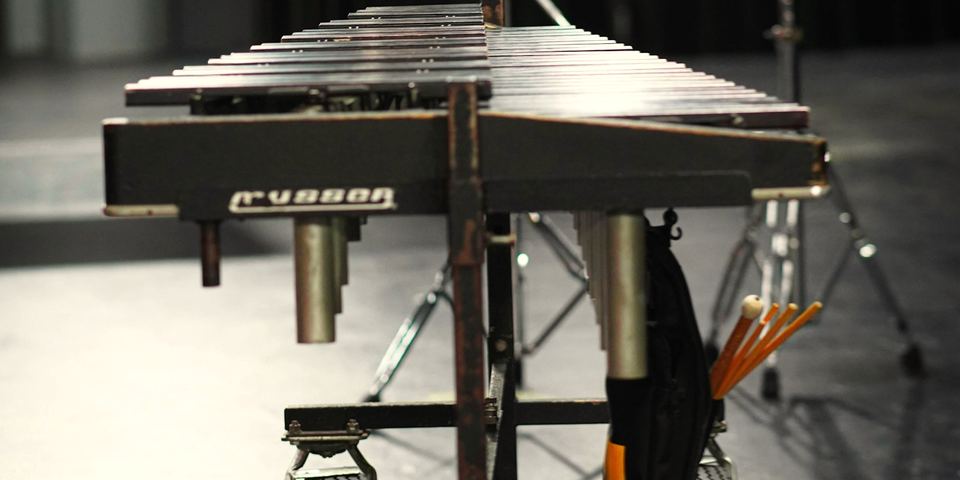
The marimba
The marimba is a percussion instrument with wooden bars struck by mallets. Resonator tubes hang below the bars and make their sound fuller. The bars are arranged like the keys of a piano. The marimba plays lower than the xylophone. Its name has Bantu roots, and Guatemala holds it as its national instrument.
In this quick marimba piece, listen for the round tone that the resonator tubes give the wooden bars.
Music: Envato (denisdrummer85)
The sound of the marimba
Listen for the round tone of the wooden bars. The first button below plays an early disc by a marimba band from Guatemala. In a band of this kind, several players stand at one large marimba, and the players cover different parts of its range.
The other three buttons play single notes of a concert marimba: a low C, a middle C and a high C. Compare how long they ring. The low note rings longest, because its bar is large and its resonator tube is long. The high note is short and bright.
Names of the marimba
The word marimba comes from the Bantu languages. The prefix ma- means "many," and rimba means "xylophone." Kikongo and Swahili have related words.
Central America has its own names for the forms of the instrument. In Guatemala the marimba de tecomates is the old marimba of the Maya highlands. Its resonators are gourds, and tecomate is a local word for a gourd. In Ecuador the most common type is the marimba esmeraldeña. Its name comes from the province of Esmeraldas. In Colombia it is the marimba de chonta. Chonta is the peach palm, whose wood forms the bars.
History of the marimba
Instruments like the marimba are played throughout sub-Saharan Africa. The closest relatives share its name in Angola and the Democratic Republic of the Congo. West Africa has a related instrument. It is the balafon of the Mandinka people.
In the Americas the first written account of a marimba comes from Chiapas in southern Mexico. A Spanish landowner of the sixteenth century described an instrument at a festival of the local people. It had eight slats of red wood, and the player struck them with two small sticks with heads of black wax.
Historians still debate how the marimba reached Central America. Many trace it to enslaved Africans brought to Guatemala and Mexico. Others hold that the Maya created it. Maya musicians in the highlands of Guatemala adopted marimbas with gourd resonators. Over the next two centuries, Maya and Ladino ensembles brought the marimba to their festivals.
Makers then lengthened the keyboard and raised it on legs, so the players could stand. Wooden boxes replaced the gourds as resonators. Late in the nineteenth century, makers in Chiapas and Guatemala added a second row of bars for the sharps and flats. The marimba could now play all twelve notes of the octave. These large chromatic marimbas had permanent stands, and four players with two mallets apiece shared one instrument.
Early in the twentieth century, marimba bands from Guatemala toured the United States. The large marimbas of the Guatemala City workshop of Rosendo Barrios helped make the instrument known in the United States and Europe. American companies such as J. C. Deagan and Leedy then built marimbas for Western music. They hung metal tubes below the bars as resonators, and the marimba played in vaudeville theaters and dance orchestras.
In the middle of the twentieth century, composers in the United States and France wrote the first concertos for the marimba. Players developed grips that hold two mallets per hand, so one player could sound full chords. The marimba became the main solo instrument among the keyboard percussion.
The role of the marimba in music
In Guatemala, the marimba plays at town festivals, processions, weddings and dances. Guatemala made it the national instrument by law, and a later law made it a national symbol. The same law asks the Ministry of Culture and Sports to promote the marimba annually in September. Guatemala celebrates its independence in that month.
On the Pacific coast of Colombia and Ecuador, the marimba is built of palm wood with resonators of bamboo. Drums and maracas join it, and men and women sing chanted stories and poems with it. In Afro-Ecuadorian communities, marimba music accompanies religious ceremonies, festivals and dances.
In concert music the marimba is a solo instrument. It also plays in orchestras, percussion ensembles, concert bands and the front ensemble of marching bands.
Music for the marimba
UNESCO lists the marimba music, chants and dances of two regions as intangible cultural heritage. They are the South Pacific region of Colombia and the province of Esmeraldas in Ecuador. Elders pass on the stories of the songs, and music teachers pass the playing to young people.
The concert repertoire of the marimba is young. Paul Creston wrote the first concerto for the instrument, his Concertino for marimba and orchestra. Darius Milhaud followed with a concerto for marimba and vibraphone. Later composers wrote many concertos and solo works. Students often meet Yellow After the Rain and Sea Refractions by Mitchell Peters among their first pieces for four mallets.
Marimba players also borrow music from other instruments. A five-octave marimba reaches down to the low C of the cello, so players can perform the cello suites of Bach. The four mallets let one player carry the melody and the harmony of such a piece together.
How the marimba is built
Concert marimba bars are made of rosewood, padauk or a fiberglass material. The most valued wood is Honduras rosewood, a hard, heavy wood that grows only in southern Belize and Guatemala. The lowest bars are the widest and the longest. The bars grow narrower and shorter as the notes rise.
A maker tunes a bar by taking wood from the middle of its underside. This cut leaves a deep arch under the bar. The arch lowers the main note, and it also tunes the overtones. On a marimba the first overtone is tuned two octaves above the main note. On a xylophone the cut is shallower, and the first overtone sounds an octave and a fifth above the main note. This difference gives the marimba its rounder tone.
Tubes hang below the bars as resonators. The tubes are closed at the bottom and tuned to the main notes of their bars. The air inside sounds with the bar and makes the note louder and fuller. Concert marimbas use aluminum tubes. The lowest notes need tubes longer than the frame is tall, so makers bend them or widen them into boxes.
Traditional marimbas use gourds or carved wooden boxes as resonators. In Mexico and Central America, small holes are cut in the bottoms of the resonators. A thin membrane made from the intestine of a pig covers the hole. The membrane buzzes with the bar, and the buzz is called charleo.
How the marimba is played
Marimba mallets have rubber heads that are usually wrapped in yarn. Softer mallets suit the low notes, and harder mallets suit the high notes. Mallets that are too hard can damage the low bars.
A bar sounds fullest when it is struck a little off the center. A stroke on the node, where the string passes through the bar, sounds weak and muted. A note on the marimba fades quickly, so players sustain a long note with a roll. A roll is a quick, even alternation of two mallets on one bar.
Advanced players hold two mallets per hand. In some grips the two shafts in a hand cross inside the palm. In others they stay apart, so the mallets can move on their own. With four mallets a player can sound chords and wide leaps. In Mexico and Central America, some players hold three mallets in one hand.
What makes a fine marimba
Much of the tone comes from the wood of the bars. Honduras rosewood gives the most valued sound. Padauk costs less and is a common choice for schools. Synthetic bars stand up to heat, damp and outdoor use, but their tone is less rich, and their notes ring longer than wooden ones. Changes in humidity or temperature alter the moisture in a wooden bar, and this can move its pitch.
The tuning of the overtones marks a fine marimba. The maker cuts the arch under a bar until the main note and its overtones are true. Well-tuned bars sound clear in chords, and the tone stays even from the lowest note to the highest. Many marimbas are tuned with the A above middle C at four hundred forty vibrations a second. Others are tuned a little higher so that they blend with an orchestra. On these marimbas the A vibrates four hundred forty-two times a second.
The resonators must match the bars. On a fine instrument the stops inside the tubes can be moved, so the tubes can be tuned to the temperature of the room. The low tubes need enough air for a full bass. The frame must stand firm and quiet, because a frame that rattles adds noise to the strokes. Good mallets complete the sound.
Choosing a marimba
Marimbas come in several ranges. The most common size covers four and a third octaves. It runs from A2 to C7. A four-and-a-half-octave marimba begins on F2, and a five-octave marimba reaches down to C2. A larger range needs more room and costs more.
Synthetic bars suit outdoor use and changing weather. Rosewood bars give the most valued sound, but they need a room with steady humidity. Ask whether the resonators can be adjusted. Choose a set of medium yarn mallets with the instrument, and add softer and harder mallets later.
Who keeps these instruments
The Musical Instrument Museum in Phoenix, Arizona, keeps a wide set of Latin American marimbas. Its marimba de tecomates was made by K'iche' Maya musicians in Guatemala. It has a single row of bars and gourd resonators, and its membranes are fixed with beeswax. A wooden arc on the player's side helped carry its weight.
The same museum holds a marimba grande from the Guatemala City workshop of Rosendo Barrios. It is about two and a half meters long. It also holds a marimba grande of nearly the same length from Chiapas. Its decorated front panel was made for an ensemble of brothers. These large chromatic marimbas inspired the orchestral marimba.
In Guatemala and Chiapas, marimba bands still carry the tradition at festivals and dances. Guatemalan law asks public and private schools to teach the marimba. In Colombia and Ecuador, music teachers and elders pass the marimba music of the Pacific coast to young people. UNESCO lists this music as living heritage.
First steps on the marimba
Stand one step back from the middle of the bars. Hold one mallet loosely in the left hand and one in the right. Let the mallet head drop onto the bar and bounce off at once. The bounce gives the bar room to ring.
Play the C major scale slowly with the hands in turn. Strike the bars a little off the center. When the scale sounds even, hold the last note with a slow roll. Speed the roll up only when both hands sound alike.
A short check
Choose one answer per question.
What hangs below the bars of a marimba?
A resonator tube below a bar makes its sound fuller.
Which country has the marimba as its national instrument?
Guatemala made the marimba its national instrument by law. A later law made it a national symbol.
Where on the bar does a marimba sound fullest?
A stroke a little off the center gives the fullest sound. A stroke on the node, where the string passes through, sounds weak.
Which mallets suit the lowest notes?
Softer mallets suit the large low bars, and harder mallets suit the small high bars.
What is charleo?
On the marimbas of Central America, thin membranes cover small holes in the resonators. It buzzes with the bar, and the buzz is called charleo.
Sources
- Wikipedia: Marimba
- Musical Instrument Museum: the marimba exhibit
- UNESCO: marimba music of the Colombian South Pacific and Esmeraldas
- Agencia Guatemalteca de Noticias: the marimba as a national symbol
- Justia Guatemala: the marimba decree
- HyperPhysics: xylophone and marimba
- Wikimedia Commons: a marimba band record
Common questions
Is the marimba the same as the xylophone?
They are close relatives with wooden bars. The marimba covers a lower range, and its bars are tuned to a rounder tone. Marimba music is written at the pitch you hear, while xylophone music sounds an octave higher than written.
Why is the marimba the national instrument of Guatemala?
Guatemala made the marimba its national instrument by law, and a later law made it a national symbol. The marimba has sounded at Guatemalan festivals for centuries.
How many mallets do marimba players use?
Beginners hold one mallet per hand. Advanced players often hold two mallets per hand, so they can play chords.
What is charleo?
Charleo is the buzzing sound of the Central American marimba. A thin membrane covers a hole at the bottom of a resonator and buzzes with the bar.
What is the marimba de chonta?
It is the most widespread marimba of Colombia, and it is played on the Pacific coast. Its name comes from the chonta, the peach palm.
What is a Zimbabwean marimba band?
It is an ensemble of marimbas in sizes from high soprano to bass. Thin cellophane over holes in the resonators gives a buzzing sound.
What is the difference between a marimba and a vibraphone?
The vibraphone has metal bars and a pedal that damps them. The marimba has wooden bars and no pedal, and its notes fade sooner.
What wood are marimba bars made of?
The finest bars are Honduras rosewood. Padauk is a common, less costly wood, and some marimbas have synthetic bars for outdoor use.