The balafon
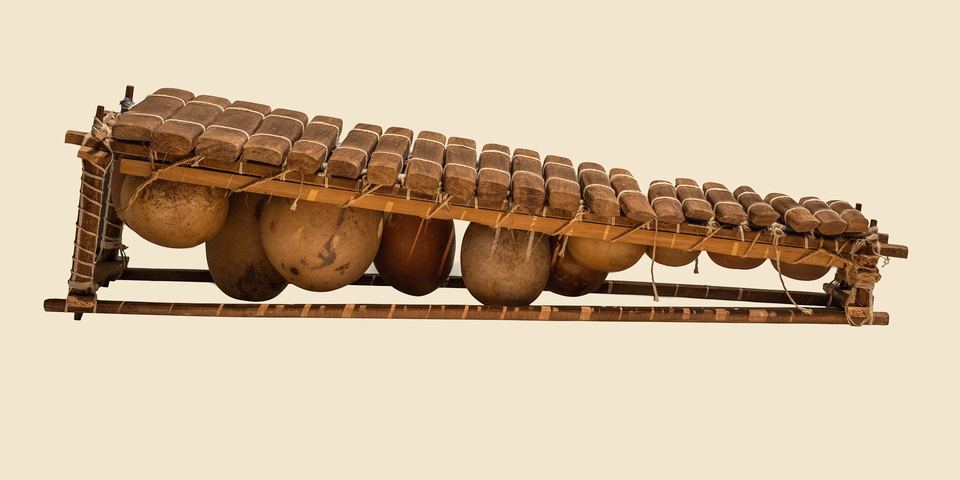
The balafon is a West African xylophone. Its wooden bars lie in a row on a frame, and dried gourds hang under the bars. The gourds make the sound louder. Thin membranes over holes in the gourds add a buzz. The Mande peoples of Guinea and Mali have played it for many centuries.
A balafon plays this piece with a kora, a guitar and percussion. Listen for the dry buzz in the balafon notes. It comes from the thin membranes over holes in the gourds.
Music: Envato (MyMusicID)
The sound of the balafon
The first recording is a single bar of a gourd xylophone made in Ghana. Listen for the buzz that follows the stroke.
The other four are bars of a studio balafon. They run from the lowest bar to the highest. A shorter bar sounds a higher note.
Names of the balafon
The name is usually explained as a Malinké compound. Bala is the name of the instrument, and fô is a verb that means to play. In some regions a large bass instrument is still called a bala, and a small high one is a balani.
Neighboring peoples use their own names. The Dagara, Lobi and Gurunsi call their buzzing balafon the gyil. In Sierra Leone it is the balangi.
Where the balafon is played
The balafon belongs to West Africa. The Mande peoples, among them the Malinké, Susu and Bambara, are closely tied to it. So are the Senufo communities of Mali, Burkina Faso and Côte d’Ivoire. Cameroon and Chad keep long balafon traditions of their own.
The role of the balafon in music
A balafon can play melodies, bass lines and short repeated patterns. In Guinea and Mali it often plays in a group of three instruments. They are pitched low, middle and high. In Cameroon a larger group of balafons forms an orchestra.
In some communities the balafon is a sacred instrument. Only trained players may play it, and only at festivals, funerals, weddings or royal events. Young players learn on a separate instrument.
Music for the balafon
Oral histories trace the balafon at least to the founding of the Mali Empire in the thirteenth century. It is probably older still. In the fourteenth century the traveler Ibn Battuta saw the balafon at the court of the Mali ruler Mansa Suleyman.
Gyil duets are the music of Dagara funerals, and a gourd drum called the kuor plays with them. Among the Sambla of Burkina Faso, the balafon imitates the words of their language, as a talking drum does. In Cameroon, the popular style called bikutsi joins the balafon with drums and rattles.
How the balafon is made
A balafon usually has seventeen to twenty-one bars, which players also call keys. Makers dry the wood slowly over a low flame. They tune the bars by shaving wood from the underside. Wood taken from the middle lowers the pitch, and wood taken from the ends raises it.
Gourds of graded sizes hang under the bars, and leather straps hold the bars above the frame. A small hole in a gourd is covered by a thin membrane. It was once made from the egg sacs of spiders. Today it is often cigarette paper or thin plastic film.
This is the fixed-key balafon. On a free-key balafon, the loose bars rest on any padded surface.
How the balafon is played
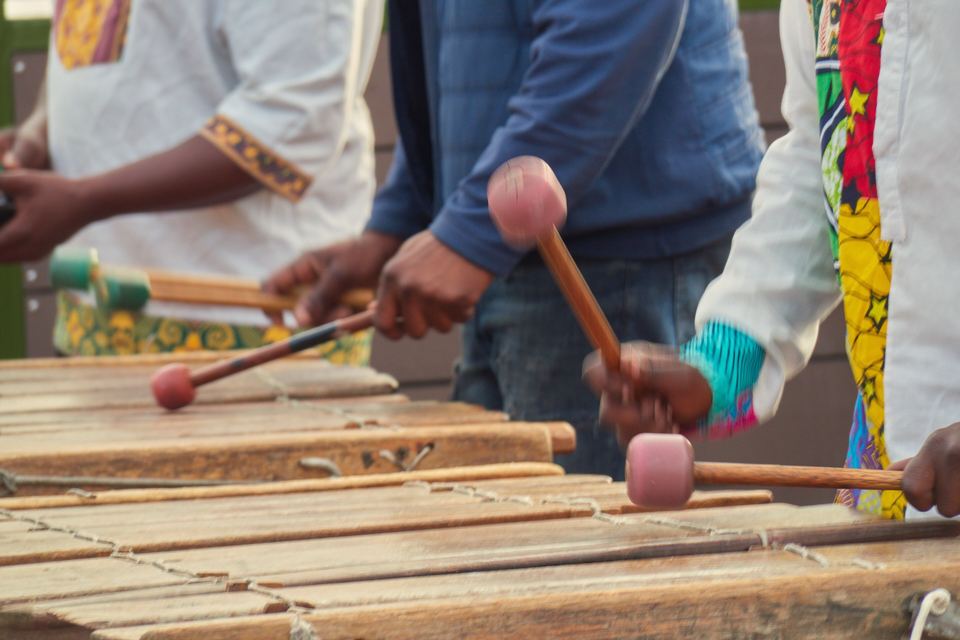
The player strikes the bars with two mallets whose heads are wrapped in rubber. Most players sit on a low stool. Others stand and carry the balafon on a strap. Many wear bracelets with small bells on both wrists.
A balafon is tuned to a scale of four, five or seven notes in an octave. The scale depends on the music of its community. A scale of five notes is called pentatonic.
How the balafon has changed
European visitors described the balafon in the seventeenth century, and the instrument they saw was much like the modern one. The Atlantic slave trade brought some balafon players to the Americas. A Virginia newspaper of the eighteenth century mentions an instrument that appears to be a balafon.
In the middle of the twentieth century, balafon orchestras played in the bars of Yaoundé. The bikutsi of Cameroon grew into a popular style there. The balafon traditions of Mali, Burkina Faso and Côte d’Ivoire are on the UNESCO list of intangible cultural heritage. They share the entry with the kolintang of Indonesia.
Choosing a balafon
Check the scale first. A balafon is tuned to the scale of the music it plays, so a pentatonic instrument cannot play a scale of seven notes.
Check the membranes and the straps. A torn membrane loses the buzz, and players replace it with thin paper or plastic film. If you will play in a group, ask whether the bars are tuned to the other instruments.
First steps on the balafon
Hold a mallet loosely in your left hand and another in your right, and strike the middle of a bar. Let the mallet bounce off, so that the bar rings. Play the bars from low to high with the hands in turn.
Next, choose three neighboring bars and repeat a short pattern on them at a steady tempo. Set the metronome to a slow tempo at first. Raise the tempo only when the pattern sounds even.
A short check
Choose one answer per question. The explanation appears below the correct answer.
What gives the balafon its buzzing tone?
The gourds have small holes covered by thin membranes. The membrane vibrates with the bar and adds the buzz.
How does a maker lower the pitch of a bar?
Wood taken from the middle lowers the pitch. Wood taken from the ends raises it.
What is the gyil?
The Dagara, Lobi and Gurunsi call their balafon the gyil. The gourd drum that plays with it is the kuor.
Sources
Common questions
What is a balafon made of?
It has wooden bars tied over a wooden frame. Dried gourds hang beneath them. The mallets have heads wrapped in rubber.
What is the difference between a balafon and a xylophone?
The balafon is a type of xylophone. Its gourds and their membranes give it a buzzing tone that the orchestral xylophone lacks.
Is the balafon related to the marimba?
Both have resonators under wooden bars. Historians believe that the balafon developed in West Africa separately from the marimba.
How many bars does a balafon have?
Most balafons have seventeen to twenty-one bars. Some are built with as few as six or seven.
Where is the balafon played today?
It is heard across West Africa, especially in Guinea, Mali, Burkina Faso, Côte d’Ivoire, Senegal and the Gambia. Cameroon and Chad also have balafon traditions.
Why do balafon players wear bells?
Belled bracelets on the wrists add a ringing sound to the strokes of the mallets.