The xylophone
The xylophone is a set of tuned wooden bars struck with mallets. Its name joins the Greek words for wood and sound. The orchestral xylophone has two rows of bars that are laid out like the keys of a piano. It sounds high, bright and dry. Its music is written an octave below the notes you hear.
This early disc pairs a xylophone with a piano in a ragtime piece. Listen to the short notes of the wooden bars over the steady beat of the piano.
The sound of the xylophone
In the ragtime piece, the piano keeps a steady beat in the left hand. Above it the xylophone plays syncopated melodies. Their accents fall between the beats. The notes are short, because a wooden bar stops ringing soon after the stroke. To hold a long note, the player repeats it quickly with both mallets. This is called a roll.
The recordings below open with a melody on the pattala. The pattala is the bamboo xylophone of Myanmar. After it come a low note and a high note of an orchestral xylophone. Compare the soft, round sound of the bamboo with the hard, bright sound of the orchestral bars.
Names of the xylophone
Many cultures have their own xylophones and their own names for them. In Myanmar the xylophone is the pattala (ပတ္တလား), and it is usually made of bamboo. In Thailand the ranat ek (ระนาดเอก) leads the piphat ensemble. The piphat is an ensemble of percussion and wind instruments. In Japan the xylophone is the mokkin (木琴). The name is written with the sign for wood. In West Africa the Manding peoples play the balafon, and the Dagara people of Ghana and Burkina Faso play the gyil.
Orchestral scores use the Italian silofono, the French claquebois and the German Xylophon. Older German scores sometimes say Holzharmonika, which means "wooden harmonica." Older xylophones in Central Europe rested their bars on bundles of straw.
History of the xylophone
The xylophone is ancient, and its first home is uncertain. The earliest firm evidence of a true xylophone comes from Southeast Asia in the ninth century. Some scholars think that it traveled from there to Africa. Others hold that Africans invented it on their own, because Africa has so many kinds of xylophone and of simpler struck wooden instruments.
In West Africa the balafon is tied to the history of the Mali Empire. The Epic of Sundiata tells of a sacred balafon and of the griot who played it. Griots are hereditary musicians and keepers of history. In Niagassola in Guinea a family of griots keeps an old balafon called the Sosso Bala. Tradition says that it is the first balafon, and UNESCO has honored the cultural space around it.
In Europe the earliest mention of a xylophone comes from a German book on organs published early in the sixteenth century. It calls the instrument hültze glechter, the "wooden clatter." For centuries the instrument belonged to the folk music of Central and Eastern Europe.
In the nineteenth century the klezmer musician Josef Gusikov from Shklow, in present-day Belarus, toured Western Europe with a xylophone of wood and straw. Klezmer is the folk music of the Jews of Eastern Europe. Felix Mendelssohn heard him and called him a phenomenon. Later Saint-Saëns wrote a well-known orchestral part for the xylophone in his Danse macabre. Early in the twentieth century American makers built xylophones with metal resonator tubes. The instrument became a star of vaudeville, the variety theater of America, and of the first recordings.
The role of the xylophone in music
In the orchestra the xylophone belongs to the percussion section. It doubles fast melodies to make them sharper, and it adds a bright point to loud passages. A percussionist usually plays it beside the glockenspiel, the marimba and the vibraphone.
In many classrooms children play small xylophones in the Orff approach. This way of teaching music uses singing, movement and simple instruments. In West Africa xylophones play at festivals, at work and at funerals. Among the Dagara, gyil players often play in pairs with a gourd drum, and gyil duets are the traditional music of funerals.
Music for the xylophone
In the Danse macabre by Saint-Saëns, the xylophone plays the dance of the skeletons. Saint-Saëns quoted the same tune in The Carnival of the Animals. It returns there in the movement called Fossils. Shostakovich wrote prominent xylophone parts in most of his symphonies. The xylophone also plays a leading part in the Saber Dance by Khachaturian, and Mahler, Stravinsky and Bartók all wrote for it.
Early jazz bands and vaudeville shows used its bright sound for syncopated dance music. In the years of the first records, xylophone soloists recorded ragtime, marches and light comic pieces, and many composed their own. Later the vibraphone, which has metal bars and a motor that adds vibrato, took the place of the xylophone in jazz.
How the xylophone is made
Orchestral bars are made of rosewood, padauk or cocobolo, or of a fiberglass material that sounds louder. The bars are thick, and they are cut to lengths that give their pitches. The maker tunes a bar by carving an arch into its underside. Taking wood from the middle lowers the pitch, and taking wood from the ends raises it.
Below the bars hang tube resonators. The tube is closed at the bottom, and its length matches the pitch of the bar above it. The air in the tube vibrates with the bar, and the tone grows fuller and rings longer. Cords pass through holes in the bars at the points where they vibrate least. This lets the bars ring freely.
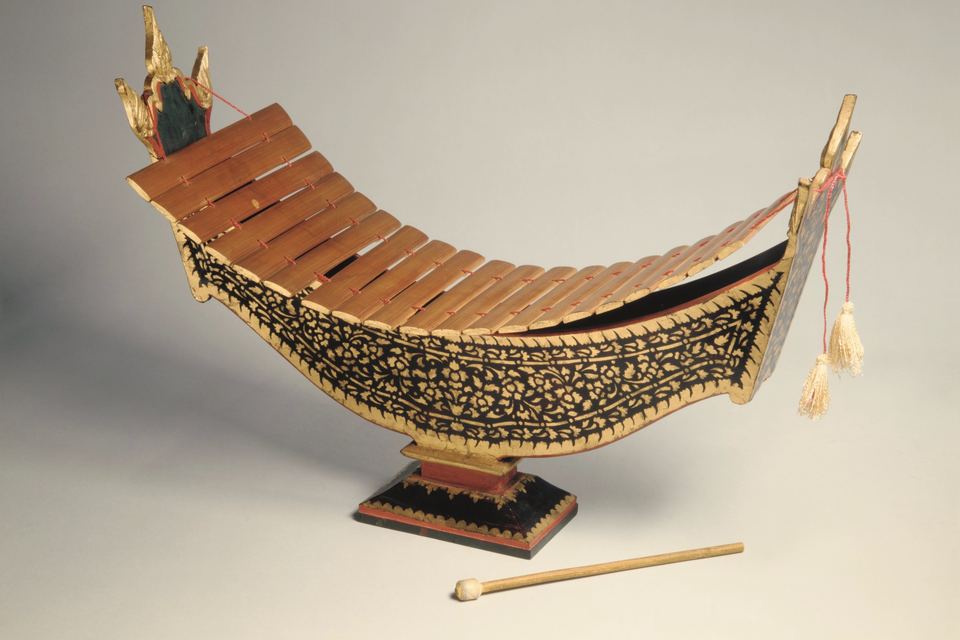
Other traditions use other resonators. The balafon hangs gourds under its bars. Small holes in the gourds are covered with a thin membrane. The membrane was traditionally spider silk. It adds a buzz to the notes. The ranat ek of Thailand hangs its bars over a curved wooden trough shaped like a boat.
How the xylophone is played
The player holds a mallet in the left hand and one in the right. Hard rubber or plastic mallets give the usual sound. Yarn mallets give a softer sound, and wooden mallets give the hardest, brightest sound.
Strike the middle of the bar, or the edge of a raised bar near its end. Let the mallets bounce off the bar after the stroke. A stroke that stays on the bar stops it from ringing. Wooden bars ring only briefly, so long notes are played as rolls. Advanced players hold two mallets per hand to play chords.
What makes a fine xylophone
Honduras rosewood is the traditional wood for concert bars. It is dense and hard, and it gives a clear, ringing tone. The wood is dried for a long time before the maker cuts the bars, so that they keep their pitch through changes of weather. Fiberglass bars are louder and do not crack, so schools and marching bands often choose them.
Tuning makes the greatest difference. A fine xylophone is in tune across its whole range. Its bars match one another in loudness and in tone color, so that a scale sounds even from bottom to top. Makers tune the bars by ear and with electronic tuners, and they check the tuning again after some time.
The resonators and the frame matter too. On a fine instrument the tubes are tuned to their bars, and the bars ring longer and fuller. The frame stands firm on the floor and does not rattle. Its height can be adjusted for the player, and its wheels lock in place.
A concert xylophone usually covers three and a half or four octaves. A smaller instrument with good bars is better than a large one with poor bars. A student can learn well on a rosewood or fiberglass instrument of modest range with resonators.
Choosing a xylophone
A classroom xylophone with removable bars suits young children, because they can play a tune with only the bars they need. Students who play in a band or orchestra move on to an orchestral xylophone with resonators.
Many toys sold as xylophones have metal bars. In the study of instruments these count as glockenspiels.
Who keeps these instruments
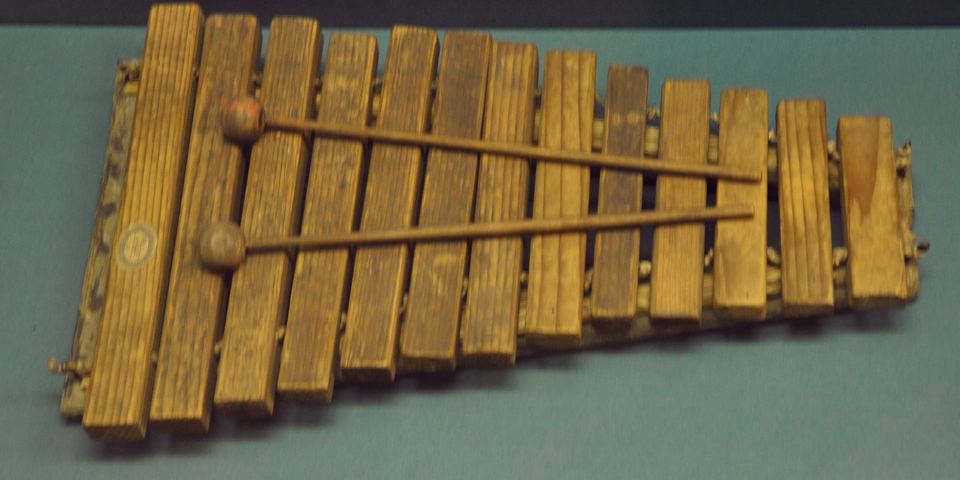
The Collection of Historic Musical Instruments of the Kunsthistorisches Museum in Vienna holds an old xylophone with two wooden mallets. It is on loan from the Society of Friends of Music in Vienna. The Metropolitan Museum of Art in New York holds xylophones from Asia, Africa and the Americas. Among them is a ranat ek from Thailand with a gilded, boat-shaped trough.
In West Africa the xylophone is still played and taught. In Niagassola in Guinea, the Kouyaté griots keep the Sosso Bala in a round hut of mud with other sacred objects. The head of the family is its guardian. He alone plays it. He plays it on great occasions, such as the festival of the Muslim New Year, and at burials. He also teaches the balafon to the children of the family. In Ghana and Burkina Faso, players of the gyil still pass the music from teacher to student. In Thailand the ranat ek still leads the piphat ensemble.
First steps on the xylophone
Stand at the middle of the instrument with a mallet in the left hand and one in the right. Find C. It is the front bar to the left of a group of two bars in the back row.
Play the C major scale slowly with one hand at a time. Then play it with the hands in turn. Begin with the right hand.
Begin with single strokes on C, and let the mallet spring back at once. Then hold a C as a slow roll. Move the mallets in turn. Make the roll faster, and keep it even.
A short check
Choose one answer per question.
What are the bars of a xylophone made of?
Orchestral bars are rosewood, padauk or a fiberglass material. Instruments with metal bars are glockenspiels.
What does the word xylophone mean?
It joins the Greek words for "wood" and "sound."
How does xylophone music sound compared with the written notes?
Xylophone parts are written an octave below the sound, so the notes sound an octave higher than written.
Which instrument is a xylophone of West Africa?
The gyil is played by the Dagara and Lobi peoples of Ghana, Burkina Faso and Ivory Coast.
Sources
Common questions
What is the difference between a xylophone and a marimba?
Both have wooden bars. The xylophone covers a higher range and has a drier sound. The marimba plays lower, and its music is written at the pitch you hear.
What is the difference between a xylophone and a glockenspiel?
A xylophone has bars of wood or a synthetic material. A glockenspiel has metal bars and sounds two octaves above its written notes.
How many octaves does a xylophone have?
Concert xylophones usually have three and a half or four octaves. Smaller models may have two and a half, and classroom xylophones about one and a half.
What is a gyil?
The gyil is a xylophone of the Dagara and Lobi peoples of Ghana, Burkina Faso and Ivory Coast. It is tuned to a pentatonic scale.
Where does the xylophone come from?
Its origins are ancient and uncertain. The earliest firm evidence of a true xylophone comes from Southeast Asia in the ninth century.
What is a roll on the xylophone?
A roll is a fast, even repetition of one note with both mallets in turn. Wooden bars ring only briefly, so players use rolls for long notes.