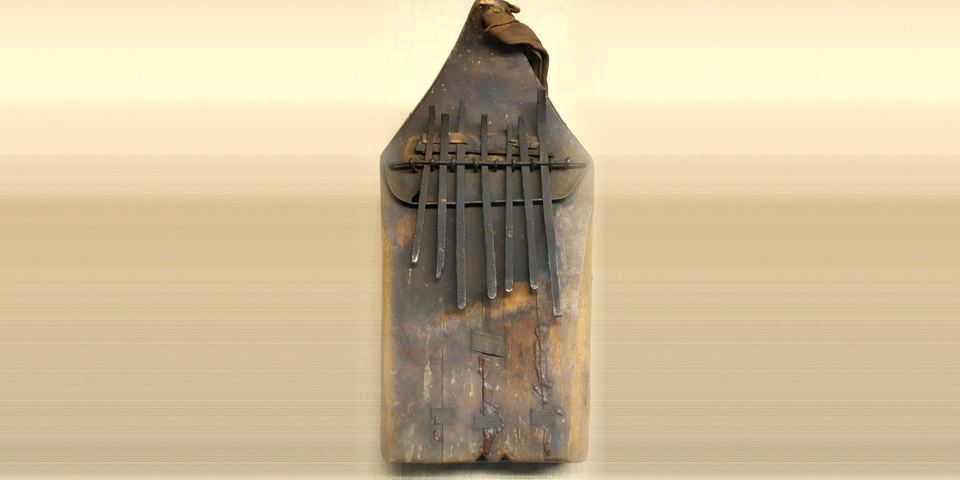
The kalimba: a thumb piano from Africa
The kalimba is a small instrument with thin metal strips called tines. You pluck the tines with your thumbs. It grew from the mbira and other thumb pianos of Africa. A tine sounds one note. The longest tine sits in the middle and gives the lowest note.
A kalimba plays over a low drone. A tine rings on after the thumb leaves it, so the notes overlap and blend into chords.
Music: Envato (lucafrancini)
World Music pages are free and are not part of the levels or tests.
The sound of the kalimba
The first recording in this section is a kalimba alone. Listen to the start of the notes. A plucked tine gives a short metallic click. A round tone follows and slowly fades. The click comes from overtones that do not match the main note. They die away quickly, so the tone grows purer as it fades. When one tine sounds, its neighbors ring a little too, and this adds a soft halo to the notes.
The second recording is a shorter kalimba melody. Listen to how a note goes on ringing under the next one, since nothing stops the tines. Players use this ringing to build chords out of single notes.
Music: Envato
Where the kalimba comes from
Thumb pianos are African instruments, and scholars think that they were invented twice. Instruments with tines of wood or bamboo appeared on the west coast of Africa about three thousand years ago. Instruments with metal tines appeared in the valley of the Zambezi River about one thousand three hundred years ago. The metal kind spread across much of the continent. It reached from the north to the Kalahari Desert and from coast to coast.
The family has many names. Musicologists call these instruments lamellophones. The name comes from the Latin lamella, which means a thin plate. The Shona people of Zimbabwe play the mbira. In Malawi a related instrument is the sansi. In the Democratic Republic of the Congo the likembe is common. Kalimba was itself an old African name for an instrument of this family.
The modern kalimba was designed in the middle of the twentieth century by the ethnomusicologist Hugh Tracey. He worked in southern Africa and made tens of thousands of recordings of African music. He modeled his kalimba on the mbira nyunga nyunga of Zimbabwe and Mozambique. He tuned it to a Western major scale, so that people anywhere could play it at once. His kalimbas were made by hand in a family workshop in Grahamstown, South Africa. The town is now called Makhanda.
Kalimbas based on his design are now made in many countries. Many kalimbas sold today have seventeen tines tuned to the C major scale. In Zimbabwe and Malawi the traditional instruments are still made and played. They keep their own tunings and their own music.
How the kalimba works
The tines are thin strips of spring steel. A metal bar presses them down across a raised bridge. The part of a tine between the bridge and its free end vibrates when the thumb plucks it. A long free end gives a low note, and a short one gives a high note. The player tunes a tine by sliding it through the bridge with a small hammer.
The body carries the sound. A board kalimba is a flat plank of wood. A box kalimba is hollow, so the air inside resonates and the tone is louder and rounder. Many box kalimbas have a round sound hole on the front.
Traditional African thumb pianos often add a buzz. Players fix bottle caps, shells or loose metal rings to the board, and these rattle when the tines sound. On the Shona mbira the buzzers are called machachara. In a public performance the mbira is often set inside a large calabash called a deze, which makes it louder.
The layout of the notes
The kalimba places its lowest note in the middle. The notes move outward and alternate between the left and the right, so neighboring notes of the scale sit on opposite sides. The thumbs pivot at the base, and all the tines are within easy reach.
This layout puts a chord under the left thumb and another under the right. On one side, tines that sit next to one another are a third apart. In the middle of a kalimba in C, the tines for C, E and G sit side by side. A single sweep of the thumb sounds a C major chord. The same notes return an octave higher on the opposite side. A player can therefore play a melody on high tines with one thumb and its chords on low tines with the other.
Many kalimbas have the note letters or numbers stamped on the tines. The numbers follow the scale, so 1 is C, 2 is D and 3 is E. A dot above a number marks the higher octave. The table shows the seventeen tines of a kalimba in C. Middle C is written C4.
| Place on the kalimba | Notes from the middle outward |
|---|---|
| The middle tine | C4 |
| The left side | D4, F4, A4, C5, E5, G5, B5 and D6 |
| The right side | E4, G4, B4, D5, F5, A5, C6 and E6 |
How the mbira differs from the kalimba
The kalimba and the mbira look alike, but they are different instruments. The mbira dzavadzimu of the Shona has twenty-two keys or more in three rows. The player puts the right little finger through a hole in the board. The left thumb plays two rows of keys. The right thumb and first finger play the third row. A kalimba has one row of tines, and the two thumbs play it.
The mbira dzavadzimu is a sacred instrument of the Shona. It is played at the bira. At this all-night ceremony, families call on the spirits of their ancestors. Mbira players often play in pairs and interlock their parts. The first part, called kushaura, leads. The second part, called kutsinhira, fits its notes between the notes of the first. Mbira music rests on cross-rhythm, in which three beats are set against two.
What makes a fine kalimba
The tone depends most on the tines. Good tines are spring steel of even thickness, so that they return to shape and ring for a long time. Their tips are rounded and smooth, and the thumbs do not catch on them. The tines should sound clear notes with no rattle.
The bridge and the bar must hold all the tines firmly. A tine that sits loose under the bar buzzes or slips out of tune. The tines should be spaced evenly, and their lengths should step smoothly from the middle outward. A well-made kalimba stays in tune for a long time.
The body shapes the voice. Makers build it from solid hardwood or from plywood, and a solid body usually sounds warmer. A hollow box sounds louder and rounder than a flat board. A flat board gives a clearer and drier tone, and some players prefer it for quick melodies.
Who keeps these instruments
Hugh Tracey founded the International Library of African Music. It is now part of Rhodes University in Makhanda, South Africa. The library keeps his field recordings, and it has returned copies to the communities in which he made them. It also teaches African instruments to students.
The Royal Museum for Central Africa in Tervuren, Belgium, holds the kalimba from the Kongo region shown on this page. The Metropolitan Museum of Art in New York keeps thumb pianos from across Africa. Among them are an mbira from South Africa with a gourd resonator and a nyonganyonga decorated with shells and beads. UNESCO lists the craft and the playing of the mbira and the sansi of Malawi and Zimbabwe as intangible cultural heritage.
Choosing a first kalimba
A seventeen-key kalimba in C suits most beginners. A hollow box gives a louder and rounder sound than a flat board. Check that the tines sit evenly and do not buzz, and that a small tuning hammer comes with the instrument.
Most beginner books and song sheets are written for seventeen tines in C. A kalimba with fewer tines limits the songs that you can play. A kalimba with more tines adds low or high notes, which you can use later.
First steps on the kalimba
Tune the kalimba first. Pluck the tines one at a time and check their notes with the tuner. Tap the tip of a tine toward the bridge to shorten it and raise its note. Tap it the other way to lower the note.
Hold the kalimba in both hands with the thumbs resting on the tines. Press the tip of a tine down with the pad of the thumb or the edge of the nail, and let it spring free. Keep the stroke short and light.
Play C, E and G with alternating thumbs to sound a C major chord.
Then play a first melody. Mary Had a Little Lamb begins on E, D, C, D, E, E and E. On a kalimba in C these notes lie at the middle, so the thumbs move in small steps from side to side.
Common questions
Is a kalimba the same as an mbira?
No. Both are thumb pianos, but the mbira of the Shona has more keys in several rows and its own tunings. The kalimba is a modern instrument with one row of tines in a Western scale.
How many keys does a kalimba have?
Many kalimbas have seventeen keys, which span two octaves and a third. Smaller models have eight to fifteen keys, and larger ones have twenty-one or more.
What key is a kalimba in?
Most kalimbas sold today are tuned to C major. The kalimbas of Hugh Tracey were tuned to G major. Because the tines can be moved, a player can retune the kalimba to another key or scale.
Is the kalimba easy to learn?
The first steps are easy. A tine gives one fixed note, and a beginner can play simple melodies within a few days. Quick passages and two-handed parts take longer.
Why does my kalimba buzz?
A tine that sits loose under the bar, or touches its neighbor, can buzz. Press the bar down evenly, and move the tine a little until the buzz stops.
Why is it called a thumb piano?
The tines work like the keys of a piano, and the player plucks them with the thumbs.
Sources
- Wikipedia: Mbira
- Wikipedia: Lamellophone
- Wikipedia: Hugh Tracey
- Wikipedia: Likembe
- International Library of African Music, Rhodes University
- UNESCO: the mbira and the sansi of Malawi and Zimbabwe
- Metropolitan Museum of Art: mbira from South Africa
- Metropolitan Museum of Art: nyonganyonga
- Wikimedia Commons: kalimba in the Royal Museum for Central Africa
