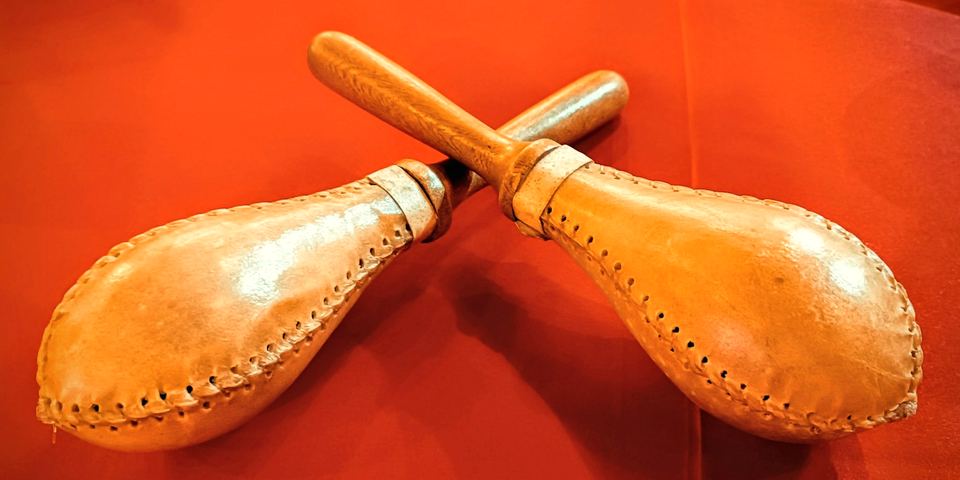
Maracas
Maracas are rattles that are usually played in pairs. A maraca has a round shell on a handle. Seeds or pebbles fill it. The player shakes them so that the filling strikes the inside of the shell. Maracas come from the Indigenous peoples of South America and the Caribbean. Today they keep time in son, salsa, cumbia and calypso.
A brass section, a piano, guitars and percussion play this salsa. Salsa grew from son, which is a style of Cuban music. The maracas keep time in both styles.
Music: Envato
The sound of maracas
In salsa, the maracas and the güiro keep a steady flow of short, even notes. Most other parts follow the clave, a rhythm that spans two measures. The maracas stay neutral to it, so they steady the whole band. The recordings below let you hear the maracas on their own.
In the first recording the player keeps a steady triplet rhythm. There are three even shakes to a beat. The next two recordings play other patterns. The player uses a pair of ordinary maracas and then a pair of large ones. A single shake of a pair follows, and a short free rhythm ends the set.
Names of the maracas
A maraca is one rattle, and maracas are the pair. In Spanish a maraca player is a maraquero. In Brazil the instrument is the maracá. The stress falls on the last syllable.
The word is believed to come from mbaraka in the Guaraní language. In the eastern Caribbean the instrument is called the shak-shak or chac-chac. In Puerto Rico it is called the higuera, which is also the name of the calabash tree. Brazil has many regional forms with names of their own. The adjá, the ganzá and the xeque are among them.
History of the maracas
Maracas are older than the arrival of Europeans in the Americas. Indigenous peoples of South America and the Caribbean used them in ceremonies and to send messages. Accounts link them to the Arawak and Taíno peoples. In the eighteenth century, the Jesuit missionary José Gumilla described maracas among Arawak-speaking peoples of the Orinoco basin.
Early European writers described the maraca of the Tupinambá people of Brazil. It was a gourd on a handle. Pebbles filled it, and red feathers of the scarlet ibis crowned it. A slit cut into the gourd served as a mouth. The religious leaders were called pajés, and they made the maraca give answers through this mouth. Among some Indigenous peoples of Brazil, the maraca is still a sacred object. Healers in the Andes also use maracas in their rites.
Indigenous, African and Spanish music met in the Caribbean. The maracas passed into the new popular styles that grew from this meeting. In eastern Cuba the son grew up late in the nineteenth century. Its percussion of bongos, claves and maracas has roots in Bantu traditions. In Havana, the son sextet joined guitar, tres, bongos, claves, maracas and double bass. The singers often played the claves and the maracas.
Salsa grew largely from the son. Salsa bands in New York kept the small hand percussion of the son ensemble and added a horn section, congas and timbales.
The role of maracas in music
Maracas mark the beat and fill the spaces between the other parts. They play a steady stream of short notes, and an accent shows where the beat falls. A singer can play them while singing, so a small group gains a percussion part without another player. In a salsa band, the maracas and the güiro form the steady layer of the percussion. The drums play more freely above it.
In some styles, such as the bomba of Puerto Rico, a single maraca is played. Other styles need a pair played together.
Music with maracas
Maracas play in son cubano, guaracha, danzón, salsa, mambo, samba, cumbia and calypso. Early bachata groups also used them, until the metal güira took over their part. Rock bands use them now and then.
In the joropo of Venezuela and Colombia, the maracas are the only true percussion instrument. A harp or a bandola plays the melody, and the four-string cuatro strums the harmony. The music moves between a feel of three beats and a feel of two groups of three, and the maracas drive both. In the joropo of central Venezuela, the singer shakes the maracas and dances while the harpist plays. The whole band has only two performers.
On the Pacific coast of Colombia and Ecuador, maracas and drums accompany the marimba. Men and women sing chanted stories and poems with them at religious and festive events.
How maracas are made
Traditional maracas are dried calabash fruits fixed to a wooden handle. A long bottle gourd can also be held by its own neck. Modern shells are made of leather, wood or plastic. A wooden stick pushed through a hole in the shell serves as the handle.
Seeds, pebbles or beads inside make the rattle. The material of the shell and the kind of filling change both the tone and the loudness. In Puerto Rico, maracas are made from the fruit of the higuera tree. Old Puerto Rican maracas in museums are gourds on wooden handles, and pebbles fill them.
How maracas are played
Hold a maraca by its handle in the left hand and another in the right. A quick stop at the end of a movement throws the filling against the shell, and the sound comes out crisp. A slow, loose movement gives a softer sound with no clear attack.
Players shake the two maracas in turn or together. A steady part often alternates the hands in even notes. The beats carry a slight accent. Keep the wrists loose and the arms still, so the movement stays small and the tempo stays even.
What makes a fine pair of maracas
The shell sets the basic tone. A hard, thin shell of dried calabash gives a bright, crisp sound. A leather shell gives a softer, warmer one. The filling shapes the sound as much as the shell does. Fine seeds give a smooth hiss, and pebbles or beads give a louder, coarser rattle.
The two maracas of a pair should match in weight and loudness, so that the hands sound even. The handle must sit firmly in the shell, because a loose joint adds a click to the shakes. The weight should rest near the hand, so long passages do not tire the wrist.
Choosing maracas
Shells and fillings differ, so shake several pairs before you choose. Check that the handles sit firmly in the shells. Listen to both maracas of the pair alone and then together.
For salsa and son, many players choose a pair with a clear, crisp attack. For quiet music or recording, a softer pair suits better. Children do best with small, light maracas that fit the hand. A gourd shell can crack if it falls, so keep traditional maracas in a padded bag.
Who keeps these instruments
The Metropolitan Museum of Art in New York keeps old maracas in its Crosby Brown Collection of Musical Instruments. Several are maracas from Puerto Rico of the nineteenth century. They are gourds on wooden handles, and pebbles fill them. The collection also holds a pair of painted gourd maracas from Cuba.
In the Caribbean and in South America, players and makers keep the tradition alive. Son groups in Cuba still place the maracas in the hands of a singer. In the plains of Venezuela and Colombia, the joropo ensemble of harp, cuatro and maracas plays at dances and festivals. In Brazil, some Indigenous peoples keep the maraca as a sacred object in their rites.
Keeping time with maracas
Set the metronome to a slow tempo. Shake one maraca once per beat, and listen for a single clean sound.
Then divide the beat into two even shakes. These shakes are eighth notes. Shake right, left, right, left, and accent the shake on the beat.
Last, try three even shakes to a beat. This is the triplet rhythm of the first recording. When it feels steady, play along with the Cuban salsa in even eighth notes.
A short check
Choose one answer per question. The explanation appears below the correct answer.
What makes the sound of a maraca?
When the player shakes the maraca, the filling strikes the inside of the shell.
Where do maracas come from?
Maracas were used in the Americas before Europeans arrived. Accounts link them to the Arawak and Taíno peoples.
What is a maraquero?
In Spanish a person who plays maracas is a maraquero.
What is a triplet rhythm on the maracas?
A triplet divides a beat into three equal parts. The first recording uses this rhythm.
In joropo, which instrument is the only true percussion?
In joropo the harp or bandola and the cuatro play the music, and the maracas are the only percussion.
Sources
Common questions
Is it maraca or maracas?
Maraca is one rattle. Because they are usually played in pairs, people more often say maracas.
What are maracas made of?
The shell may be a dried gourd, leather, wood or plastic. The handle is usually wood, and seeds or pebbles fill the shell.
How do you hold maracas?
Hold the maracas by their handles, loosely enough for the wrist to move freely. The shell points up and away from you.
Which music uses maracas?
They are heard in much Caribbean and Latin American music. Son, salsa, cumbia, joropo, samba and calypso all use them.
What is the difference between maracas and an egg shaker?
An egg shaker is a small shaker with no handle. The player holds it in the palm. Maracas have handles and larger shells.
What do maracas play in salsa?
They play a steady flow of even notes that does not follow the clave. With the güiro, they hold the band together beneath the drums.
Who invented maracas?
No single person invented them. Indigenous peoples of South America and the Caribbean played maracas long before Europeans arrived.