Timing in milliseconds
Clap with the beat. The site shows how early or late a clap came in thousandths of a second.
Clave is a five-stroke rhythm that organizes much Cuban music. The first half of the pattern has three strokes and is called the three side. The other half has two strokes and is called the two side. Son clave and rumba clave differ in one stroke. The same name belongs to the claves, which are two hardwood sticks.
This Afro-Cuban piece moves at a medium tempo. Count four steady beats as it plays, and clap son clave against them.
Music: Envato
Claves are a pair of short hardwood sticks. The sticks are about twenty to twenty-five centimeters long and about two and a half centimeters thick. Makers use rosewood, ebony or grenadilla. Some modern claves are made of fiberglass or plastic.
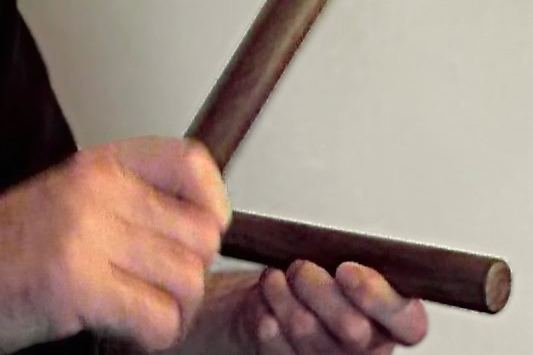
The player rests one clave on the fingertips of the weaker hand and cups the palm beneath it. The cupped hand forms a small resonating chamber. The stronger hand holds the second clave near one end, as it would hold a drumstick, and strikes the resting clave in its center. Cuban players call the striking stick el macho and the resting stick la hembra. The bright, dry click carries over a whole dance band. The recordings below have wooden claves struck once and then several times.
Charts usually write clave across two bars of two-two time. This meter is called cut time. The grid shows the same rhythm in one bar of four beats. A beat is divided into four sixteenths.
Son clave has a stroke on beat one and on the last sixteenth of beat one. The next stroke falls on the half beat after beat two. The two side has a stroke on the half beat after beat three and one on beat four.
Hear the pattern twice on the piano. The second version adds a low note on the beat.
Rumba clave moves the third stroke one sixteenth later. The stroke falls on the last sixteenth of beat two. The other four strokes stay where they are.
Cuban rumba is a family of drum, song and dance styles. Afro-Cuban workers created it in the poor neighborhoods of Havana and Matanzas in the nineteenth century. Its three main styles are yambú, guaguancó and columbia. Rumba clave is the guide pattern of rumba. Its triple form, with three pulses to a beat, can be traced to the iron bell of the Abakuá societies. That bell is called the ekón. The Abakuá are secret societies of Afro-Cuban men. Some rumba groups in Havana still play son clave for yambú. The son probably took its clave from rumba when the son moved from eastern Cuba to Havana early in the twentieth century.
A song in 3-2 clave starts its chord pattern on the three side. A song in 2-3 clave starts on the two side. The strokes stay the same, and only the starting point changes.
Arrangers of Cuban dance music write all the parts with the clave in mind. The melody, the bass, the piano figure and the breaks all line up with its two sides. Music that does this is said to be in clave. A part that crosses the two sides by mistake is heard as out of clave. Most salsa is in 2-3 clave. Cuban folk musicians do not use the terms 3-2 and 2-3 at all, and many Cuban popular musicians do not use them either.
The three side of son clave is the tresillo, which is a figure of three strokes. It divides eight sixteenths into groups of three, three and two. Tresillo is one of the basic rhythm figures of Latin American music.
The tresillo runs through the habanera of nineteenth-century Cuba and through the bass lines of many later styles. The danzón was the first written Cuban music built on the clave rhythm. Its composers set the pattern down in notation in the nineteenth century, long before the first recordings. Clap the tresillo first. When it is steady, add the two strokes of the other side, and the tresillo becomes son clave.
Son clave and rumba clave also have a triple form. In this form the beats divide into three pulses in place of four, and musicians write it in twelve-eight or six-eight time. The two forms count their strokes on the same beats. Only the spacing inside the beats changes. Columbia, one of the three main styles of rumba, uses rumba clave in its triple form. The seven-stroke bell pattern of much African and Afro-Cuban music contains the strokes of both claves. Some musicians call it the six-eight bell.
Clave is the core of many Cuban styles, among them son, rumba, mambo and salsa. Its roots lie in the music of sub-Saharan Africa, and Cuban music gave it a standard form.
The patterns that Cubans call son clave and rumba clave are two of the most common bell patterns in sub-Saharan Africa. Enslaved Africans brought them to Cuba and Brazil. Musicians in the western Cuban cities of Havana and Matanzas first played the pattern on claves. In Brazil the same pattern sounds on the bell in maculelê and in some candomblé rhythms. In the United States it is known as the hambone rhythm. The guitar parts of highlife in Ghana and Nigeria use a closely related figure.
Play the Afro-Cuban piece below and count four steady beats with it. Tap the beats lightly on your knee. In a Cuban band the claves sound as a sharp click above the drums. Many pieces leave the claves out. The clave still guides the music, and the piano, the bass and the drums line up with it.
Clap son clave in 3-2 against the music. If your strokes clash with the melody, start again on the other side and clap 2-3. Keep the side that fits the phrases of the melody. Next, clap rumba clave and listen to how the later third stroke changes the feel.
Music: Envato
Count four steady beats and clap the clave over them. Begin slowly, and say the strokes as you clap. If you have claves, hold them as the sound section shows. Rest one stick in your cupped hand. For practice, a pair of wooden spoons gives a similar click.
The clap mirror is a clapping test. It plays a steady click at seventy-two, ninety-two or one hundred twelve beats per minute. It shows how early or late your claps come. Clap the beat there first, so that the pulse is secure before you add the clave.
Clap with the beat. The site shows how early or late a clap came in thousandths of a second.
A clave is the five-stroke rhythm at the center of much Cuban music. The same word means the two wooden sticks that play it.
Clave means key in Spanish. It can also mean code or keystone.
They are the same rhythm with different starting points. In 3-2, the half with three strokes comes first. In 2-3, the half with two strokes comes first.
Only the third stroke differs. In rumba clave it comes one sixteenth later than in son clave.
Tresillo is the first half of son clave. Its three strokes divide eight sixteenths into groups of three, three and two. Clave adds the two strokes of the other half.
Count four beats, and divide them into sixteenths, four to a beat. Say “one e and a” for the first beat and “two e and a” for the second. Son clave falls on beat one and on the “a” of beat one. It also falls on beat four and on the “and” of beats two and three.
Most claves are made of a hardwood. Rosewood, ebony and grenadilla are common choices. Some modern claves are fiberglass or plastic.
Rest one clave on the fingertips of your weaker hand and cup the palm beneath it. Hold the other clave near one end, and strike the center of the resting clave with it.
World MusicHabaneraBossa novaMetronomePolyrhythm