Music of Japan
The music of Japan includes gagaku, the ancient music of the imperial court, and the chanting of Buddhist temples. Noh and kabuki theater both have their own music. The koto, the shamisen and the shakuhachi lead the traditional solo and chamber music. Folk songs and taiko drums belong to local festivals across the islands.
A koto and a shakuhachi play this piece together. The koto is a long zither with thirteen strings, and the shakuhachi is an end-blown bamboo flute. The plucked notes of the koto start sharply and soon fade. The flute can hold a note and make it swell with the breath.
Music: Envato (SoundTheLimit)
Gagaku
Gagaku means elegant music. It is the music of the imperial court, and it took its present form about a thousand years ago. Court musicians still perform it at the Imperial Palace in Tokyo. UNESCO lists gagaku as intangible cultural heritage.
Gagaku drew on music from China and Korea, and Japan joined these styles with its own music. Kangen is gagaku for instruments alone. Bugaku is gagaku for dance, and it leaves out the strings.
The shō is a mouth organ of bamboo pipes that holds chords. The hichiriki is a double-reed pipe that carries the melody. The ryūteki is a flute held to the side. In the recording, the hichiriki and the shō play at a wedding in a shrine.
Buddhist chant
Shōmyō is the chanting of Japanese Buddhist temples. Monks sing the sacred texts together. Shōmyō dates from the same early periods as gagaku.
Temple bells
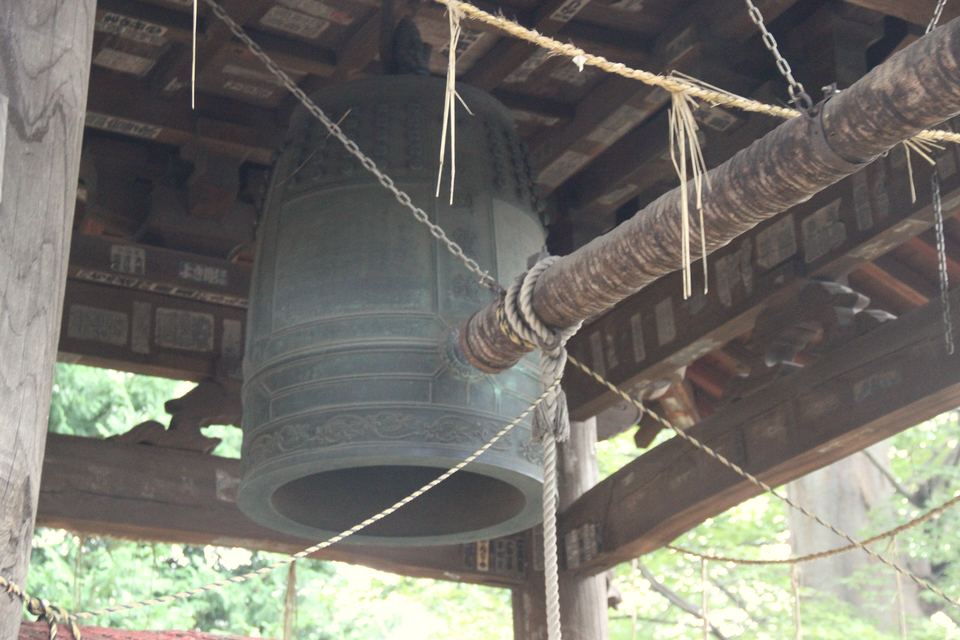
Buddhist temples in Japan hang a great bronze bell called the bonshō (梵鐘). The bell has no clapper inside. A heavy wooden log hangs from ropes beside it, and the ringer swings the log against the outside of the bell. The deep stroke rings for a long time and fades slowly. Temples sound the bell to mark the hours of the day.
On the last night of the year, many temples strike their bell one hundred and eight times. The custom is called joya no kane. The number stands for the worldly desires of Buddhist teaching. In the recording, the evening bell of Mii-dera rings seven times. Mii-dera is a temple near Lake Biwa. Its evening bell is one of the Eight Views of Ōmi, which are classic scenes of the land around the lake.
Music for the theater
Noh is a theater of song and dance. Its lead actor performs in a mask. Its ensemble, the hayashi, has a flute called the nōkan and three drums. The kotsuzumi is held at the shoulder, and the ōtsuzumi rests at the hip. The third drum, the taiko, is played with sticks. A chorus of six to eight singers tells much of the story. In noh, the silences between sounds count as part of the music.
Kabuki theater and bunraku puppet theater use the shamisen. The long songs of kabuki are called nagauta. UNESCO lists noh, kabuki and bunraku as intangible cultural heritage.
The shamisen
The shamisen is a lute with three strings and a long neck without frets. The player strikes the strings with a large pick, or plectrum, called a bachi. The lowest string gives a buzzing sound called sawari.
In the recording, a street musician plays the shamisen at a train station in Sendai.
The koto
The koto is a long zither with thirteen strings over movable bridges. It descends from the Chinese zheng, which China today calls the guzheng. The player plucks with picks on the thumb and the first two fingers.
The guqin is a different zither. It belongs to China, and it has no bridges.
The shakuhachi
The shakuhachi is an end-blown flute of bamboo. It has four finger holes on the front and one on the back. Its name means one point eight shaku. A shaku is an old Japanese unit of about thirty centimeters, so the flute is about fifty-four centimeters long.
Monks of the Fuke sect of Zen Buddhism, called komusō, played it as a form of meditation. Their solo pieces are called honkyoku. The player bends a note down or up by changing the angle of the breath. These two moves are called meri and kari.
Taiko
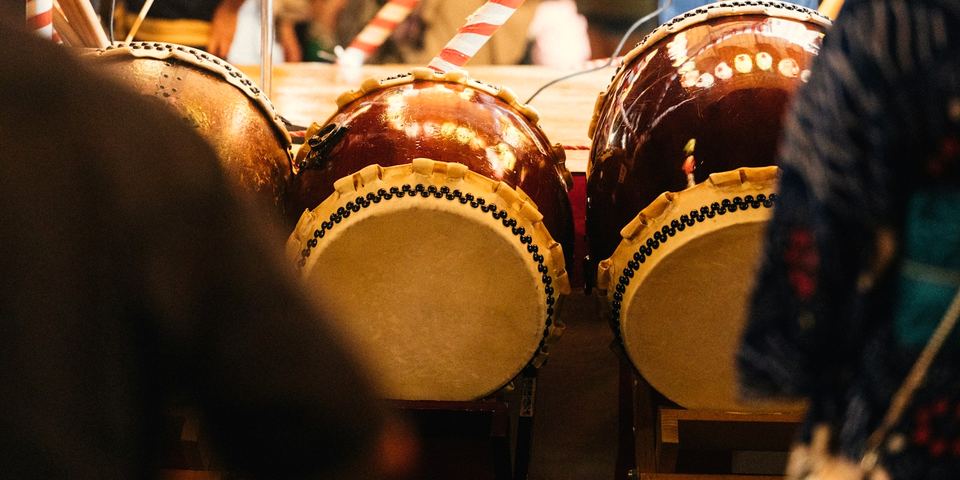
Taiko is the Japanese word for drum. In kumi-daiko, a large group of drummers plays many drums of different sizes together. This ensemble style began in Japan in the middle of the twentieth century. Groups now play it in many countries.
Folk song
Min’yō is the folk song of Japan. It includes work songs, lullabies, festival songs and children's songs. The shamisen, the shakuhachi and the taiko often accompany the singer. An ondo is a folk song with a swinging rhythm. Ondo songs are often heard at the Obon dances.
Okinawa has its own folk music. There the sanshin, a three-string lute, takes the place of the shamisen.
Japanese scales
Much traditional Japanese music uses scales of five notes. A half step is the distance between two neighboring keys of the piano.
The yo scale has no half steps. Starting on D, it uses D, E, G, A and B. Folk songs often use it.
The in scale has two half steps. Starting on D, it uses D, E♭, G, A and B♭. Music for the koto and the shamisen often uses it.
Popular song
Enka is a sentimental popular song style with roots in older Japanese popular song. Japanese media coined the term J-pop for the pop music of Japan in the late twentieth century.
A short check
Choose one answer per question.
What is gagaku?
Gagaku means elegant music. It is the music of the imperial court.
How many finger holes does the shakuhachi have?
The shakuhachi has four holes on the front and one on the back.
Which of the two scales has no half steps?
The yo scale on D uses D, E, G, A and B. The in scale has two half steps: D to E♭ and A to B♭.
Common questions
What are the traditional instruments of Japan?
The koto, the shamisen, the shakuhachi and the taiko are the best known. Gagaku adds the shō, the hichiriki, the ryūteki and the biwa lute.
What is the oldest music of Japan?
Gagaku and the Buddhist chant called shōmyō are the oldest traditions still performed. Both took shape at the early courts and temples.
What is the difference between the koto and the shamisen?
The koto is a zither with thirteen strings over movable bridges. The shamisen is a three-string lute with a long neck, and the player strikes it with a plectrum.
Is the guqin a Japanese instrument?
No. The guqin is a Chinese zither. The long zither of Japan is the koto, which descends from the Chinese zheng.
What music is heard at Japanese festivals?
Local festivals bring taiko drums, flutes and folk songs. At Obon, people dance to ondo songs.
What scales does Japanese music use?
Much of it uses five-note scales. Folk song often uses the yo scale. Koto and shamisen music often uses the in scale, which includes half steps.
Sources
World MusicTaikoString instruments of East AsiaGuzhengLevel 3 course