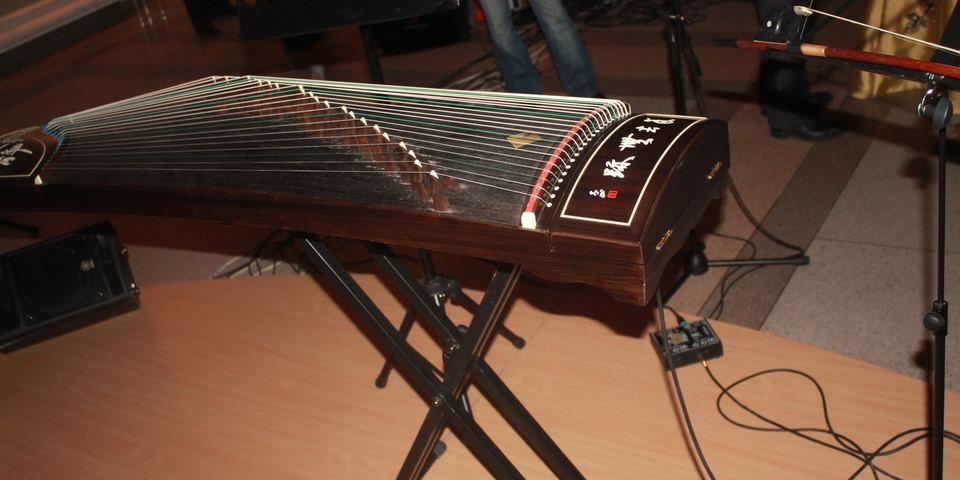
The guzheng
The guzheng is a Chinese plucked zither. A modern guzheng is about one hundred sixty centimeters long and commonly has twenty-one strings. The strings run over movable bridges. The player plucks with fingerpicks and presses the strings beside the bridges to bend the pitch. The strings are tuned to a major pentatonic scale, which has five notes.
The guzheng leads this piece for the Chinese New Year. Listen for the sharp start of the plucked notes and the long ring after them.
Music: Envato (panda-x-music)
The sound of the guzheng
The first two recordings come from a guzheng tuned to the D major pentatonic scale: D, E, F♯, A and B. The last is a single plucked note.
Names of the guzheng
Zheng is the name of the instrument, and guzheng means the ancient zheng. In English it is often called the Chinese zither. It differs from the guqin, which is a seven-string zither with no bridges.
Where the guzheng is played
The guzheng is a Chinese instrument with several regional schools. The northern schools are those of Shandong and Henan. The southern schools are those of Chaozhou, of the Hakka and of Zhejiang.
The role of the guzheng in music
The guzheng plays melody. In the traditional way, the right hand plucks the strings. The left hand presses them beside the bridges to bend, slide and shake the notes. A fast tremolo of the thumb is one of its signature sounds. In modern styles both hands may pluck.
Music for the guzheng
The regional schools have their own pieces and their own styles of ornament. Since the middle of the twentieth century, composers have written new pieces for the guzheng. These use harmony and counterpoint in the left hand.
How the guzheng is made
The soundboard is made of paulownia wood. The strings were once silk and later brass wire. Most are now steel wrapped in nylon. A string rests on its own movable bridge, and moving the bridge changes the pitch of the string.
A modern guzheng commonly has twenty-one, twenty-five or twenty-six strings.
How the guzheng is played
Players pluck with fingerpicks made of plastic, resin or shell. In the traditional way, the picks are worn on the right hand. The left hand presses the strings to the left of the bridges for slides and vibrato.

How the guzheng has changed
The oldest known zheng had thirteen strings. Over the centuries it gained more strings, and its silk strings gave way to brass and then to steel. By the Tang dynasty it was among the most common instruments in China.
The zheng is the ancestor of the Japanese koto, the Korean gayageum, the Mongolian yatga and the Vietnamese đàn tranh.
Choosing a guzheng
A full guzheng needs room and a stand. Most players start on an instrument with twenty-one strings. Check that the soundboard has no cracks, that the bridges stand straight and that the tuning pins hold.
Sources
Common questions
What is the difference between the guzheng and the guqin?
The guzheng has movable bridges under its strings. The guqin has seven strings and no bridges, and inlaid dots on its surface mark the pitches.
What is the difference between the guzheng and the koto?
The koto is a Japanese zither that descends from the Chinese zheng. Most kotos have thirteen strings, while a modern guzheng commonly has twenty-one.
How many strings does a guzheng have?
A modern guzheng commonly has twenty-one strings. Some instruments have twenty-five or twenty-six.
How is the guzheng tuned?
The guzheng is tuned to a major pentatonic scale. The strings have movable bridges, and the player moves a bridge to change the pitch.
What is the guzheng made of?
The soundboard is paulownia wood. The strings are usually steel wrapped in nylon.
What are guzheng picks made of?
Guzheng picks are made of plastic, resin, tortoiseshell or ivory.
World MusicErhuString instruments of East AsiaKalimbaGayageum