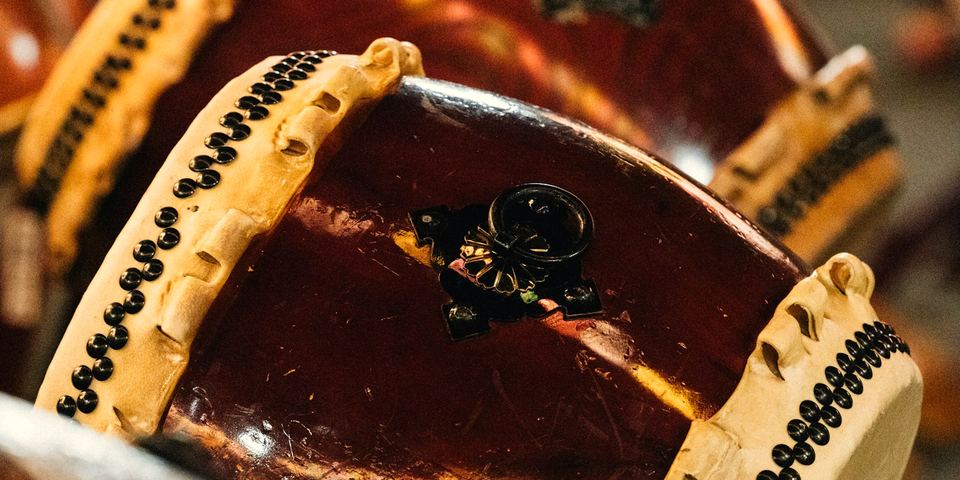
Taiko drums
Taiko are the drums of Japan. In Japanese the word means any drum. Outside Japan it means the Japanese drums and the ensemble style called kumi-daiko. Players strike the heads with sticks called bachi. Taiko play at festivals, in theater and temple music, and on concert stages around the world.
Several taiko drums play this piece together. Listen for the deep strokes and the quicker high strokes above them.
Music: Envato (India_Happy)
The sound of the taiko
The recording is a short performance by a group of taiko drummers.
Names of the taiko
Wadaiko means Japanese drum. Kumi-daiko means a set of drums, and it is the name of the ensemble style. The sticks are called bachi.
Where the taiko is played
Taiko came to Japan through Chinese and Korean influence. Clay figures of the sixth century show a drum played with a stick. Today kumi-daiko groups perform in Japan and in the United States, Canada, Brazil, Australia, Europe and Taiwan.
The role of the taiko in music
In an ensemble the drums have separate parts. The chū-daiko plays the main rhythm. The small shime-daiko sets and changes the tempo. It often plays the jiuchi, the base rhythm that holds the group together. The large ō-daiko gives a steady pulse beneath them.
Players call out shouts called kakegoe. The shouts encourage the other players and give cues for changes.
Music for the taiko
Taiko accompany kabuki, noh and the court music called gagaku. They play at local festivals and in the Bon dances of Buddhist tradition. Kumi-daiko began in the middle of the twentieth century. A drummer arranged a piece for several players on drums of different sizes.
How the taiko is made
The nagadō-daiko is shaped like a wine barrel. Its heads are nailed to the body, so it cannot be tuned. Makers carve the body from the Japanese zelkova, a hardwood, or build it from staves.
The heads are usually cowhide. The shime-daiko is smaller, and its heads are tightened with ropes or bolts, so it can be tuned.
How the taiko is played
Kata is the posture and movement of a player. A common stance is wide and low. The left knee bends over the toes, and the right leg stays straight. The hips face the drum, and the shoulders stay relaxed.
Many performances begin with an oroshi. The player starts with slow strokes and shortens the gap between them until they become a fast roll.
How the taiko has changed
Kumi-daiko groups from Japan began to tour abroad, and groups formed in many countries. In North America taiko became part of the community life of Japanese Americans. Some groups also draw on ideas from Zen Buddhism.
Choosing a taiko
Bachi come in various sizes. They are made of woods such as white oak, bamboo and Japanese magnolia.
A shime-daiko can be tuned, and a nagadō-daiko cannot. Choose a drum by the part you will play in the group.
How taiko is taught
Taiko is taught by ear and by example. Teachers speak the rhythms in syllables called kuchi shōga. Don is a single stroke at the center of the drum. Do-ko is two quick strokes in the time of one don. The right hand plays first, and the left hand follows.
Speak a pattern aloud before you play it. Keep a steady pulse with the metronome, and leave a clear space between strokes. This space is called ma.
A short check
Choose one answer per question.
Which drum often sets and changes the tempo of a taiko group?
The small shime-daiko sets and changes the tempo. It often plays the jiuchi, the base rhythm of the group.
In kuchi shōga, what does don stand for?
Don is a single stroke at the center. Do-ko is two strokes in the time of one don.
Sources
Common questions
What does taiko mean?
In Japanese, taiko means any drum. In English it usually means the Japanese drums or the ensemble style of drumming.
What are taiko sticks called?
Taiko sticks are called bachi. Makers use woods such as white oak, bamboo and Japanese magnolia.
What is an ō-daiko?
The ō-daiko is the largest drum of a group. Some have heads about one hundred eighty centimeters across, and some never leave their temple or shrine.
What is kumi-daiko?
Kumi-daiko is drumming by a group on several taiko of different sizes. The drums play their own parts.
What are taiko drums made of?
Most bodies are carved from wood. The Japanese zelkova is one such wood. The heads are usually cowhide.
Is taiko music written down?
Written scores are rare. Groups teach by ear and through spoken syllables, and the same piece is often played differently by different groups.