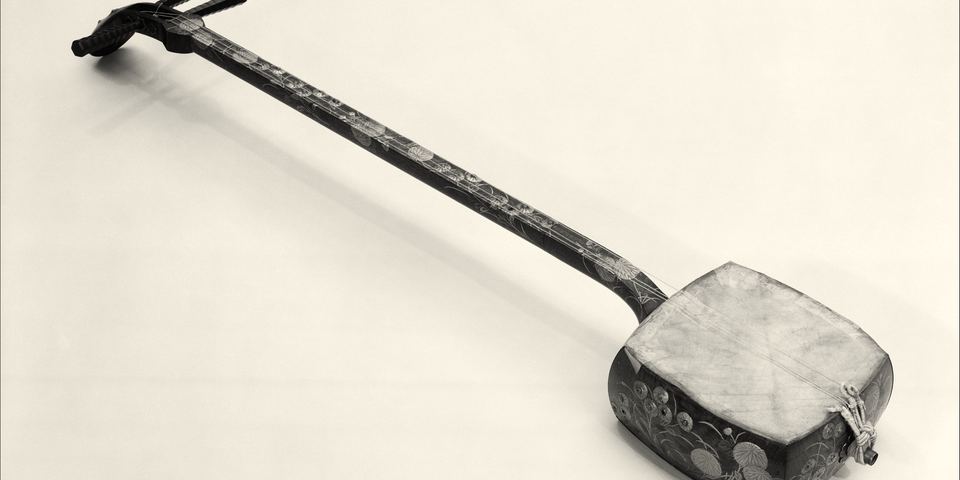
The shamisen
The shamisen is a lute of Japan with three strings. The neck is long and fretless. Like a drum, its body is a wooden frame covered with skin. The player strikes the strings with a large pick, or plectrum, called a bachi. The bachi often hits the skin as well. The shamisen accompanies kabuki theater, puppet plays and folk songs.
This recording plays Tsugaru Jongara Bushi, which is a folk song from the Tsugaru region of northern Japan. It is the best-known piece of the fast shamisen style from that region. Listen for the hard strokes of the bachi. They strike the skin as well as the strings.
Music: Envato (PremiumBeat)
The sound of the shamisen
A street musician plays the shamisen outside the train station in Sendai in the first recording. In places you can hear people talking nearby.
In the second recording a player tries out single plucks and chords on a shamisen. Listen for the sharp attack of the bachi and for the buzz of the lowest string.
Names of the shamisen
Shamisen means three strings. The instrument is also called sangen, which has the same meaning. In western Japan it is called samisen. When another word comes before it, the name can become jamisen, as in tsugaru-jamisen.
Where the shamisen is played
The shamisen belongs to Japan. Its ancestor is the sanxian, which is a three-string lute of China. The sanxian reached the Ryukyu Kingdom in the sixteenth century and became the sanshin there. The Ryukyu Kingdom is now Okinawa. The ancestor of the shamisen probably entered Japan in the same century. It came through the port of Sakai near Osaka.
The role of the shamisen in music
The shamisen plays solo. It also plays with other shamisen and with singers. It accompanies kabuki theater and bunraku, which is the puppet theater of Osaka. In bunraku a narrator speaks all the roles, and the shamisen player answers the turns of the story.
Both men and women have traditionally played the shamisen.
Styles of shamisen music
Nagauta, or long song, is the music of kabuki. Kouta, or little song, is the style of the geisha. Jiuta is a more classical style. Min’yō is folk song.
Tsugaru shamisen grew from folk songs of northern Honshu in the late nineteenth and early twentieth centuries. Its first players were blind musicians who added improvisation and fast fingerwork. The style is sometimes compared to bluegrass banjo, and it now appears in jazz and rock.
How the shamisen is made
The body, called the dō, is a wooden frame with skin on the front and the back. Skins were traditionally animal hide, and synthetic skins are now common. A bridge called the koma rests on the skin.
The neck, called the sao, usually comes apart in three or four pieces. The pegs are long and thin. They were once ivory and are now often wood or plastic. The strings are silk, which professionals use, or nylon, which lasts longer.
How the shamisen is played
The player holds the shamisen across the lap and strikes the strings with the bachi. The bachi often hits the skin too, which gives a percussive sound. In kouta the player plucks with the fingernails, and a shamisen is sometimes even played with a bow.
The lowest string sits lower than the others where it leaves the pegbox. It buzzes against the neck, and this buzz is called sawari. A small cloth band on the left hand helps the fingers slide along the neck.
How the shamisen has changed
Makers now often use plastic for pegs and plectra, because ivory is scarce and its trade is restricted. Many makers have also moved from animal skins to synthetic skins. Some makers have fitted the Tsugaru shamisen with electric pickups for use with amplifiers.
Choosing a shamisen
Choose the neck size for the music you will play. The hosozao, or thin neck, is used for nagauta. The chuzao, or middle neck, suits jiuta and many other styles. The futozao, or thick neck, is used for bunraku and Tsugaru shamisen.
Students usually choose nylon strings and a bridge of bone or plastic. A higher bridge sounds louder but is harder to control, so it is not suited to beginners.
Tuning the shamisen
The shamisen has no fixed pitch. The player tunes it to suit the voice of the singer, and three tunings are the most common.
Honchoushi is the base tuning. The first and third strings lie an octave apart, and the middle string lies a fourth above the first. In C it is C, F and C. Niagari raises the second string to a fifth above the first, which gives C, G and C. Sansagari lowers the third string by a whole step, which gives C, F and B♭.
| Tuning | Meaning | Strings |
|---|---|---|
| Honchoushi | Base tuning | C, F, C |
| Niagari | Second string raised | C, G, C |
| Sansagari | Third string lowered | C, F, B♭ |
First steps on the shamisen
Set the shamisen to honchoushi with the tuner. Strike the open strings in turn with the bachi until the notes sound clear. Next, learn the positions on the neck from tablature. These positions are called tsubo. The styles write their tablature in their own ways, so learn from the tablature of one style first.
A short check
Choose one answer per question.
What makes the buzz called sawari?
The lowest string sits lower than the others where it leaves the pegbox. It touches the neck lightly and buzzes.
In the honchoushi tuning, how far apart are the first and third strings?
Honchoushi tunes the outer strings an octave apart, as in C, F and C. The middle string lies a fourth above the first.
Which neck size is used for Tsugaru shamisen?
Tsugaru shamisen needs force, so it uses the large futozao. The thin hosozao belongs to nagauta.
Sources
Common questions
What is a shamisen made of?
It has a wooden neck and a wooden body covered with skin. Modern skins are often synthetic, and the strings are silk or nylon.
How many strings does a shamisen have?
A shamisen has three strings. Its name means three strings.
What is the difference between the shamisen and the banjo?
Both have a body covered with skin that strengthens the sound. The shamisen has three strings, no frets and a large plectrum called a bachi.
What is Tsugaru shamisen?
It is a fast, virtuoso style of shamisen playing from northern Honshu. It grew from folk song and uses the thick-necked futozao.
How is a shamisen tuned?
It is tuned to suit the singer. The most common tuning, honchoushi, sets the outer strings an octave apart and the middle string a fourth above the lowest.
Is the shamisen hard to learn?
In the first lessons a beginner learns to strike clear open strings with the bachi. The positions on the neck, the tsubo, take longer, because the long neck has no marks. Tablature shows them, but the styles write it differently.