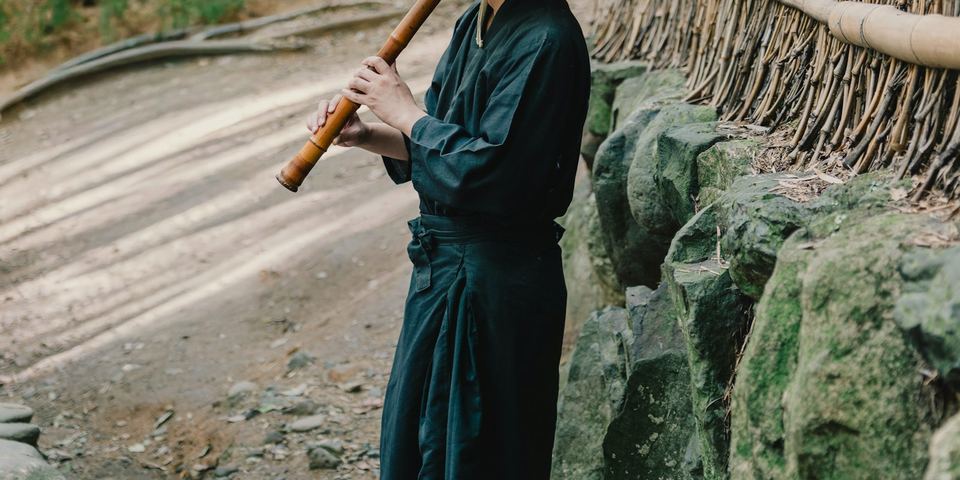
The shakuhachi
The shakuhachi is an end-blown bamboo flute of Japan. The player blows across a sharp edge cut into its top end. The front of the tube has four finger holes, and the back has a fifth. Zen monks of the Fuke sect once played it as a form of meditation. Its name comes from its standard length.
A shakuhachi plays quiet phrases over soft strings. Listen for the pauses between the phrases. Shakuhachi players often shape a phrase to the length of one breath.
Music: Envato (flutist)
The sound of the shakuhachi
The sound of breath is part of the shakuhachi tone. Listen for it inside the long notes.
The first recording is a passage on the shakuhachi. In the second the flute is heard outdoors, and cicadas sound in the background.
Names of the shakuhachi
Shakuhachi means one point eight shaku. The shaku is an old Japanese unit of length of about thirty centimeters. A standard shakuhachi is one shaku and eight tenths long, which is about fifty-four centimeters. Flutes of other lengths share the same name.
Where the shakuhachi is played
The shakuhachi belongs to Japan. An older bamboo flute came to Japan from China in the seventh or eighth century, but it died out. The shakuhachi played today took shape in Japan in the sixteenth century. It is now taught in many countries.
The role of the shakuhachi in music
The shakuhachi plays solo music. It also plays in ensembles with the koto and the shamisen. The koto is a long zither, and the shamisen is a lute with three strings. The shakuhachi also appears in folk music, in jazz and in film scores.
Music for the shakuhachi
Honkyoku are the solo pieces of the Fuke monks. These monks were called komusō. They covered their heads with baskets. They traveled through Japan and played for alms. They paced their pieces by their breathing, and to them the playing was a form of meditation called suizen.
Sankyoku is chamber music for shakuhachi, koto and shamisen. Shinkyoku is newer music for shakuhachi and koto. Much of it shows the influence of Western music. A shakuhachi piece called “Crane’s Nesting” travels on the Voyager spacecraft.
How the shakuhachi is made
A traditional shakuhachi is cut from the root end of madake bamboo. The maker cures the bamboo for years. The bore is then shaped with layers of a paste and finished with urushi lacquer. No two pieces of bamboo are alike, so the flutes are made one at a time by hand.
Shakuhachi are also made of wood and of plastic. Nearly all players prefer bamboo for its tone.
How the shakuhachi is played
The five finger holes give a pentatonic scale, which has five notes. On a standard flute they are D, F, G, A and C, and the scale then returns to D an octave higher. With all holes closed, the lowest note is the D above middle C.
The player changes the blowing angle to bend a note. Meri lowers the pitch, and kari raises it. With these and with half-covered holes, a note can move by a whole step or more. To repeat a note, the player strikes a finger hole quickly. Most Western wind players use the tongue for this.
How the shakuhachi has changed
The government abolished the Fuke sect during the Meiji Restoration. This happened in the second half of the nineteenth century. Playing the shakuhachi was forbidden for a few years, and many honkyoku were lost. When playing was allowed again, the flute first returned as a partner of the koto and the shamisen.
Traditionally, almost all shakuhachi players in Japan were men. Many teachers now report that most of their students are women.
Choosing a shakuhachi
A standard shakuhachi is one point eight shaku long, and its lowest note is the D above middle C. A longer flute sounds lower. A flute of two point four shaku has the A below middle C as its lowest note. Its holes are farther apart, so the fingers must stretch farther.
Bamboo flutes are made by hand and cost the most. Wooden flutes cost less. Plastic flutes cost less again, and heat and cold do not harm them.
First steps on the shakuhachi
The blowing edge comes first. Blow a narrow stream of air across the edge, as you would across the top of an empty bottle. Hold one long note until the tone is steady.
Close all five holes and sound the lowest D. Lift the fingers one at a time to find the notes of the pentatonic scale. Then change the blowing angle to bend a note down. This bend is meri.
A short check
Choose one answer per question.
What do meri and kari do?
Meri lowers the pitch, and kari raises it. The player changes the blowing angle for both.
What does the name shakuhachi describe?
Shakuhachi means one point eight shaku. A shaku is an old unit of length, so the name gives the standard length.
Sources
Common questions
How many holes does a shakuhachi have?
It has five finger holes. The front has four, and the back has one.
What key is a shakuhachi in?
A standard flute of one point eight shaku has D as its lowest note. Longer and shorter flutes sound in other keys.
Is the shakuhachi hard to play?
The first goal is one steady note with all five holes closed. The shakuhachi has no duct like a recorder, so the lips must learn to aim the air at the edge.
What is honkyoku?
Honkyoku is the solo repertoire of the shakuhachi. It comes from the Fuke monks, who played it as meditation.
What is the difference between a shakuhachi and a recorder?
A recorder has a duct that guides the air to its edge, so the player has little control of the pitch. On a shakuhachi the player directs the air and can bend the notes.
What is the utaguchi?
The utaguchi is the blowing edge at the top of the shakuhachi. Its name means the mouth that sings.
World MusicTaikoBansuriPan flutePentatonic scale