The djembe
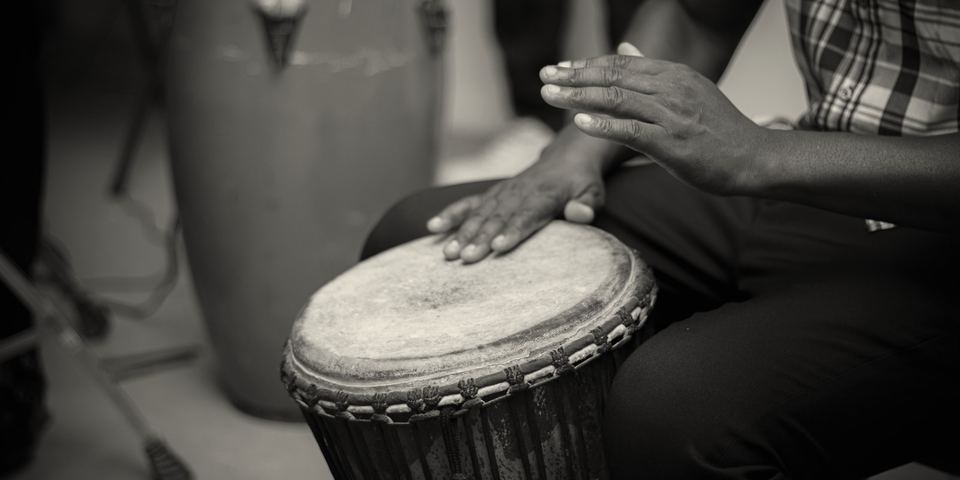
The djembe is a goblet-shaped drum from West Africa. It is carved from one piece of hardwood and covered with goatskin, and ropes pull the skin tight. The player strikes it with bare hands. It gives three basic sounds: a low bass, a middle tone and a sharp, high slap.
Djembes and bells play this piece. More drums join after about twenty seconds. Listen for the three sounds of the djembe. The low bass comes from the center of the skin. The tone and the sharp slap come from near the edge.
Music: Envato (PremiumBeat)
The sound of the djembe
The first recording is a short djembe pattern. The second is a groove on a single djembe.
The last two are single strokes. The bass is struck near the center, and the slap is struck near the edge. Listen for the difference in pitch.
Names of the djembe
Djembe is also spelled jembe. The word comes from the Malinké language. The Bambara of Mali explain it through the saying “Anke djé, anke bé.” It means “Let everyone gather together in peace.”
A djembe player is a djembefola. The word means one who plays the djembe, and it says nothing about skill.
Where the djembe is played
The djembe belongs to the Mande peoples of West Africa. Its home lies in the lands of the old Mali Empire. Today these lands are parts of Guinea, Mali, Burkina Faso, Côte d’Ivoire, the Gambia and Senegal. Since the twentieth century it has spread around the world.
The role of the djembe in music
The djembe plays for dances and village celebrations. Traditionally only men played the djembe and the dunun. Today women also play them, in Africa and abroad.
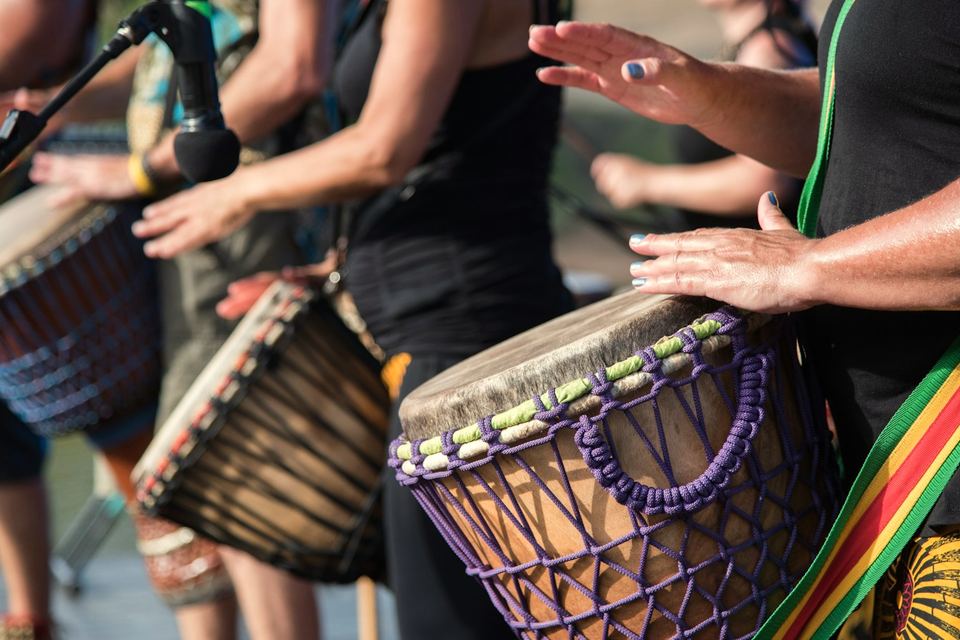
In a traditional group, several djembes and one or more dunun play together. The dunun are barrel drums struck with sticks. The instruments repeat their own patterns, and the lead djembe plays solos over them.
Music for the djembe
The repeating patterns are called accompaniment parts. Most of them repeat after four beats, though cycles of three, six or eight beats are also common. The parts lock together, so the whole group sounds like one rhythm.
The lead djembe plays accents that match the steps of the dancers. The rhythms have their own typical phrases, and the lead player works them into the solo. Skilled players are said to make the djembe talk.
How the djembe is made
The shell is carved from a single log of dense hardwood. Lenke wood is the most prized. Carvers leave shallow grooves inside the bowl, because a smooth inside makes the tone ring too long.
The head is rawhide, most often goatskin. The skin is held between two metal rings at the top of the drum. A rope runs from the top ring to a third ring around the waist of the drum, and pulling it tight raises the pitch. A djembe stands about sixty centimeters tall, and the skin is about thirty to thirty-eight centimeters across.
How the djembe is played
The bass comes from the flat palm near the center of the skin. The tone and the slap come from the fingers near the edge. For the tone, more of the fingers touch the skin. For the slap, only the fingertips and the edge of the palm touch it.
The hands bounce off at once, so the skin rings freely. The bass sounds at about sixty-five to eighty hertz. Hertz is the unit of frequency. A frequency of one hertz means one vibration per second.
How the djembe has changed
After the independence of Guinea, the national ballet of Guinea toured the world. Its drummers made the djembe famous outside Africa. Many djembefolas later taught in Europe, North America and Australia.
Factories in many countries now make djembes. Some have synthetic skins and metal bolts for tuning. Djembe recordings far outnumber those of any other African drum.
Choosing a djembe
A hand-carved djembe from Guinea, Mali, Burkina Faso or Senegal is usually made of a traditional dense wood. Softer woods from machine production are less suitable.
Check the skin for even thickness and the rope for a firm, even pull. A skin of thirty-three to thirty-five centimeters suits most adult players.
First steps on the djembe
Sit on a chair and tilt the djembe slightly away from you, so that the air can leave through the foot. Rest your hands on the skin with the thumbs apart.
Play the bass with a flat palm near the center. Play the tone with straight fingers held together near the edge. Bounce off quickly on all the strokes. The slap comes last, because it is the hardest of the three.
Set the metronome to a slow tempo of about seventy beats per minute. Play bass, tone, tone in groups of three beats, and change hands from stroke to stroke. Keep the sounds clear before you play faster.
A short check
Choose one answer per question. The explanation appears below the correct answer.
Where on the skin does the player strike for the bass sound?
The flat palm near the center gives the low bass. Tone and slap are played near the edge.
Which of the three basic sounds is the highest?
The bass is low, the tone is in the middle, and the slap is the highest.
Which drums play the accompaniment under the djembe in a traditional group?
The dunun are barrel drums played with sticks. They play the low patterns under the djembes.
Sources
Common questions
What is a djembe made of?
The shell is one piece of hardwood. The skin is usually goatskin, and synthetic rope holds it tight.
How do you tune a djembe?
The rope is pulled tighter to raise the pitch of the tone and slap. The pitch of the bass depends on the size of the shell.
What are the three sounds of the djembe?
They are the bass, the tone and the slap. They come from different places on the skin and different shapes of the hand.
Is the djembe good for beginners?
Yes. The bass and the tone come quickly. A clean slap and the fast solo patterns take longer.
What is the difference between a djembe and a conga?
The djembe is a goblet carved from one log and tuned with rope. The conga is a tall barrel drum from Cuba. It is usually tuned with metal hardware.
What size djembe should I buy?
Most adults play a djembe with a skin about thirty-three to thirty-five centimeters across. Smaller drums suit children.