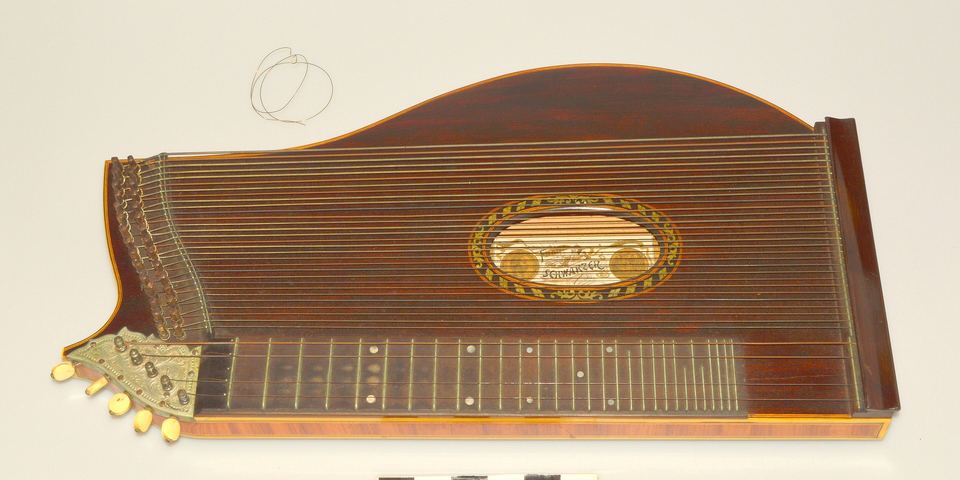
The zither
A zither is a string instrument with many strings stretched across a flat wooden box. It has no separate neck. The concert zither has four or five melody strings over a fretted fingerboard and more than twenty open strings for chords and bass. It lies flat on a table, and the player plucks it.
A pair of zithers plays “The Herd Girl’s Dream” by August Labitzky on this early record. The tune sounds on the fretted melody strings, and the open strings add the chords and the bass.
The sound of the zither
Part of the zither solo in Tales from the Vienna Woods opens the recordings. This waltz is by Johann Strauss II. The second recording is a selection from Carmen played on a zither. It comes from an early phonograph cylinder. The last is an early record of a harp zither, which is a concert zither with extra bass strings.
Names of the zither
The word zither comes from the Latin cythara and the Greek kithara. German printers used the Latin word on books of music for the cittern.
In the study of instruments, zither is also the word for a large family. In a zither, the strings run along the body and do not extend past it.
Where the zither is played
The concert zither belongs to the Alpine lands. It is traditional in Austria, southern Germany and Slovenia, and also in Hungary, the Czech Republic, Slovakia, Poland and Ukraine.
Emigrants from these lands took the zither to North and South America in the nineteenth century.
The role of the zither in music
The zither is a solo instrument that plays the melody, its chords and its bass at once. Early in the nineteenth century, it was a popular folk instrument in Bavaria and Austria, where it was called the Volkszither.
In the United States it was a fashionable parlor instrument in many homes around the turn of the twentieth century.
Music for the zither
Johann Strauss II gave the zither a famous solo in his waltz Tales from the Vienna Woods. A group of composers who were also zither virtuosos wrote concert music for it.
In the middle of the twentieth century, the music for the film The Third Man was played on a single concert zither. Its theme became a best-selling record.
How the zither is made
The melody strings run over a fretboard like that of a guitar. Beside them lie twelve accompaniment strings and twelve bass strings. Several contrabass strings come last. None of these open strings has frets.
The Alpine zither adds an extension to the body. The extension holds the longest contrabass strings and their tuners.
How the zither is played
The zither lies flat on a table, which helps to make it louder. It can also rest on the lap.
The left hand presses the melody strings to the frets, and a plectrum ring on the right thumb plucks them. The first and second fingers pluck the accompaniment and bass strings. The third finger plucks the contrabass strings.
How the zither has changed
Early zithers had a few melody strings and several drone strings. In Munich in the nineteenth century, the zither gained fixed bridges, more strings and a fully fretted fingerboard. This turned a folk instrument into the concert zither.
The Salzburg zither has one rounded side, and the Mittenwald zither has two. The Salzburg shape is now by far the most common.
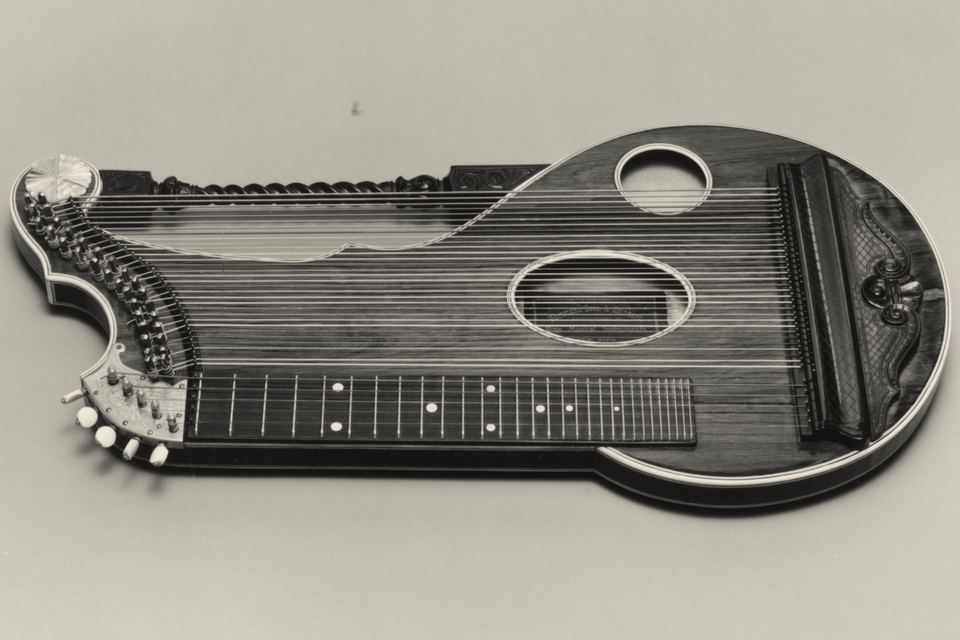
Choosing a zither
Many zithers for sale today are older instruments, because only a few workshops still make new ones. Check the bridge, the frets and the tuning pins before you buy.
Ask whether the instrument uses Munich or Viennese tuning. The chord zither is a different instrument. It has no fingerboard, and all its strings are played open, as on a harp.
First steps on the zither
Begin on the melody strings alone. Press a string to a fret with a fingertip of the left hand, and pluck it with the thumb ring.
Play the C major scale slowly on the fingerboard. Then add one open string for the bass on the first beat of the bar.
A short check
Choose one answer per question.
Which strings of a concert zither carry the melody?
The melody strings, four or five of them, run over a fretted fingerboard. The left hand presses them to the frets.
What does the right thumb wear?
A plectrum ring on the right thumb plucks the melody strings.
Where does the zither usually lie when it is played?
The zither lies flat on a table, which helps to make it louder. It can also rest on the lap.
Which instrument also belongs to the zither family?
In the study of instruments, the zither family includes the guzheng, the koto, the santoor and even the piano.
Sources
Common questions
How many strings does a concert zither have?
A concert zither has from twenty-nine to thirty-eight strings, and thirty-four or thirty-five is most common. An Alpine zither has forty-two.
How is the concert zither tuned?
The common tunings are Munich tuning and Viennese tuning. In both, the accompaniment and bass strings give all twelve notes of the octave in a cycle of fifths.
Is the guzheng a zither?
Yes. The guzheng, the koto and the santoor all belong to the zither family. So do the harpsichord and the piano.
What is the difference between a zither and an autoharp?
An autoharp has bars with felt pads that press across the strings to play chords. It has no fingerboard, so it is closer to the chord zither.
Is the zither hard to learn?
A beginner soon plays simple tunes on the melody strings. Concert pieces add chords and bass, and they take advanced skill.
What is the oldest instrument of the zither family?
The oldest known one is a Chinese guqin found in the tomb of the Marquis Yi of Zeng. It is about two and a half thousand years old.