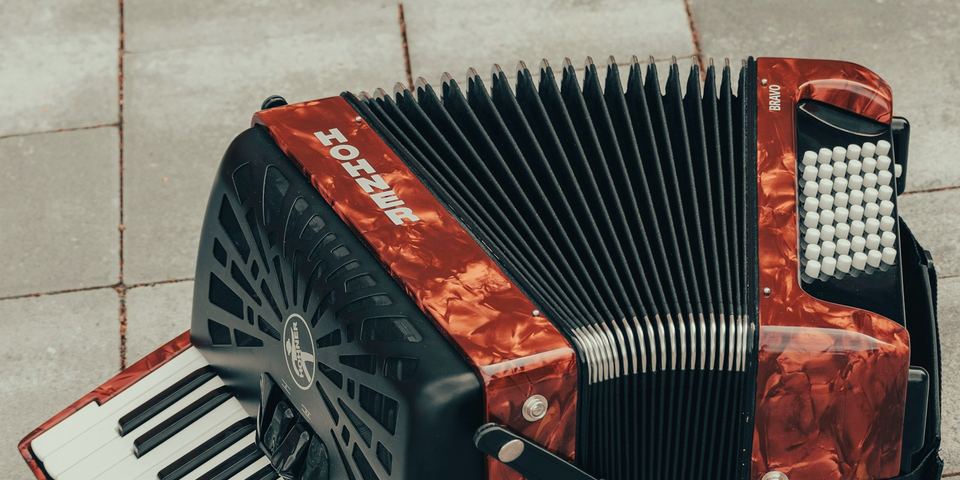
The accordion
The accordion is a box-shaped instrument driven by bellows. When the player pushes or pulls the bellows, air sets metal reeds vibrating inside. The right hand plays the melody on piano keys or buttons. The left hand plays bass notes and ready-made chords on buttons. The accordion plays folk and dance music around the world.
This is a musette waltz for the accordion. Musette is the accordion dance music of Paris. Count three beats to a bar, and listen for the low bass note on the first beat.
Music: Envato (BlackSeaMusic)
The sound of the accordion
A rag played by an accordion soloist on an early disc comes first. Listen for the bass and chords of the left hand below the melody. The surface noise of the old disc remains.
A piano accordion then plays one scale through five registers. The register switches bring in different sets of reeds, so the same notes change color. The bellows alone come next. Shakes, swells and the sound of air show what the bellows can do. A single held C on an old accordion follows.
The last button plays a bass note and its chord on a recorded grand piano. The left hand of the accordion plays this pattern, first on C and then on G.
Names of the accordion
The word comes from the German Akkordeon. Akkord is the German word for chord. An early instrument patented in Vienna sounded a whole chord from a single button. A person who plays it is an accordionist.
The accordion belongs to the family of free-reed instruments. The concertina, the harmonica, the bandoneon and the harmonium are its relatives.
Where the accordion is played
The accordion was invented in central Europe early in the nineteenth century. Makers in Berlin and Vienna built the first models. Emigrants from Europe then carried it around the world.
It became a folk instrument in many countries. It leads the vallenato of Colombia, the norteño music of Mexico, the forró of Brazil and the merengue of the Dominican Republic. In Louisiana it plays in Cajun music and in zydeco, which Creole musicians created.
The role of the accordion in music
In most folk music the accordion is a whole band in one instrument. The right hand plays the tune, and the left hand plays the bass and the chords for dancing.
In Paris the accordion became the lead instrument of musette dance music. In classical music, Berg used it in the opera Wozzeck, and many composers have since written solo works and concertos for it.
Music for the accordion
Accordion music includes waltzes, polkas, tangos, folk dances and popular songs. The concert tangos of Astor Piazzolla were written for the bandoneon, but accordionists play them widely.
Many conservatories in Europe have a department of classical accordion.
How the accordion is made
The body is two wooden boxes joined by the bellows. The bellows are pleated layers of cloth and cardboard. Leather and metal strengthen them. Inside the boxes are blocks of reeds made of brass or steel.
A set of reeds is a reed rank. Register switches combine the ranks, much as stops change the sound of an organ. Larger accordions have more ranks and more switches.
How the accordion is played
The player carries the accordion on straps across the chest. The left arm moves the bellows in and out. All expression comes from the bellows: swells, fades and quick shakes.
The left hand usually plays the Stradella bass. Its buttons are arranged in the circle of fifths. The two rows nearest the bellows play single bass notes. The next rows play major, minor, dominant seventh and diminished chords. A single button sounds the whole chord C, E and G.
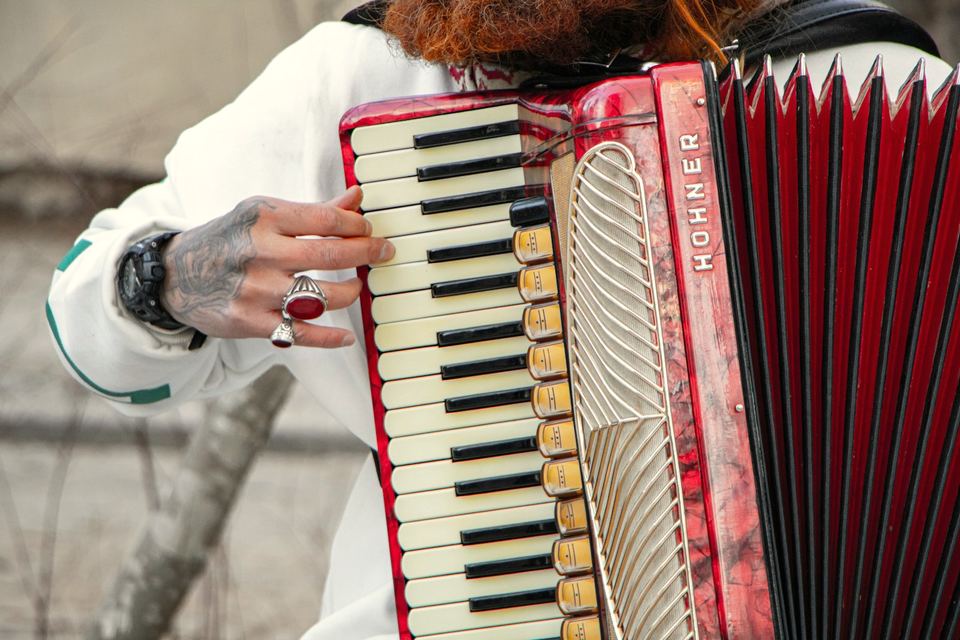
The piano accordion has a piano keyboard for the right hand. The chromatic button accordion, and its Russian form the bayan, have rows of buttons in place of keys.
How the accordion has changed
The first accordions played only chords. Makers soon added a melody keyboard. Diatonic button accordions came first. Their buttons give one note on the push and another on the pull. Such an accordion is called bisonoric.
Later makers built chromatic button accordions and piano accordions. These give the same note in both directions of the bellows and can play in all keys.
Choosing an accordion
Accordions are described by the number of keys or buttons per side. The most common full-size piano accordion has a hundred and twenty bass buttons. A beginner often starts on a smaller model with fewer basses, which is much lighter.
Choose the kind of accordion that suits the music. Piano and chromatic accordions play in all keys. A diatonic button accordion suits the folk music of many regions. Check that the bellows hold air with no buttons pressed.
First steps on the accordion
Fasten both straps so that the accordion sits firmly on the chest. Open the bellows slowly with the left arm while you press one right-hand key. Change direction smoothly at the end of a stroke.
Find the C bass button. It usually has a dimple or a stud you can feel. Play the C bass on beat one and the C major chord button on beat two.
Then play the right-hand C major scale over the bass and chord pattern. Keep the bellows moving at a steady speed with the metronome.
A short check
Choose one answer per question. The explanation appears below the correct answer.
What makes the sound of an accordion?
The accordion is a free-reed instrument. A key or button opens a valve, and air from the bellows sets a reed vibrating.
What do the bass buttons of a Stradella system play?
A bass button plays one note, and the button next to it plays a whole chord. The C major chord, C, E and G, sounds from one button.
How does the accordionist play louder?
The keys do not change the volume. The force of the bellows does.
What is a bisonoric accordion?
Many diatonic button accordions are bisonoric. The bandoneon of tango works the same way.
Sources
Common questions
Is the accordion hard to learn?
The right hand finds the melody quickly on piano keys. The left-hand buttons cannot be seen, so the player learns them by touch, and moving the bellows evenly takes practice.
What is the difference between an accordion and a concertina?
Both are free-reed instruments with bellows. The concertina is small and has buttons on both ends. It lacks the separate bass and chord buttons of the accordion.
What is the difference between an accordion and a bandoneon?
The bandoneon is a square button instrument of the concertina family, and it leads the tango orchestra of Argentina. Most of its buttons give different notes on the push and the pull.
How heavy is an accordion?
Weight depends on the size and the number of reed ranks. A full-size piano accordion is heavy for a child, so young players start on smaller models.
What are the registers of an accordion?
They are switches that choose which sets of reeds sound. Some sets are an octave higher or lower, and some are tuned slightly apart for a shimmering sound.
Is the accordion a keyboard instrument?
The piano accordion has a keyboard, but the sound comes from reeds and air. Experts group the accordion with the free-reed instruments, like the harmonica.