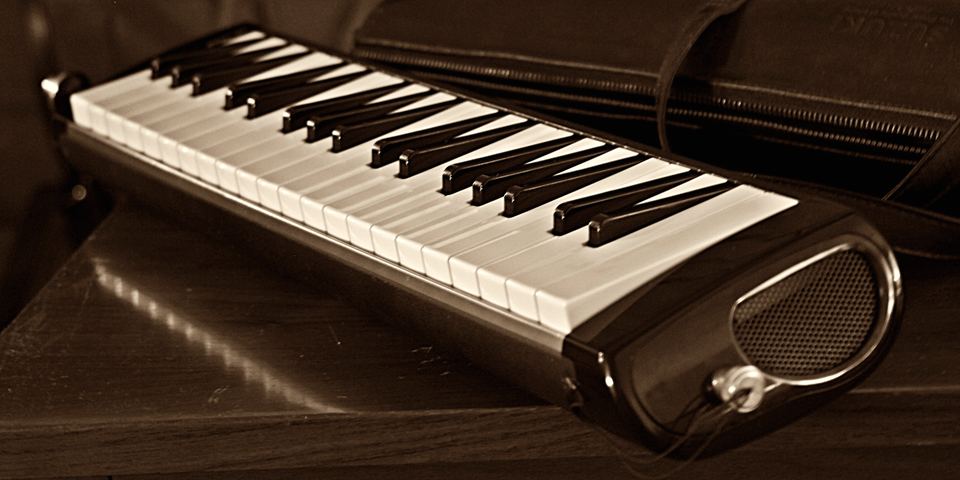
The melodica
The melodica is a small keyboard that you play by blowing into a mouthpiece. When you press a key, air flows past a metal reed and makes it sound. Most melodicas cover two or three octaves. They are light, low in cost and easy to carry, so many schools use them.
A melodica plays this piece with a guitar and a piano. Listen for the reedy tone of the melodica, which comes from the metal reeds inside it.
Music: Envato
The sound of the melodica
The button below plays one held note on a melodica. Listen to the start of the note. The reed takes a moment to start vibrating, so the tone reaches full strength soon after the note begins. It then holds steady for as long as the air flows. The tone is reedy and a little nasal. It is close to the sound of a harmonica or an accordion, because these instruments also use free reeds.
A player changes the sound with the breath. Firmer breath makes a note louder and brighter. A push of air at the start of a note gives an accent. The tongue separates quick notes, as on a recorder. Several keys pressed together sound a chord, and the chord lasts as long as the breath.
Names of the melodica
Melodica was first the trade name of the German firm Hohner. Other makers sell the same kind of instrument under their own names. Suzuki calls it the melodion, and Yamaha calls it the pianica. Other names include the clavietta and the diamonica. In Japan the general term is kenban hāmonika (鍵盤ハーモニカ), which means keyboard harmonica. People often shorten it to kenhamo (ケンハモ).
History of the melodica
Free reeds came to Europe from Asia. The Chinese sheng (笙) is a mouth organ of bamboo pipes, and it is thousands of years old. Its small metal reeds vibrate freely through a slot. European organ builders copied its reeds in small organs. In the early nineteenth century, free reeds led to the harmonica, the accordion and the concertina.
Keyboards sounded by the breath appeared soon after. In France, Philippe-Auguste Kayser patented the piano éolien. It had a piano keyboard, free reeds and a mouthpiece. In this it was much like a melodica today. Inventors in Europe built several more instruments of this kind, but none of them spread widely, and they were soon forgotten.
The modern melodica came from Hohner. This firm of harmonica makers worked in Trossingen in southern Germany. Hohner brought it out in the years after the middle of the twentieth century. Makers in Italy and France brought out the clavietta soon after. At first the melodica spread as an instrument for schools. It was light, cost little and had a piano keyboard, so a whole class could learn melodies on it together.
The melodica reached Japan through imports, and Japanese makers soon built their own. Suzuki brought out the melodion. The Tokai company brought out the pianica, which Yamaha later sold and then built under its own name. The instrument became a standard part of music lessons in Japanese kindergartens and primary schools. Children there carry their own melodica to school.
Professional musicians took it up as well. In the nineteen-seventies the Jamaican musician Augustus Pablo made the melodica a lead voice of reggae and dub. In Ecuador it is heard at the Inti Raymi festival in Otavalo.
Music for the melodica
Augustus Pablo set the model for the melodica in reggae. His melodica lines sound over the deep bass lines of Jamaican rhythm tracks. In dub, the producer adds echo to the melodica, and its notes repeat and fade into the distance.
In the classroom the melodica plays songs, simple pieces and music for ensembles. A class can play in parts, with soprano, alto and tenor melodicas sharing the harmony. In Japan, melodicas also play in children's bands with drums and fifes. Students learn to read notes and to find them on a keyboard at the same time.
Players outside reggae also use the melodica. Some jazz players sing through the instrument while they play, so the voice and the reed sound together. In pop and folk bands its reedy sound adds a color between that of the accordion and the harmonica. The melodica can play a melody and its chords at once, so a single player can accompany a singer.
How the melodica works
A melodica has a keyboard set into a long, narrow case of plastic, wood or metal. Inside the case is an air chamber. Above it lies a reed plate with one reed per key. The reed is a thin metal tongue fixed over a slot. It is called a free reed because it swings back and forth through the slot without striking anything.
The keys work valves. At rest the valve covers its reed. When the player presses the key, the valve opens, and the breath in the chamber flows through that reed and makes it vibrate. The length and thickness of the tongue set its pitch. The melodica sounds only when the player blows. Unlike the harmonica, it makes no sound when the player draws in air.
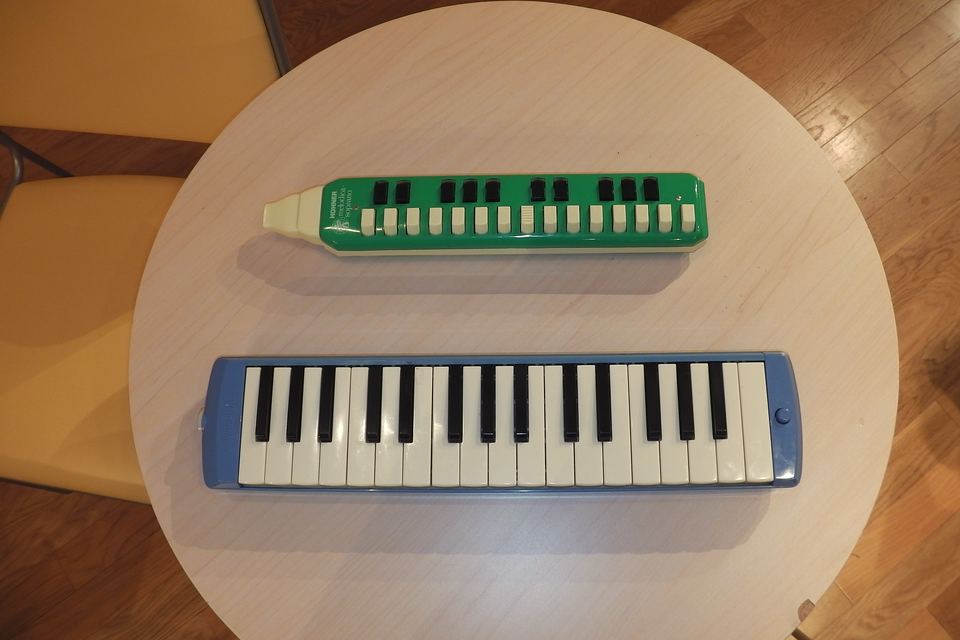
Melodicas come in several ranges. Soprano and alto models sound higher and thinner. Tenor models sound lower and fuller, and bass models also exist. Most keyboards start on a low F and have thirty-two or thirty-seven keys. Some soprano models are played with two hands. The left hand plays the black keys, and the right hand plays the white keys.
How the melodica is played
Players hold the melodica and blow into a short mouthpiece at the end. With a long flexible tube, they can lay it flat on a table and play with both hands. Some players use a foot pump in place of the breath.
The keys follow the layout of the piano, so piano lessons help melodica players. Beginners usually hold the melodica in the left hand and play with the right hand. They start in a five-finger position. The five fingers rest over the five keys from C to G. The breath needs to stay steady through a phrase. Players breathe at the ends of phrases, as singers do.
What makes a fine melodica
The reeds shape the tone. A fine melodica has reeds that start at a light breath and stay in tune when the player blows harder. The reed plate must be fixed firmly, so that no air leaks around the reeds. The reeds sound through the shell of the instrument, so the material of the shell colors the tone.
The action must be airtight and quiet. The valves under the keys should close firmly, so that no reed sounds when its key is up. The keys should move evenly and return without clicks. A well-made melodica plays in tune across its whole range.
Professional melodicas are larger and heavier than school models. Some have bodies of wood or metal. Some have a microphone built in, so that the player can connect the melodica to an amplifier on stage. A wider range of keys lets the player use both hands for melody and chords.
Choosing a melodica
Choose a melodica with both a short mouthpiece and a long tube. Ask the teacher how many keys the class uses. A common student melodica has thirty-two keys. They run from the F below middle C to the C two octaves above middle C.
Play the keys one at a time to check that all the reeds sound and that no key sticks. After playing, wash the mouthpiece and the tube in warm water and let them dry. Store the melodica in its case. An alto melodica suits most beginners. Tenor and bass models suit players who want a fuller, lower sound.
Who keeps these instruments
The German Harmonica Museum in Trossingen keeps the history of Hohner and its instruments. The town grew up around the Hohner factories, where harmonicas, accordions and melodicas have been made for generations. Members of the Hohner family still support the museum.
In Japan, the melodica is above all a school instrument. Makers such as Suzuki and Yamaha build school models in large numbers. New classes of children learn their first melodies on them. The Museum of Making Music in Carlsbad, California, has shown the history of reed instruments. Its exhibition traced them from the sheng to the harmonica and the accordion.
First steps on the melodica
Fit the short mouthpiece, and hold the melodica in your left hand with the keys facing you. Find middle C. On a thirty-two-key melodica it is the lowest C on the keyboard. Blow gently and steadily, and press one key at a time.
Play the five notes from C to G up and down. Use fingers one to five of the right hand. Start the notes with a soft tongue, as on a recorder. Then play the opening of Ode to Joy, which uses only these five notes. When you add the long tube, lay the melodica on a table and play with both hands.
A short check
Choose one answer per question.
What makes the sound of a melodica?
A key opens a valve. The breath then flows through a metal reed and makes it vibrate.
What happens when you breathe in through a melodica?
The melodica sounds only when you blow. A harmonica sounds on both the blow and the draw.
Which other instruments use free reeds?
The harmonica, the accordion and the melodica are all free-reed instruments.
Why can a melodica lie flat on a table?
With the long tube in the mouthpiece, the player can lay the melodica flat and play with both hands.
Sources
Common questions
Is the melodica a wind instrument or a keyboard?
It is both. You choose notes on a keyboard, and your breath makes the sound. Books group it with the free-reed instruments, which include the harmonica.
Can you play chords on a melodica?
Yes. Press several keys at once and blow, and all their reeds sound. The chord lasts as long as your breath.
Why do schools use the melodica?
It costs little, weighs little and has a keyboard like a piano. A whole class can learn note names and melodies on it at the same time.
Where does the melodica come from?
Its modern form comes from the Hohner company in Germany. Earlier keyboards played with the breath were made in France and elsewhere in Europe in the nineteenth century.
How do you play a melodica on a table?
Attach the long tube to the mouthpiece and lay the melodica flat. You can then play with both hands, as on a piano.
Who made the melodica famous in reggae?
The Jamaican musician Augustus Pablo made it a lead voice of reggae and dub in the nineteen-seventies.
What is a pianica?
Pianica is the name Yamaha uses for its melodicas. In Japan the word is often used for any melodica.