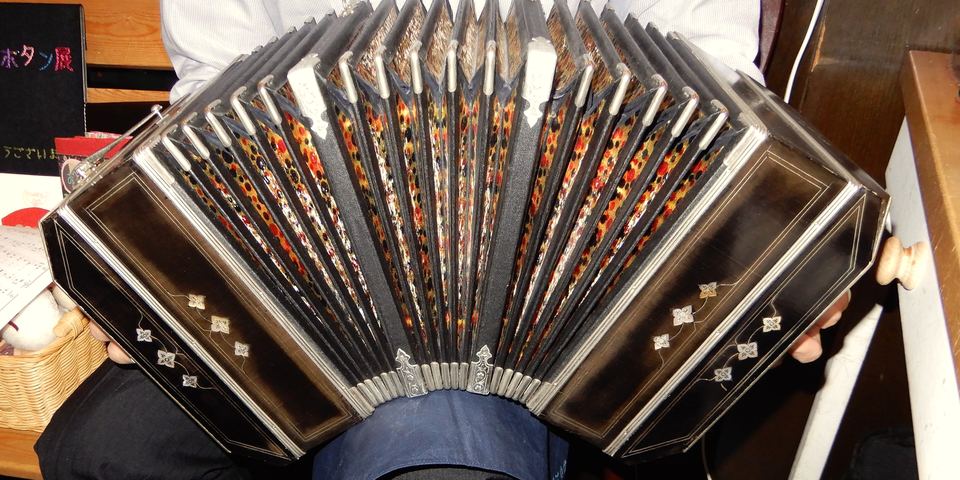
The bandoneon
The bandoneon is a button concertina with bellows and metal reeds. It is the main instrument of the tango orchestras of Argentina and Uruguay. Most buttons give one note when the bellows open and another when they close. The left side sounds muted and nasal, and the right side sounds bright.
A bandoneon and a guitar play this tango. Listen for how the bandoneon notes swell and fade. The player shapes the notes with the pressure of the bellows.
Music: Envato (soundartmusic)
The reeds of the bandoneon
The reeds of the left hand sit inside a wooden box. This box gives the left side a muted and nasal tone. The right side sounds bright and sharp.
The player shapes the notes with the pressure of the bellows. A change of pressure makes a note louder or softer.
The recording is an early record of a tango quartet, and the bandoneon leads it. The old disc adds some surface noise.
Names of the bandoneon
The German instrument dealer Heinrich Band gave the bandonion its name. Bandoneon is the usual English spelling, and bandoneón is the Spanish spelling. Its players are called bandoneonists.
Where the bandoneon is played
The bandoneon was first made in Germany for religious and popular music. German and Italian emigrants and sailors probably brought it to Argentina. There it joined tango, which was a young music of the region of the Río de la Plata. It also plays in chamamé.
The role of the bandoneon in music
The tango orchestra is called the orquesta típica. In it, the bandoneons form a section of their own. Earlier tango sextets used two bandoneons. Their style laid the base for the later bandoneon sections.
Music for the bandoneon
Tango grew from the earlier milonga. Most tango ensembles use the bandoneon. Many tango players play almost entirely while pulling the bellows open. Between phrases they press the air button and close the bellows quickly. The air button lets air pass without sounding a note.
How the bandoneon is made
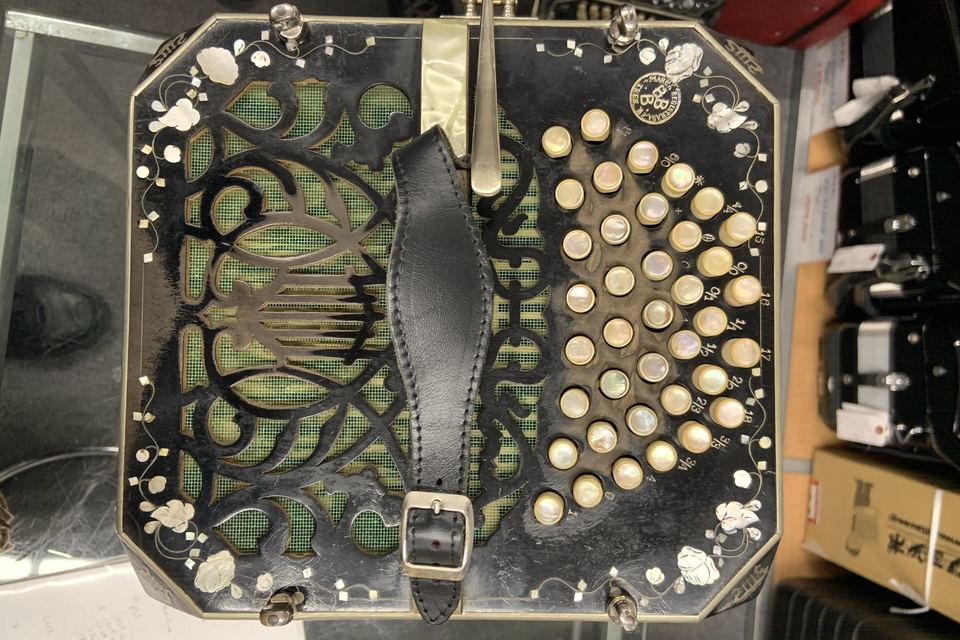
A bandoneon has two wooden ends joined by bellows. Both ends carry buttons, and the buttons open valves to tuned metal reeds.
The bandoneon usually has no register switches, which most accordions have. The same sets of reeds always sound. The fingers press the buttons in the same direction as the bellows move.
How the bandoneon is played
The player holds the bandoneon between the hands and pulls and pushes the bellows. Most buttons give one note on the pull and another on the push. Either hand has one layout on the pull and another on the push. The player therefore learns four layouts.
The common tango system has seventy-one buttons and one hundred forty-two notes. Some variants give the same note in both directions. They are called unisonoric bandoneons.
How the bandoneon has changed
Bandoneons were made in Germany for the markets of Argentina and Uruguay. Demand for the bandoneon fell, and the Second World War disrupted German manufacturing. Mass production then came to an end. Over the following decades, old bandoneons became rare and costly.
Choosing a bandoneon
Check the system before you buy. Most tango music is written for the bisonoric system, in which a button gives two notes. That system has seventy-one buttons. Unisonoric and hybrid instruments are meant to be easier to learn. Some tango passages are harder on them.
Many bandoneons for sale are old German instruments. Ask a repairer to check the bellows, the reeds and the valves.
Different notes on the push or the pull
On a bisonoric bandoneon, a button opens the way to two sets of reeds. The first set sounds when the bellows open on the pull. The second set sounds when they close on the push. The same button therefore gives two notes.
The player must know the direction of the bellows as well as the button. This is why the four layouts take time to learn.
The bandoneon is a free-reed instrument, like the melodica and the shruti box. In all of them, moving air makes a thin metal reed vibrate.
First steps on the bandoneon
Learn the notes of the pull first, because tango players use the pull for most of their playing. Practice closing the bellows quickly with the air button between phrases. Then learn the notes of the push.
A short check
Choose one answer per question.
What does a standard bandoneon button do on the push and on the pull?
The standard bandoneon is bisonoric. A button gives one note when the bellows open and another when they close.
Which tango ensemble has a section of bandoneons?
The orquesta típica is the tango orchestra. Its bandoneons form a section of their own.
Sources
Common questions
What is the difference between a bandoneon and an accordion?
The bandoneon is a concertina. Its buttons sit on the two ends, so the fingers press them in the same direction as the bellows move. It usually has no register switches, and most of its buttons give two notes.
Where does the bandoneon come from?
It was developed in Germany. Emigrants and sailors took it to Argentina and Uruguay, where it became the main instrument of the tango orchestra.
Why is the bandoneon hard to learn?
The buttons give different notes on the push and the pull. The two hands also have different layouts, so there are four layouts to learn.
How many buttons does a tango bandoneon have?
The usual tango bandoneon has seventy-one buttons. Together they give one hundred forty-two notes.
What is a chromatic bandoneon?
It is a unisonoric bandoneon, which gives the same note on the push and the pull. It was designed from the start to play in all keys.
Is the bandoneon still made?
Mass production ended in Germany, so most instruments in use are old. Some workshops still make and repair bandoneons.
World MusicMelodicaShruti boxHabanera rhythmTuner