Indonesian music
Indonesian music includes the gamelan ensembles of Java, Bali and Sunda. It also includes kroncong, a style that grew from Portuguese guitars, and dangdut, a popular style with roots in Indian and Arabic music. The Sundanese people of West Java play the bamboo angklung. Rote island has the sasando, a plucked string instrument.
Gamelan instruments play this piece over a steady beat. Gamelan is the ensemble music of Java and Bali, and most of its instruments are tuned gongs and metal bars. Near the middle of the piece, the low parts stop for about fifteen seconds. The high parts play on alone. Listen for the fuller sound when the low parts return.
Music: Envato (FASSounds)
Gamelan
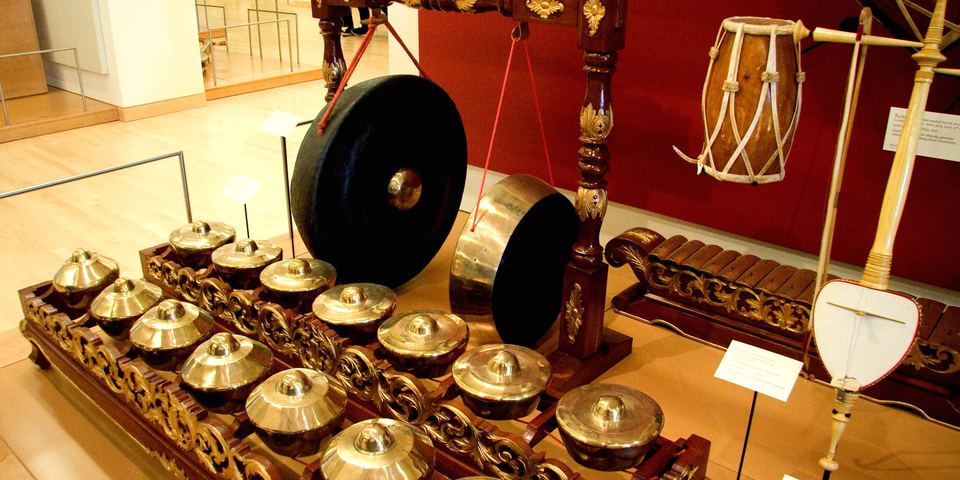
Gamelan is the traditional ensemble music of the Javanese, Sundanese and Balinese peoples. Players strike metal bars and gongs with mallets, and kendang drums keep the beat. Gongs of different sizes mark the cycles of the pieces.
Javanese gamelan uses two tuning systems. Sléndro has five notes in the octave, and pélog has seven. Balinese instruments are built in pairs tuned slightly apart, so their notes shimmer.
Kroncong
Kroncong grew from the guitars of Portuguese sailors and settlers. It developed in the port cities of Java. These include Jakarta, Semarang and Surabaya.
A pair of small instruments related to the ukulele gives kroncong its sound. The cak is strummed, and the cuk is plucked in broken chords. A cello is plucked quickly for rhythm, and a bass plays a few low notes. A flute and a violin add the introduction and ornaments. The singer holds a slow melody over the faster accompaniment.
Dangdut
Dangdut is one of the most popular styles of music in Indonesia. It grew from Malay bands and draws on Hindustani music, Indian film songs and Arabic music. It first appeared on Java.
Its name imitates the sound of its drum: dang and dut. A singer leads a group of four to eight players. The group may include drums, flute, mandolin, guitars and keyboards. People sing dangdut at karaoke and at family celebrations.
The angklung
The angklung is a bamboo instrument of the Sundanese people of West Java. The player shakes it, and an angklung sounds only one note. A group of players shares the notes to play a melody. UNESCO lists the Indonesian angklung on its Representative List of the Intangible Cultural Heritage of Humanity.
Sundanese music
Jaipongan is a dance music of the Sundanese people of western Java. Its rhythms are complex, and they often change without warning.
Tembang Sunda, also called cianjuran, is a form of sung poetry from Cianjur. The kacapi zither and the suling flute accompany the singer. In some pieces the rebab joins them. The rebab is a bowed string instrument.
The sasando
The sasando is a plucked string instrument from Rote island in East Nusa Tenggara. Its strings run around a bamboo tube. A fan of dried lontar palm leaves surrounds the tube and works as its resonator.
Common questions
What is the traditional music of Indonesia?
Gamelan is the best-known traditional music of Indonesia. It belongs to the Javanese, Sundanese and Balinese peoples. The regions also have their own songs, dances and instruments. Examples are the angklung of West Java and the sasando of Rote.
What is Javanese music?
Javanese music centers on the gamelan, which accompanies dance, ceremonies and wayang puppet theater. Kroncong grew up in the port cities of Java, and dangdut first appeared on Java as well.
What is Balinese music?
Balinese music is best known for its gamelan. Balinese instruments are built in pairs that are tuned slightly apart. When a pair sounds together, its notes shimmer.
What is the most popular music in Indonesia?
Dangdut is one of the most popular styles. People sing it at karaoke and at family celebrations.
Which Indonesian instrument is played by shaking?
The angklung is played by shaking. It is a bamboo instrument from West Java, and an angklung plays one note.
What are the cak and the cuk?
The cak and the cuk are small instruments of kroncong. Both are related to the ukulele. The cak has steel strings and is strummed. The cuk has three nylon or gut strings and is plucked in broken chords.